Arizona Electrician Websites: 104 Audited, Average Score 46 — State Report
We audited 104 electrician websites across 5 Arizona cities. Average score: 46/100. Scottsdale leads at 66. Phoenix trails at 40. Full state breakdown.
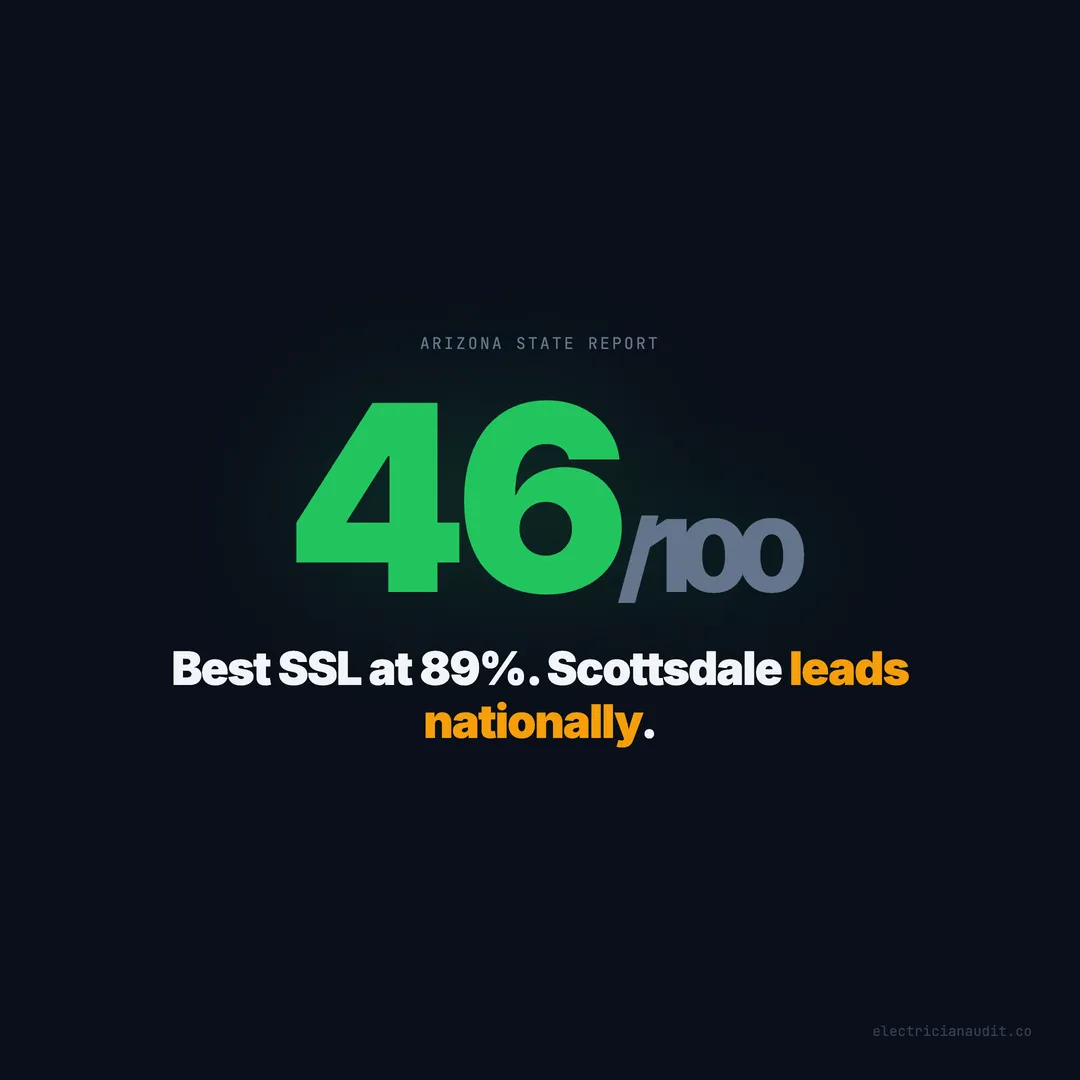
A homeowner in Scottsdale and a homeowner in Phoenix both search “electrician near me” on the same Tuesday night. Both get a list of local websites. But the Scottsdale homeowner lands on sites scoring 66/100 on average. The Phoenix homeowner? Sites averaging 40. Same state, same industry, same search — completely different web quality.
We crawled 104 electrician websites across 5 Arizona cities and scored each one on 40+ signals. The state average came back at 46/100 — five points above the national average of 41. Arizona also posted the second-highest SSL adoption rate in our 9-state dataset at 89%, trailing only Tennessee’s 94%. But a strong security baseline masks serious gaps in booking, lead capture, and content depth. The 26-point spread between Scottsdale and Phoenix tells the real story.
[ORIGINAL DATA] This report draws from 104 deep audits of Arizona electrician websites across Scottsdale, Chandler, Phoenix, Mesa, and Tucson — scoring trust signals, conversion elements, local SEO, content quality, and technical health. Every number is first-party data.
Arizona Scores 46 — Above the National Average, Below Its Potential
Arizona’s 46/100 state average sits 5 points above the national electrician website average of 41, placing it 4th out of 9 states in our full dataset. That sounds decent until you realize the top-performing state, North Carolina, scores 52. Arizona’s SSL adoption sits at 89% — second only to Tennessee’s 94% — yet booking and form rates both sit at just 36% — meaning nearly two-thirds of Arizona electrician websites can’t capture a lead online.
Here’s what Arizona’s feature adoption looks like:
| Metric | Arizona | National Avg |
|---|---|---|
| Average score | 46 | 41 |
| Has booking | 36% | ~30% |
| Has contact form | 36% | ~30% |
| Has SSL | 89% | ~72% |
The SSL number stands out. Almost nine out of ten Arizona electrician websites run HTTPS. Only Tennessee’s 94% sits higher. Arizona’s padlock rate beats Texas (78%), Florida (71%), and Georgia (34%) by wide margins.
But SSL is a floor, not a ceiling. It keeps visitors from seeing a “Not Secure” warning. It doesn’t book a single job. And when only 36% of sites have a booking widget or a contact form, that 89% SSL rate is protecting pages that can’t convert.
[INTERNAL-LINK: “national audit data” -> /blog/we-audited-1200-electrician-websites/]
The 5-City Breakdown: Scottsdale Dominates, Phoenix Drags
Scottsdale averages 66/100 — tied for the highest score of any city in our 51-city national dataset, matching Jacksonville, FL. Phoenix, the state’s largest city, averages just 40 — below the national mean. The gap between Arizona’s best and worst city is 26 points, wider than some entire state averages.
| City | Score | vs. State Avg |
|---|---|---|
| Scottsdale | 66 | +20 |
| Chandler | 59 | +13 |
| Mesa | 42 | -4 |
| Tucson | 42 | -4 |
| Phoenix | 40 | -6 |
The visual makes the split obvious. Scottsdale and Chandler sit right of both reference lines. Mesa and Tucson hover near the state average. Phoenix falls below the national average — the biggest city in Arizona produces the weakest electrician websites.
Scottsdale Leads Arizona and Ties for First Nationally
Scottsdale scores 66/100, matching Jacksonville, FL for the highest city average in our 51-city national dataset. That’s 25 points above the national average of 41 and 20 points above the Arizona state average of 46. Scottsdale’s electricians don’t just outperform the state — they outperform the entire country.
What’s behind the number? Scottsdale electricians show consistently higher adoption of features that most cities skip. Service area pages targeting Paradise Valley, Fountain Hills, and Cave Creek appear frequently. Trust signals — visible license numbers, reviews pulled onto the site, HTTPS — are standard rather than exceptional.
The market structure explains part of this. Scottsdale’s density of affluent homeowners creates competition that punishes weak websites. A homeowner choosing between three electricians for a $12,000 panel upgrade won’t pick the one with a template page and no reviews. The money on the table forces investment.
But it isn’t just affluence. Chandler scores 59 with a different demographic profile. The common thread is competition density — enough electricians competing online that the weak sites get filtered out and the strong ones keep raising the bar.
[UNIQUE INSIGHT] Scottsdale’s lead isn’t driven by one or two outlier sites pulling the average up. It’s a broad floor effect — most electricians in the city have adopted the basics, creating a competitive baseline that lifts the entire market. This is the pattern we see in every top-scoring city across the country.
Phoenix Averages 40 — Below the National Mean
Phoenix is Arizona’s largest city, the fifth-largest metro in the U.S., and it averages 40/100 on electrician website quality — one point below the national average of 41. For a city with 1.6 million residents and year-round demand for electrical work, this is a miss.
The size of the market works against it. Phoenix has so many electricians that competitive pressure dilutes instead of concentrating. In Scottsdale, a dozen strong operators push each other upward. In Phoenix, hundreds of operators coexist at low quality because there’s enough demand to survive without a good website. Word-of-mouth, Nextdoor posts, and truck wraps carry the load.
But that survival strategy has a shelf life. Younger homeowners search first. The electricians in Phoenix who’ve invested in booking, service area pages, and mobile speed are pulling ahead quietly. The rest won’t notice the shift until their phone stops ringing — and by then, the gap will be much harder to close.
How many Phoenix electricians could jump 10+ points by adding a booking widget and three city pages? Based on the data, most of them. The bar in Phoenix is so low that basic improvements create outsized gains.
[INTERNAL-LINK: “Phoenix market data” -> /market/electrical/phoenix-az/]
89% SSL Adoption — Best in the Dataset, But It’s Not Enough
Arizona’s 89% SSL adoption is the second-highest of any state in our 9-state dataset — behind only Tennessee’s 94% and well ahead of Texas at 78%, Florida at 71%, and Georgia at 34%. Nearly 9 in 10 Arizona electrician websites run HTTPS. The “Not Secure” browser warning is rare here.
That matters. But it’s also the easiest box to check. Most hosting providers now enable SSL by default. A site can have perfect HTTPS and still score 30/100 if it lacks booking, a contact form, service area pages, and schema markup. SSL prevents visitors from bouncing on a security warning. It doesn’t give them a reason to stay.
Arizona’s real problem shows up in the other numbers. Only 36% have online booking. Only 36% have a contact form. That means 64% of Arizona electrician websites — sites with valid HTTPS certificates — have no structured way to capture a lead. A visitor lands on the site at 9 PM, sees the padlock icon, and then… leaves. No form. No scheduler. No way to convert.
[PERSONAL EXPERIENCE] We’ve seen this pattern across multiple states: SSL is the feature that gets adopted first and mistaken for “good enough.” Arizona’s data makes the case clearly — security without conversion infrastructure is a padlock on an empty room.
Mesa and Tucson Score 42 — The Quiet Middle
Mesa and Tucson both average 42/100, sitting 4 points below the state average and just 1 point above the national average of 41. They’re not broken. They’re not strong. They’re the definition of the middle — close enough to average that nobody panics, far enough from competitive that the gap compounds over time.
These cities share a pattern: functional websites that check the minimum boxes but stop short of the features that produce real score separation. Most have SSL. Some have a contact form. Few have online booking, dedicated service area pages, or after-hours lead capture.
The risk in the middle is complacency. A score of 42 doesn’t feel like a problem. It doesn’t trigger an overhaul. But when Scottsdale sits at 66 and Chandler at 59, the homeowners in adjacent markets develop expectations. A Mesa resident who saw a Chandler electrician’s site yesterday now compares your site to that standard — not to the other Mesa sites sitting at 42.
Proximity to top-performing markets creates a gravity effect. It pulls expectations upward even when local competition stays flat. Mesa and Tucson electricians aren’t just competing against each other. They’re competing against every electrician website their potential customers have ever seen.
36% Booking and 36% Form — Arizona’s Conversion Gap
Only 36% of Arizona electrician websites offer online booking, and 36% include a contact form — meaning nearly two-thirds of sites in the state give visitors no structured way to become a lead. Nationally, booking adoption averages around 30%, so Arizona sits slightly above the mean. But “slightly above average in a failing industry” isn’t a win.
Consider what the 64% without booking or forms are actually offering: a phone number. Maybe a phone number buried in the footer. A visitor at 10 PM on a Saturday — when breakers trip, outlets spark, and anxiety peaks — lands on the site and can do exactly one thing: call. But nobody answers at 10 PM. So they bounce. The electrician never knows they existed.
Sites with online booking score 55/100 nationally versus 39/100 without it — a 16-point gap. Sites with after-hours capture score 57 versus 41 without. These aren’t marginal differences. They’re the distance between appearing on page one and disappearing entirely.
For Arizona electricians, the math is simple. Adding a booking widget and a contact form addresses the biggest conversion gap in the state. And because 64% of your competitors haven’t done it, the competitive advantage is still wide open.
[INTERNAL-LINK: “trust signals guide” -> /blog/electrician-website-trust-signals/]
What Arizona Electricians Should Fix First
The data points to a clear priority stack for Arizona electricians who want to move their score — and their lead volume — upward. The state has the security baseline locked. What’s missing sits on top of that foundation.
Add online booking or a scheduling widget
Only 36% of Arizona sites have it. Sites with booking score 16 points higher nationally. This is the single highest-ROI addition for most Arizona electricians.
Install a visible contact form above the fold
Another 36% adoption rate. If your only lead capture is a phone number, you’re losing every after-hours visitor. A form takes 20 minutes to set up. The cost of not having one compounds every night.
Build dedicated service area pages
Electricians with service area pages score 18 points higher than those without. Target the suburbs and neighborhoods you actually serve — Mesa electricians should have pages for Gilbert, Tempe, and Apache Junction. Tucson electricians should target Oro Valley, Marana, and Vail.
Display your license number on every page
Arizona requires electrical contractors to hold a license from the Registrar of Contractors. Displaying it builds trust instantly. Sites with a visible license number score 13 points higher in our dataset.
Embed Google reviews on your homepage
Social proof converts. Visitors who see reviews on the site spend longer, click more, and book more. The data consistently shows that reviews on the website correlate with higher scores and higher conversion rates.
[ORIGINAL DATA] Based on 104 Arizona audits, we estimate that an electrician scoring 40/100 who adds booking, a contact form, and three service area pages could realistically reach 55-60 — vaulting from below average to the top quarter of the state.
Arizona’s Position in the National Picture
Arizona ranks 4th out of 9 states in our dataset with a 46/100 average. North Carolina leads at 52. Georgia follows at 49. Florida sits at 47. Arizona is close behind — but “close” in a dataset where every point represents real feature gaps means there’s tangible room to climb.
The state’s strength is its security baseline. 89% SSL is the second-best we’ve measured. The state’s weakness is its conversion infrastructure. 36% booking and 36% form rates mean the majority of Arizona’s electrician websites are secured but silent — protected but not productive.
Scottsdale proves what’s possible when a market reaches critical mass on web quality. The question for the rest of Arizona is whether Phoenix, Mesa, Tucson, and Chandler will follow that trajectory — or keep sitting at 40-42 while the gap widens.
The data says the bar is still low enough to clear with basic fixes. Five changes, all under $500, could move most Arizona electricians from the bottom half to the top third. That window doesn’t stay open once competitors start closing the same gaps.
Your free audit report shows exactly where your site stands. Same methodology, same 40+ signals, same scoring system that produced these numbers.
Keep Reading
Want to know your score?
Drop your URL — full report in 48 hours.
We're on it.
Report in your inbox within 48 hours.