You Have a 4.78-Star Rating. 76% of Electrician Websites Don't Show It.
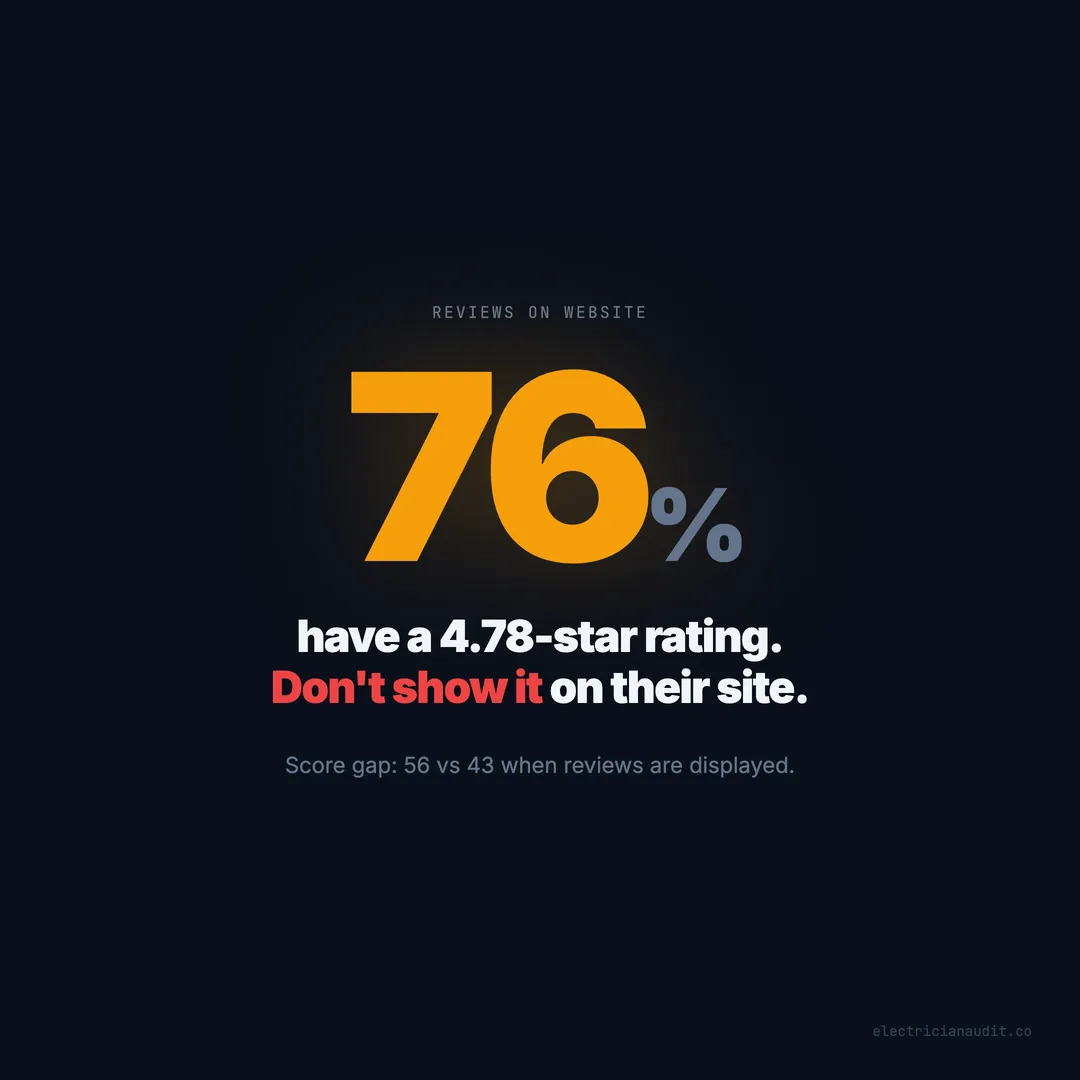
76% of electrician websites hide their Google reviews. Sites that display them score 56 vs 43 — a 13-point gap costing real leads every month.
Mike runs a three-truck electrical company outside of Dallas. He’s been at it for 17 years. His Google Business Profile has 214 five-star reviews, a 4.9 rating, and photos of real panel upgrades he’s done. Homeowners love him. His reputation is flawless.
His website has none of it. No reviews. No star rating. No customer quotes. Just a stock photo of a lightbulb, a phone number, and the word “professional” used five times on the homepage. A homeowner who finds Mike through a Google Ad — not through the map pack — lands on his site and sees nothing that separates him from the unlicensed handyman two search results below.
Mike isn’t unusual. When we audited 1,200+ electrician websites across 9 states, 76% didn’t display a single review on their website. The average Google rating across our dataset was 4.78 stars. Electricians have some of the best reputations in home services — and three out of four are hiding that reputation from anyone who doesn’t check Google Maps first.
This post breaks down what that costs. Every number comes from our audit data.
76% of electrician websites hide their best marketing asset
Three out of four electrician websites in our 1,200-site audit display zero Google reviews on-site, despite an industry-wide average rating of 4.78 stars (electricianaudit.co, 2026). That’s the definition of a wasted asset — great reputation, invisible proof.
Reviews aren’t a nice-to-have sidebar widget. They’re conversion fuel. When a homeowner lands on your site from a Google Ad, a Facebook post, or a direct referral link, she doesn’t see your Google Business Profile. She sees your homepage. And if your homepage has no social proof, she has to open a new tab, search your business name, find your reviews, read them, then navigate back.
Most won’t bother. They’ll pick the next electrician whose website showed the proof up front.
[ORIGINAL DATA] Of 1,390 electrician websites audited across 51 cities, only 24% embedded any form of Google review on their website. The remaining 76% relied entirely on the Google Business Profile — a platform visitors from paid ads, social media, and direct links never see.
The “But they can just check Google” trap
This is the most common objection. Sure, your Google reviews exist. But the homeowner who clicked your ad already left Google. She’s on your site now. Asking her to go back to Google to verify you isn’t a minor inconvenience — it’s a conversion leak.
Every click away from your site is a chance she finds your competitor instead. Every tab she opens dilutes her intent. By the time she’s read your reviews on Google, she’s also seen three “People also search for” suggestions. You’ve effectively handed her back to the competition.
If you’re already spending money on Google Ads, this matters even more. You paid $25-$50 for that click. Then you sent her to a website that forces her back to Google to trust you. That’s not a marketing strategy. That’s a leak.
Sites showing reviews score 56 vs 43 — a 13-point gap
The data is clean on this one. Electrician websites displaying reviews on-site averaged 56/100 in our audit. Sites without reviews averaged 43/100 — a 13-point gap (electricianaudit.co, 2026). Same industry. Same services. Different trust architecture.
That 13-point difference isn’t random. Sites that embed reviews tend to have more intentional web presence across the board — but the review display itself signals something powerful to visitors. It says: “Real people hired us and liked it enough to say so publicly.”
This mirrors the license number gap we found in the same dataset. Sites displaying a license number scored 54 vs 41 — almost the same 13-point spread. Reviews and licenses are the two biggest trust levers electricians control, and most are pulling neither.
Why 13 points matters more than it sounds
A 13-point jump at the middle of the scale is significant. It’s the difference between scoring in the bottom half of all electrician websites and landing in the top third. The industry average is 41/100. A site at 56 outperforms roughly 65% of all competitors in our dataset. That gap changes which search results a homeowner trusts enough to call.
[UNIQUE INSIGHT] The 13-point review gap and the 13-point license gap are nearly identical — but only 24% of sites have reviews and only 44% show a license. Sites stacking both signals cluster in the top third of all scores, while sites with neither sit in the bottom half. The compounding effect matters more than either signal alone.
Review count creates the largest score gap in our entire dataset
Electricians with 100+ Google reviews averaged a site score of 61/100. Those with fewer than 20 reviews averaged just 30/100 — a 31-point canyon (electricianaudit.co, 2026). No other variable in our audit produced a gap this large.
Here’s the full breakdown by review count bracket:
| Review Count | Avg Site Score | Sites |
|---|---|---|
| Under 20 | 30 | 412 |
| 20–50 | 42 | 389 |
| 50–100 | 53 | 318 |
| 100+ | 61 | 271 |
It’s not that Google reviews magically improve your homepage. Electricians who actively collect reviews tend to invest more in their digital presence overall. Review count is a proxy for how seriously you treat the online side of your business. But the correlation is undeniable — and the gap is massive.
What 31 points looks like in practice
A site scoring 30 typically has no booking, no service area pages, no click-to-call, no schema markup, and no trust signals. A site scoring 61 usually has most of those things. The 31-point gap isn’t about one missing widget. It’s about an entirely different level of investment in the online experience.
Hidden reviews compound with hidden credentials
Here’s where it gets worse. 56% of electricians don’t display their license number on their website (electricianaudit.co, 2026). Combine that with the 76% hiding reviews, and you’ve got a majority of the industry presenting websites with zero verifiable trust signals.
No license number. No reviews. No “Licensed and Insured” mention. Just a phone number and a promise.
When we isolated sites that display both reviews and a license number, they clustered in the top third of all scores. Sites with neither sat in the bottom half. The combination matters more than either signal alone — trust signals compound.
| Trust Signal Combination | Avg Score | Position |
|---|---|---|
| Reviews + license + insurance mention | Top third (58+) | Outperforms ~70% of sites |
| Reviews only | Mid-range (50-55) | Above average |
| License only | Mid-range (48-54) | Above average |
| Neither reviews nor license | Bottom half (<41) | Below industry average |
Research consistently shows trust signals increase conversion rates by 30-40% for home service businesses. That’s not traffic — it’s the percentage of visitors who actually become leads. On a site getting 500 visits per month, the difference between a 3% and a 4.5% conversion rate is 7 extra leads. At an average job value of $400, that’s $2,800 in monthly revenue from trust signals alone.
[PERSONAL EXPERIENCE] We’ve reviewed hundreds of electrician sites where the owner has a stellar reputation offline and a bare-bones site online. The pattern is remarkably consistent: great work, great reviews, zero on-site proof. The fix takes 15 minutes. The revenue impact compounds monthly.
The homeowner sees your site, not your GBP
This distinction matters most when you’re paying for traffic. Visitors from Google Ads land on your website — not your Google Business Profile. Visitors from Facebook posts land on your website. Visitors from referral links land on your website. Visitors from email signatures land on your website.
The only traffic that sees your GBP reviews automatically is organic search where the map pack shows up. Everything else bypasses your reputation entirely — unless you’ve embedded it on your site.
If you’re wondering why your Google Business Profile and website tell different stories, this is the disconnect.
How to display reviews on your electrician website (free and paid options)
Embedding reviews doesn’t require a developer. Most options take under 15 minutes from start to live reviews. Here are the practical methods, ranked by effort level.
Free: Google reviews embed script
Google’s own reviews can be embedded using a simple JavaScript snippet or iframe. Copy your Google Place ID, paste it into a free embed tool like EmbedSocial’s free tier or Google’s own embed code, and drop it onto your homepage.
Where to place them:
- Homepage — 3-5 recent reviews below the hero section, with your aggregate rating displayed above (“4.8 stars from 200+ reviews”)
- Service pages — reviews mentioning the specific service (panel upgrade reviews on the panel upgrade page, rewiring reviews on the rewiring page)
- Dedicated reviews page — a full review feed pulling from Google automatically
Don’t screenshot reviews and paste them as images. Those look fabricated, don’t update, and can’t be verified. Use a live feed that pulls real data.
Paid: Review management widgets ($10-$30/month)
Tools like Birdeye, Podium, or NiceJob provide review widgets that pull from Google, Yelp, and Facebook simultaneously. They auto-update, match your site’s design, and typically include a review request feature.
The advantage of paid tools is the built-in ask flow. They’ll text customers a review link after the job, follow up if they don’t respond, and route negative feedback to you privately before it goes public. That dual purpose — display reviews and generate new ones — makes the $10-$30/month a strong return.
The minimum viable review display
If you do nothing else, put this on your homepage: your star rating, your review count, and three recent customer quotes with first names. That’s it. Even a static block that says “Rated 4.8 stars from 200+ Google reviews” with three pull quotes beneath it is infinitely better than showing nothing.
The goal isn’t perfection. It’s visibility. Any review display beats no review display.
How to get more 5-star reviews (the ask flow matters)
Most electricians know they should ask for reviews. Few have a system. The difference between an electrician with 40 reviews and one with 200 isn’t talent — it’s process.
The timing window
Ask within 2 hours of finishing the job. Not the next day. Not next week. Right after the homeowner says “looks great” and you’re packing up your tools. That’s when satisfaction peaks. That’s when she’s most likely to act.
The best-performing method we’ve seen is a text message sent from your CRM or a review tool immediately after the invoice is marked complete. It should say something like: “Thanks for choosing [Business Name]. If you’re happy with the work, a Google review helps us a lot: [direct link].” Short. No guilt. Easy to tap.
The direct link trick
Don’t send customers to your Google Business Profile and hope they figure out where the review button is. Generate a direct review link that opens Google with the review box already expanded.
Search “Google Place ID finder,” enter your business name, copy the Place ID, and construct the link: https://search.google.com/local/writereview?placeid=YOUR_PLACE_ID. That link skips every navigation step and drops the customer directly into the review form.
Every extra click between your ask and the review form costs you completions. One tap from a text message to an open review box is the highest-converting flow.
The follow-up for non-responders
About 60-70% of satisfied customers won’t respond to the first ask. Not because they’re unhappy — because they’re busy. A single follow-up 3-5 days later doubles your response rate.
Keep the follow-up short: “Hey [First Name], just checking in after Tuesday’s panel upgrade. If everything’s working well, a quick Google review would really help: [link].” That second touchpoint is where most of the review volume actually comes from.
What not to do
Don’t offer incentives for reviews — Google’s policies prohibit it and they’ll flag your profile. Don’t ask only happy customers — that’s considered review gating and Google penalizes it. Don’t write reviews yourself or have staff post them — the IP patterns are trivially detectable.
The best review strategy is honest and simple: do excellent work, ask every customer once, follow up once, and make the link dead simple.
The trust signal stack separates the top third from the bottom half
Reviews on your website are powerful alone. Combined with other trust signals, they’re a conversion engine. Sites in our audit’s top third consistently displayed three or more of these signals. Sites in the bottom half typically had zero.
Look at the reviews gap: 78% vs 19%. Four out of five top-performing sites embed reviews. Fewer than one in five bottom-half sites do. The license gap is just as stark: 89% vs 31%. The top sites aren’t doing anything exotic. They’re just not hiding their credentials.
The compounding math
Each trust signal alone nudges the score up by 11-14 points. But stacking them doesn’t just add — it multiplies. A site with reviews, a license number, “Licensed & Insured” text, and a service guarantee doesn’t score 41 + 13 + 13 + 14 + 11 = 92. It scores in the high 50s to mid 60s — but it converts at a rate 30-40% higher than the industry average.
That conversion lift is where the real money lives. More calls from the same traffic. More jobs from the same ad spend. More revenue without a single new marketing dollar.
What the credibility stack looks like on a real site
The highest-scoring sites in our audit place trust signals in a specific pattern:
- Header or top banner: “Licensed, Bonded & Insured” badge + license number
- Hero section: Star rating and review count (“4.9 stars from 214 reviews”)
- Below the fold: 3-5 individual review cards with customer first names, dates, and star ratings
- Footer: License number, insurance mention, BBB rating if applicable
- Service pages: Service-specific reviews embedded alongside the content
This isn’t a design trend. It’s a trust architecture that the top-performing sites converge on independently. They arrived at the same pattern because it works.
What hidden reviews actually cost per month
Let’s put a dollar amount on this. A typical electrician website gets 300-600 organic visits per month. Sites without trust signals convert at roughly 2.5% — about 8-15 leads from 500 visits. Sites with visible reviews, a license number, and insurance mention convert at 4-5% — that’s 20-25 leads from the same traffic.
| Metric | Without reviews on site | With reviews on site |
|---|---|---|
| Monthly visits | 500 | 500 |
| Conversion rate | 2.5% | 4.5% |
| Monthly leads | 12 | 22 |
| Avg job value | $400 | $400 |
| Monthly revenue from web | $4,800 | $8,800 |
| Revenue gap | $4,000/month |
That’s $48,000 per year left on the table. Not because the work is bad — the 4.78-star average proves the work is excellent. But because the website isn’t converting the visitors it already gets.
And here’s the part that should genuinely bother you. You already earned those reviews. You already did the hard part. The 214 five-star reviews sitting on your Google profile represent hundreds of satisfied customers who took time out of their day to vouch for you publicly. All you need to do is show that proof on the one place where it matters most — your site.
Your 4.78-star reputation deserves a website that shows it
The average electrician in our dataset has a 4.78-star Google rating (electricianaudit.co, 2026). That’s built over years of showing up on time, doing clean work, and treating people right. It’s a reputation most industries would envy.
But 76% of those electricians keep that reputation locked inside their Google Business Profile. The visitors who matter most — the ones coming from ads, referrals, social media, and direct links — never see it.
You don’t need a redesign. You don’t need a marketing agency. You need 15 minutes.
Add your star rating and review count to your homepage hero. Embed 3-5 recent Google reviews below the fold. Drop your license number in the footer. Add “Licensed, Bonded & Insured” to your header. That’s the stack.
The electricians already showing their reviews aren’t better than you. They just stopped keeping their reputation a secret.
Want to see where your site falls? Check our free audit reports — or see what the top-scoring sites do differently in our full 1,200-site breakdown.
Keep reading
Want to know your score?
Drop your URL — full report in 48 hours.
We're on it.
Report in your inbox within 48 hours.