76% of Electricians Pay Per Click When They Could Pay Per Lead — The LSA Gap
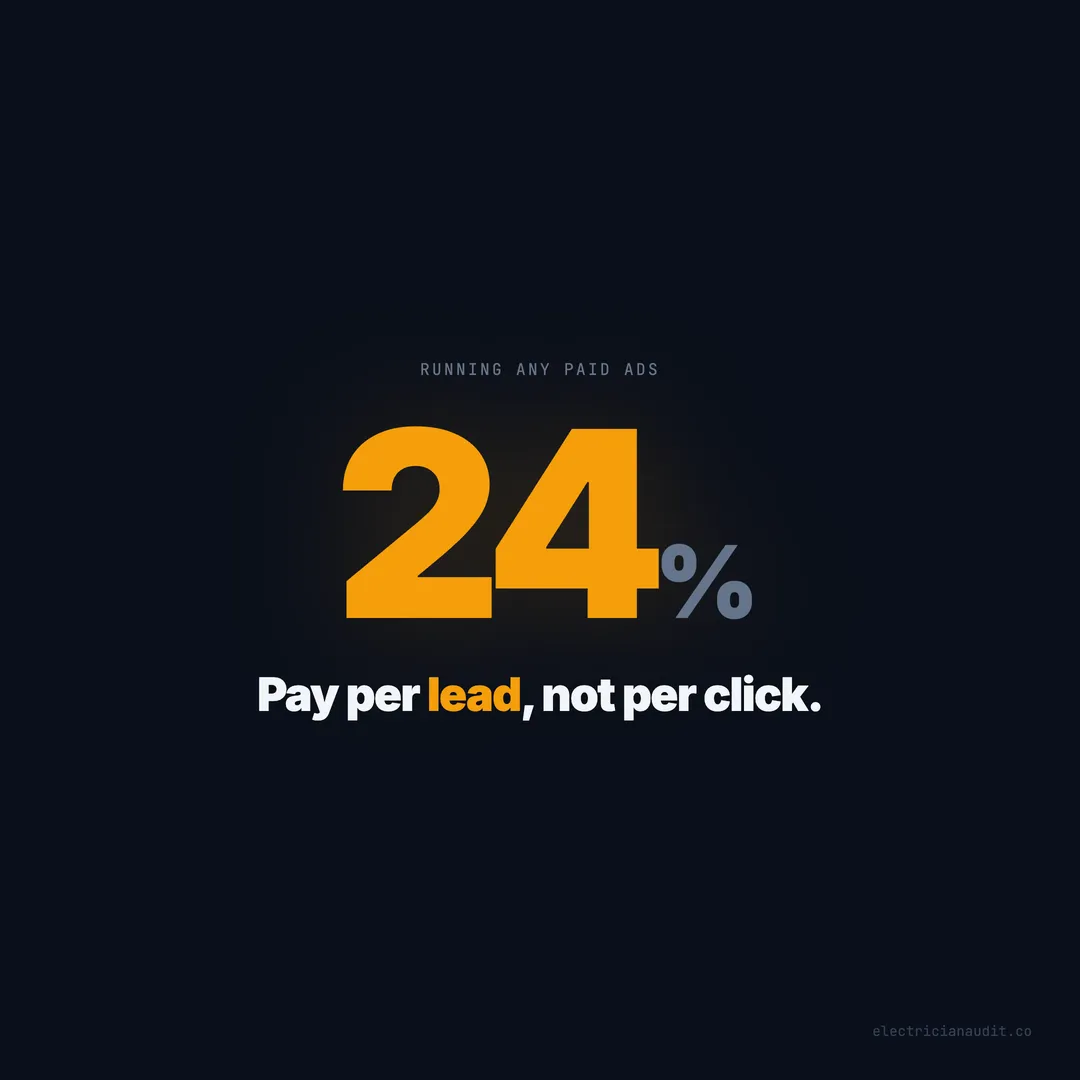
Only 24% of electricians run any ads. Google Local Services Ads charge per lead, not per click — with top-of-page placement and a Google Guaranteed badge.
It’s 10 PM on a Thursday. A homeowner in Denver smells something burning near the breaker box. She grabs her phone, types “electrician near me,” and the first thing she sees isn’t a blue ad link. It’s a row of faces with green checkmarks, star ratings, and a “Google Guaranteed” badge. She taps. She calls. She books. The electrician pays for that call — not for the tap.
That’s Google Local Services Ads. And when we audited 1,259 electrician websites across 9 states, we found that only 24% are running any paid advertising at all (Electrician Audit, 2026). The other 76% are invisible above the fold in paid search — and the small fraction using traditional Google Ads are paying $15 to $50 per click whether or not the phone rings.
LSAs flip that model. You pay when a homeowner actually contacts you. Not when they click. Not when they browse. When they call or message through the ad. For a trade where one panel upgrade is worth $2,000 to $4,000, the math is hard to ignore.
TL;DR: Google Local Services Ads place electricians above all other search results with a Google Guaranteed badge — and charge per lead, not per click. Only 24% of electricians run any ads at all (Electrician Audit, 2026). LSAs are the fastest path to phone calls, but they still send homeowners to your website. Sites averaging 41/100 can’t close what LSAs deliver.
[INTERNAL-LINK: “audited 1,259 electrician websites” -> /blog/we-audited-1200-electrician-websites/]
Google Ads charge per click — LSAs charge per lead
Traditional Google Ads cost electricians between $15 and $50 per click in most metro areas (Electrician Audit, 2026). A $3,000 monthly budget buys roughly 100 clicks — and at a typical 3-5% conversion rate, that’s 3 to 5 actual leads. You paid for 100. You got 5. The other 95 clicks bounced off your website and went to a competitor.
Local Services Ads work differently. Google charges you only when a homeowner contacts you directly through the ad — a phone call, a message, or a booking request. The cost per lead varies by market, but electricians typically pay $25 to $50 per verified lead rather than per click.
Here’s why that distinction matters. With pay-per-click, you absorb the risk of a bad website. If your landing page has no SSL, no booking, no license number — the click still costs money. With pay-per-lead, Google absorbs more of that risk. The homeowner contacts you through Google’s interface before they ever see your website.
But don’t mistake “lower risk” for “no risk.” We’ll get to why your website still matters — even with LSAs.
Citation capsule: Electricians using traditional Google Ads pay $15-$50 per click regardless of conversion, while Local Services Ads charge $25-$50 only when a homeowner actually initiates contact — shifting the financial risk from the electrician to the platform (Electrician Audit, 2026).
[INTERNAL-LINK: “paying $15 to $50 per click” -> /blog/electrician-google-ads-wasting-money/]
LSAs sit above everything else in search results
Here’s what most electricians don’t realize about LSA placement. Local Services Ads appear at the very top of Google’s search results page — above traditional pay-per-click ads, above the local map pack, above organic results. They own position zero.
When a homeowner searches “electrician near me,” the page loads in this order:
- Local Services Ads — photos, ratings, Google Guaranteed badge
- Google Ads — traditional pay-per-click text ads
- Local Map Pack — Google Business Profile listings with the map
- Organic results — your website, if it ranks
That means the 76% of electricians running no ads at all don’t just miss paid placement. They’re competing for positions that start below three paid tiers. And the 24% running traditional Google Ads? They’re paying per click for position two when position one charges per lead.
[UNIQUE INSIGHT] The structural advantage of LSAs compounds in emergency searches. When someone has a breaker tripping at midnight, they don’t scroll. They tap the first result that looks trustworthy. LSAs — with the Google Guaranteed badge and star ratings visible before the click — capture those high-urgency, high-value calls before any other ad format gets a chance.
The Google Guaranteed badge is a trust shortcut most electricians don’t have
Google Guaranteed isn’t just a label. It’s a signal that Google has verified your business — license, insurance, and background check. If a customer is unhappy with work booked through an LSA, Google may refund up to $2,000 of the job cost. That backing matters to homeowners who’ve never hired an electrician before.
In our audit, 56% of electrician websites don’t display a license number anywhere on their site (Electrician Audit, 2026). Another 60% lack HTTPS, meaning visitors see a “Not Secure” warning in Chrome. The Google Guaranteed badge sidesteps both problems — at least at first contact. The homeowner sees Google vouching for you before she ever lands on your site.
But here’s the catch. After the initial call, 72% of homeowners still visit the contractor’s website before confirming a job, according to industry research (BrightLocal, 2025). The badge gets you the call. Your website closes the deal. If she calls through the LSA, then checks your site and finds a broken template with no license number and no SSL — the trust that badge built evaporates in seconds.
Citation capsule: Google’s Guaranteed badge signals license verification, insurance, and background checks — with up to $2,000 in customer protection — but 56% of electrician websites still don’t display a license number and 60% lack HTTPS, undermining trust once homeowners visit the site directly (Electrician Audit, 2026; BrightLocal, 2025).
[INTERNAL-LINK: “don’t display a license number” -> /blog/electrician-license-number-not-on-website/]
LSAs still send people to your website — and 84% of electrician sites can’t convert them
This is the part that gets overlooked. LSAs generate the initial contact through Google’s interface. But the relationship doesn’t end there. Homeowners research. They compare. They check your website before they let a stranger into their house to rewire a panel.
Our audit found 84% of electrician websites have no online booking, 53% have no contact form, and 64% offer no after-hours lead capture (Electrician Audit, 2026). That means even if an LSA delivers the call, the follow-through falls apart when the homeowner does any additional research.
[ORIGINAL DATA] Among the 1,259 electrician websites we deep-audited, sites with all five core conversion features (SSL, click-to-call, contact form, booking, license display) scored 55+/100. Sites missing three or more scored in the low 30s. The average electrician site sits at 41/100 — well below the threshold where paid traffic of any kind converts reliably.
Consider what happens with a $4,000 panel upgrade lead. The homeowner calls through your LSA. You schedule an estimate. She tells her husband she found someone. He Googles your company name, lands on a site with no SSL padlock and no reviews. He says “let’s get a second quote.” That LSA lead just walked out the door — not because the ad failed, but because the website did.
[INTERNAL-LINK: “no online booking” -> /blog/electrician-website-traffic-but-no-calls/]
How to set up Google Local Services Ads as an electrician
Getting started with LSAs isn’t complicated, but the verification process takes time. Most electricians can go live within two to three weeks if their paperwork is in order. Here’s the step-by-step.
Step 1: Check eligibility and create your profile
Visit Google’s Local Services Ads portal and confirm that electrical services are eligible in your area. LSAs are live in most U.S. metro and suburban markets. Create your business profile with your service categories — panel upgrades, rewiring, EV charger installation, emergency electrical, lighting.
Step 2: Pass the Google screening
Google requires three things before you can run LSAs:
- License verification — your state electrical license, confirmed against the licensing board
- Insurance verification — general liability insurance meeting Google’s minimum threshold
- Background check — conducted through a third-party provider on the business owner and field employees
This is where most delays happen. License verification can take 5-10 business days depending on your state’s database. Start the process before you need the ads running.
Step 3: Set your budget and service area
LSAs use a weekly budget, not a daily one. Google recommends starting budgets based on your market, but you control the cap. Set your service area by zip code or city radius — this determines which searches trigger your ad.
[PERSONAL EXPERIENCE] From reviewing hundreds of electrician ad setups, the businesses that perform best on LSAs set tight service areas matching where they actually dispatch crews. A 50-mile radius sounds appealing until you’re paying for leads in areas you don’t serve and racking up “not interested” responses that hurt your LSA ranking.
Step 4: Respond fast — it directly affects your ranking
Google tracks your response time and response rate. Electricians who answer LSA calls within five minutes rank higher than those who let calls go to voicemail. Google’s own support documentation confirms that responsiveness is a ranking factor in the LSA algorithm.
Miss too many calls? Google pushes your ad down — or pauses it entirely. If you’re running LSAs, you need someone answering the phone. Period.
LSAs vs. Google Ads: which one makes sense for electricians
Both have a place. But for most electricians — especially those spending under $5,000 a month — LSAs deliver faster, cheaper results. Here’s how they compare.
| Factor | Local Services Ads | Google Ads |
|---|---|---|
| Cost model | Per lead ($25-$50) | Per click ($15-$50) |
| Placement | Above all other results | Below LSAs |
| Trust signal | Google Guaranteed badge | None built-in |
| Website needed | Optional (but recommended) | Required — it’s the landing page |
| Targeting | Service area + categories | Keywords + audience + location |
| Setup complexity | Low (profile + verification) | High (campaigns, keywords, bids, landing pages) |
| Time to first lead | Days after approval | Days, but optimization takes weeks |
| Dispute option | Can dispute invalid leads for credit | No refund for bad clicks |
The key difference for electricians: traditional Google Ads live or die on your website’s ability to convert. We found that sites scoring below 40 — that’s 48% of all electrician websites — are essentially burning ad spend (Electrician Audit, 2026). LSAs reduce that dependency because the first contact happens through Google, not through your site.
But “reduce” isn’t “eliminate.” As we covered above, homeowners still check your website. And if you’re running both LSAs and Google Ads, your site needs to convert from both traffic sources.
[INTERNAL-LINK: “burning ad spend” -> /blog/electrician-google-ads-wasting-money/]
The 76% running no ads are leaving the fastest leads on the table
Three out of four electricians in our dataset aren’t running any paid advertising (Electrician Audit, 2026). They rely on organic search, Google Business Profile, and word-of-mouth. For some, that’s enough — if their GBP is strong and their referral pipeline is full.
For most, it’s not. The average electrician website scores 41/100. Only 1.9% score above 80. Without ads and with weak organic presence, these businesses depend entirely on a Google Business Profile that sends traffic to a site that can’t convert. Want to know where your site stands? Our free audit reports show the exact score breakdown.
LSAs represent the lowest-friction entry into paid advertising. No keyword research. No landing page optimization. No bid management. You verify your business, set a budget, and start receiving calls. For an electrician who’s never touched paid marketing, it’s the fastest path from “invisible in search” to “phone ringing.”
Does that mean you should skip fixing your website and just run LSAs? No. It means LSAs buy you time. They get the phone ringing while you fix the site. Then when the site is ready, you add Google Ads and the entire system compounds.
[UNIQUE INSIGHT] We’ve seen a pattern across hundreds of audited sites: the electricians who start with LSAs and then invest in their website within 90 days retain more of those leads long-term. The ones who treat LSAs as a permanent substitute for a real website eventually hit a ceiling — the homeowner who checks your site and walks is the homeowner you can’t get back.
Your website is the closer — even when LSAs are the opener
Here’s where it all connects. LSAs get you to the top of search. The Google Guaranteed badge builds instant trust. Pay-per-lead means you don’t bleed money on bounced clicks. It’s a better model for electricians than traditional pay-per-click in almost every scenario.
But the data tells us something the ad platforms won’t. Among the 1,259 electrician websites we audited, the sites that convert — the ones that turn any traffic source into booked jobs — share the same five features: HTTPS, click-to-call, a contact form, online booking, and a visible license number. Sites with all five score 55+. Sites missing three or more score in the low 30s (Electrician Audit, 2026).
LSAs are the best opener in paid search. Your website is still the closer. And right now, 84% of electrician websites can’t close.
Start with LSAs. Get the calls coming in. But don’t stop there. Fix the site scoring 41/100 before the homeowner’s husband Googles your company name and picks someone else. That panel upgrade — $2,000 to $4,000 — doesn’t care which ad format brought the lead. It only cares whether your website finished the job.
The 76% running nothing are invisible. The 24% running click-based ads are overpaying. LSAs sit in the middle — better economics, better placement, lower risk. But the electricians who win aren’t the ones with the best ads. They’re the ones with the best website behind the ads.
Stop funding clicks that leak. Start with leads that land.
Keep reading
Want to know your score?
Drop your URL — full report in 48 hours.
We're on it.
Report in your inbox within 48 hours.