66% of Electrician Websites Have No Panel Upgrade Page — Your Highest-Margin Service Is Invisible
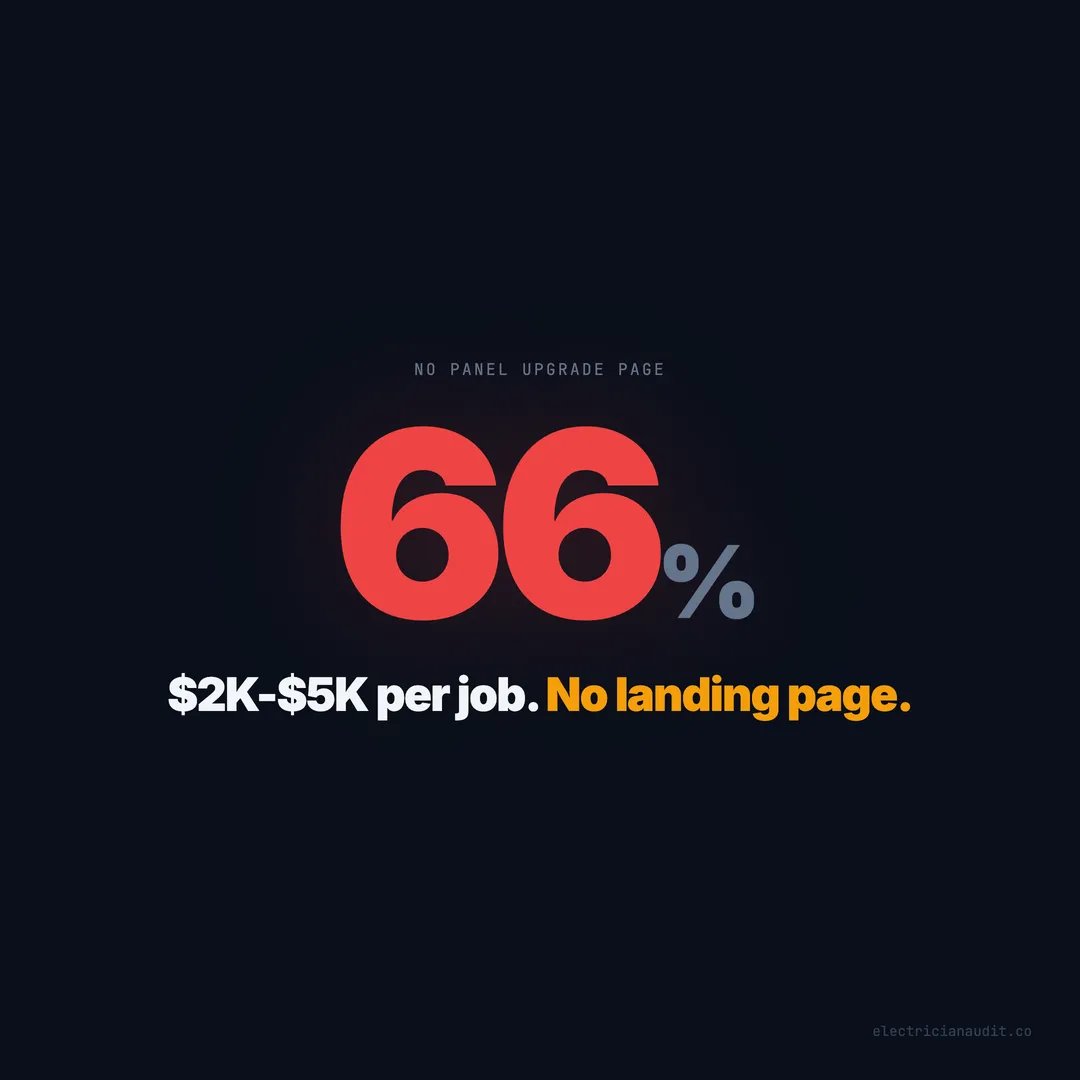
826 of 1,259 electrician sites have no panel upgrade page. At $2K-$5K per job and bundles up to $22K, that's your highest-margin service with zero web presence.
A homeowner in Mesa, Arizona flips the breaker for her new dryer. The panel buzzes. Half the kitchen goes dark. She Googles “electrical panel upgrade near me” and finds three electricians with dedicated pages explaining 100-amp to 200-amp upgrades, pricing, and permit details. You’re five miles away. You’ve done this job hundreds of times. But your website lists “residential services” on one generic page, so Google doesn’t know you exist for this query.
When we audited 1,259 electrician websites across 9 states and 51 cities, 826 of them — 66% — had no dedicated panel upgrade page. Panel upgrades run $2,000 to $5,000 per job. They’re often required before EV charger and generator installations. And two-thirds of electrician websites don’t even mention them as a standalone service.
This isn’t a niche oversight. It’s a revenue hole.
826 Out of 1,259 Electrician Websites Have No Panel Upgrade Page
Out of every three electrician websites we audited, two are completely invisible for panel upgrade searches. 826 sites out of 1,259 — 66% — lack a dedicated panel upgrade page. That’s not a weak page or thin content. It’s a total absence. No URL, no title tag, no H1 targeting the phrase “panel upgrade” or “electrical panel replacement.”
What makes this especially costly is the job value. Panel upgrades sit in the $2,000 to $5,000 range — significantly more than a standard outlet install ($150-$300) or fixture swap ($200-$400). On a per-job basis, panel upgrades are among the highest-margin residential electrical services. And the demand is growing, driven by aging infrastructure, EV adoption, and generator installations that require higher amperage.
[ORIGINAL DATA] When we cross-referenced panel upgrade page presence with overall site quality, the pattern was clear. Electrician websites that have dedicated pages for all three high-ticket services — EV chargers, generators, and panel upgrades — score an average of 58 out of 100. Sites without those pages average 41/100. That 17-point gap isn’t cosmetic. It reflects a fundamentally different approach to treating a website as a lead generation tool.
The search volume behind panel upgrades is real
Homeowners don’t search “electrical panel upgrade” for fun. They search because a home inspector flagged their panel. Because their electrician told them a 100-amp panel can’t handle a Level 2 charger. Because they bought an older home and the insurance company wants documentation. Every one of these searches carries strong purchase intent — the decision is already made, and they’re looking for someone to do the work.
The electricians capturing these searches aren’t doing anything exotic. They built a page. That’s the entire competitive advantage right now.
Panel Upgrades Are the Gateway to $7,500-$22,000 Bundled Jobs
A panel upgrade rarely happens in isolation. In our experience reviewing hundreds of electrician sites, the most common triggers for panel upgrades are EV charger installations and whole-house generators — both of which require higher amperage than most older panels provide. A 100-amp panel can’t safely add a 50-amp EV charger circuit and a 30-amp generator transfer switch. The homeowner needs 200 amps first.
That bundling effect matters. An EV charger installation runs $500 to $2,000. A generator installation runs $5,000 to $15,000. Pair either with a panel upgrade, and you’re looking at a combined job value of $2,500 to $7,000 for EV plus panel, or $7,000 to $20,000 for generator plus panel. Both services together? That’s up to $22,000 from a single household.
Yet the data shows a stacking problem. 62% of electrician sites have no EV charger page. 63% have no generator page. And 66% have no panel upgrade page. The majority of electricians are invisible for all three searches — meaning they can’t capture the initial query OR the upsell.
[UNIQUE INSIGHT] Here’s something we haven’t seen anyone else point out. The panel upgrade page should be the hub of your high-ticket service content, not an afterthought. When someone finds your panel upgrade page, they’re already spending $2,000+. That page should link to your EV charger page and your generator page, because those are the reasons they need the upgrade. The internal linking structure mirrors the actual job flow — and it helps Google understand the relationship between your service pages.
Missing This Page Costs $24,000 to $60,000 Per Year — Conservatively
The math isn’t complicated. Panel upgrades average $3,500 per job at the midpoint of the $2,000-$5,000 range. If a dedicated panel upgrade page captures just two additional jobs per month that would have otherwise gone to a competitor with a visible page, that’s $7,000 per month. Over 12 months: $84,000 in revenue from a single page.
Even the most conservative estimate is significant. Say the page only generates one extra lead per month, and you close half of them. That’s still $21,000 per year in additional revenue. From one page that takes an afternoon to build.
But the real cost is the bundled revenue you never see. When a homeowner finds your panel upgrade page and then discovers you also install EV chargers and generators, the average job value climbs. Without the panel page, you never enter the conversation — and you never get the chance to quote the full project.
We’ve found that the electricians who treat their website as a lead generation tool rather than a digital business card consistently outperform. Sites with dedicated service pages for high-ticket work score 58 vs. 41 on average. That 17-point gap translates to more visibility, more clicks, and more booked work.
The compounding loss most electricians don’t see
Here’s what really stings. A homeowner searching “panel upgrade” today is often the same homeowner who’ll need an EV charger installed next quarter. If they found a competitor for the panel work, they’re calling that same competitor for the charger. You didn’t just lose a $3,500 job. You lost a customer worth $5,000 to $10,000 over the next 18 months.
This is the compounding effect of missing service pages. Each gap doesn’t just cost the immediate job — it costs every downstream job that customer would have brought you.
A Generic “Services” Page Doesn’t Rank for Panel Upgrades
We’ve seen this pattern across 51 cities in our audit data. An electrician has a single “Our Services” page listing 12-15 things they do. Panel upgrade is bullet point number seven, sandwiched between “outlet installation” and “ceiling fan wiring.” That page isn’t ranking for any of those individual services. It can’t — because Google doesn’t treat a bullet list as a relevant result for a specific query.
When someone searches “electrical panel upgrade [city],” Google looks for pages that are about panel upgrades. A dedicated page with “panel upgrade” in the URL, title tag, H1, and body content. A page that covers when upgrades are needed, what they cost, and what the process looks like. A page that mentions 100-amp to 200-amp specifically, because that’s what most homeowners are searching for.
[PERSONAL EXPERIENCE] In reviewing hundreds of electrician sites, we’ve noticed something consistent. The sites that list everything on one page tend to rank for almost nothing. The sites that build individual pages for each major service tend to rank for several of them. It’s not even close. One dedicated panel upgrade page outperforms a 15-service list every single time.
The keyword signal Google needs
Google’s ranking system matches queries to pages. “Electrical panel upgrade Charlotte NC” is a specific query. Google wants a specific answer. A page titled “Electrical Panel Upgrade in Charlotte | [Your Company]” with 600+ words about panel upgrades in Charlotte is that answer. A bullet point on a page titled “Our Electrical Services” is not.
The 34% of electrician sites that DO have panel upgrade pages understand this. The 66% that don’t are competing for zero high-ticket panel queries.
Panel Upgrades Are Becoming Mandatory — And the Search Volume Reflects It
Three forces are driving panel upgrade demand higher every year, and they aren’t slowing down.
EV adoption is accelerating. More electric vehicles on the road means more homeowners discovering their 100-amp panel can’t support a Level 2 charger. The charger installation itself is straightforward — but the panel upgrade that precedes it is a $2,000-$5,000 prerequisite. Electricians with EV charger pages who also link to a panel upgrade page capture both jobs.
Generator demand stays constant. Storm seasons, grid instability, and remote work have kept generator installations steady across the states we’ve studied. A whole-house generator typically requires 200-amp service. Homeowners running 100-amp panels need the upgrade first. Again — two jobs from one customer, but only if your website connects the dots.
Aging housing stock forces upgrades. The median age of U.S. homes is roughly 40 years. Homes built in the 1970s and 1980s commonly have 100-amp or even 60-amp panels that can’t handle modern electrical loads. Insurance companies in some markets now require panel documentation. Home inspectors flag outdated panels in nearly every pre-sale inspection. These are motivated buyers searching for an electrician who does panel work.
The electricians winning this demand curve have pages built for it. The 66% without a panel upgrade page are watching these leads go elsewhere.
What a Panel Upgrade Page Actually Needs
This isn’t a massive content project. A functional panel upgrade page that ranks and converts needs a few specific elements. We’ve reviewed the top-scoring sites in our dataset, and the pattern is consistent.
Content that matches search intent
- When upgrades are needed: 100-amp panel at capacity, adding EV charger or generator, insurance requirements, home sale inspections, Federal Pacific or Zinsco panels
- What the upgrade involves: new panel, new breakers, possible meter base upgrade, permit and inspection
- Pricing transparency: even a range like “$2,000-$5,000 depending on panel size and local codes” outperforms silence
- Timeline: how long the job takes (typically one day for a standard 200-amp upgrade)
Conversion elements that actually work
A click-to-call button matters more than anything else on the page. Sites with click-to-call score 52 vs. 32 — a 20-point gap and the single largest conversion-feature difference in our dataset. Display your license number visibly — 56% of electrician sites don’t, and it kills trust for a $3,500 job. Include a contact form or booking widget above the fold.
Internal links that build a service ecosystem
Link to your EV charger page. Link to your generator page. Link to your service area pages so the content targets specific cities. These cross-links help every page rank better and keep visitors on your site longer. The electricians scoring in the top 2% — above 80 out of 100 — almost always have this kind of interconnected service page structure.
The total effort? One afternoon. Maybe two if you’re writing the content yourself. The page starts showing up in search results within weeks. And unlike paid ads, it doesn’t cost you per click.
Your Competitors Without This Page Are Handing You the Advantage
Here’s the flip side. That 66% number isn’t just a problem for the electricians missing the page. It’s an opportunity for the ones who build it. When two-thirds of your competitors are invisible for panel upgrade searches, the bar to rank on page one is remarkably low.
Compare that to a search like “electrician near me,” where every competitor is fighting for the same generic query. Panel upgrade searches are more specific, carry higher intent, and have less competition — because most electricians haven’t built the page.
The average electrician website scores 41/100. Only 1.9% score above 80. The industry-wide quality floor is so low that basic competence — a dedicated service page with real content, a phone number, and a license number — puts you ahead of the majority. You don’t need a perfect website. You need a page that exists.
And consider the timing. As EV adoption grows and more homeowners need panel capacity, the search volume for “panel upgrade” queries will only increase. The electricians who build this page now will have months of ranking authority by the time demand peaks. The ones who wait will be trying to catch up from zero.
We’ve published 682 individual audit reports across our dataset. The pattern is always the same. The electricians who build specific service pages for high-ticket work get found for high-ticket searches. Everyone else gets the leftovers.
One Page. $3,500 Average Ticket. Two-Thirds of Your Market Hasn’t Built It.
The data doesn’t leave much room for debate. 826 of 1,259 electrician websites lack a panel upgrade page. Panel upgrades average $2,000 to $5,000 per job and frequently bundle with EV charger and generator installations worth an additional $5,500 to $17,000. Sites with dedicated high-ticket service pages score 17 points higher than those without.
This is one page. It takes an afternoon. It targets a service with growing demand, high margins, and built-in upsell potential. And right now, 66% of your competitors haven’t built it.
That won’t last. But today, the advantage belongs to whoever builds the page first.
Check how your site compares in your market.
Keep reading
Want to know your score?
Drop your URL — full report in 48 hours.
We're on it.
Report in your inbox within 48 hours.