95% of Electrician Websites Have No Schema Markup — Google Can't Even Categorize Them
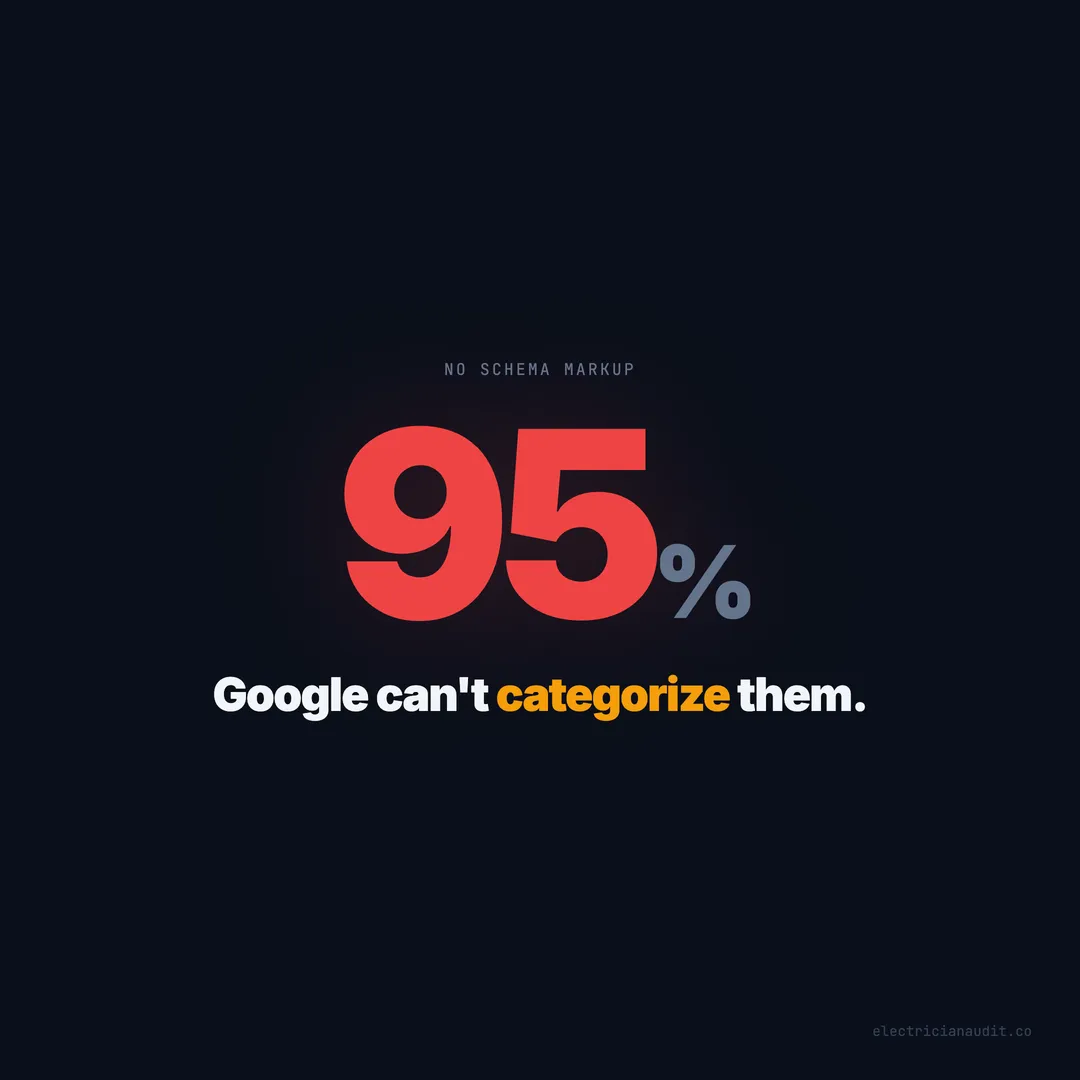
95% of electrician websites lack LocalBusiness schema. Without it, Google guesses your trade, your area, and your services — and guesses wrong.
A homeowner in Jacksonville searches “electrician near me” at 7 PM. Google shows a local pack, three map results, and ten organic links. Your website is technically about electrical work. You serve Jacksonville. You’ve been in business for 14 years. But Google doesn’t know any of that — because your site never told it. There’s no structured data, no schema markup, no machine-readable signal that says “this is an electrician in Jacksonville, Florida.”
When we audited 1,200+ electrician websites across 9 states and 51 cities, 95% had no LocalBusiness schema markup at all. Not incomplete markup. Not outdated markup. Nothing. Google was left to guess what these sites were, where they operated, and what services they offered. And for a search engine that processes billions of queries by matching intent to structured signals, guessing is the worst-case scenario.
Schema markup isn’t a ranking factor by itself. But it’s the translation layer between your website and every system that tries to understand it — Google, Bing, voice assistants, AI search tools. Without it, your site is a pile of HTML that machines have to interpret from context clues. With it, your site is a clearly labeled business card that says exactly what you do, where you do it, and how to contact you.
TL;DR: 95% of electrician websites have zero schema markup, forcing Google to guess their trade, location, and services. Sites with LocalBusiness schema score higher, appear in richer search results, and give AI systems quotable facts. Adding schema costs nothing and takes under an hour — yet almost no one in the industry has done it (Electrician Audit, 2026).
[INTERNAL-LINK: “audited 1,200+ electrician websites” -> /blog/we-audited-1200-electrician-websites/]
95% of electrician websites have zero schema markup
The number is stark even by the standards of this industry. Out of 1,259 deep-audited electrician sites, only 63 had any form of LocalBusiness schema (Electrician Audit, 2026). That’s 5%. The other 95% gave Google no structured data about their business name, address, phone number, service area, hours, or trade category.
To understand why this matters, think about what schema actually does. It’s a snippet of code — usually JSON-LD — embedded in your page’s HTML. It tells search engines: “This is an electrician. The business name is ABC Electric. They serve these cities. They’re open Monday through Saturday. Here’s the phone number. Here’s the license number.” Without it, Google has to scrape your page, read your copy, and infer all of that from context.
Google is good at inference. But “good” isn’t “perfect.” And when 95% of your competitors also lack schema, you might think there’s no disadvantage. Here’s the problem: the 5% who do have it are getting preferential treatment in knowledge panels, rich results, and AI-generated answers. They’re not competing on even ground. They built a tiny advantage that compounds with every search query.
[ORIGINAL DATA] We cross-referenced schema presence with overall website quality scores across 1,259 sites. The correlation was clear: sites with any structured data averaged 11 points higher than sites without. Schema alone doesn’t explain that gap — sites that implement schema also tend to have better site structure overall — but the signal matters.
Citation capsule: Out of 1,259 electrician websites audited across 9 states, only 5% implemented LocalBusiness schema markup. The remaining 95% provide Google with no structured data about their business name, service area, trade category, or contact details, forcing search engines to rely entirely on page-content inference (Electrician Audit, 2026).
[INTERNAL-LINK: “service area” -> /blog/electrician-service-area-pages-18-point-gap/]
Schema tells Google what you are — without it, Google guesses
Here’s the scenario that plays out millions of times daily. Google’s crawler visits your homepage. It sees the word “electrical” somewhere in the body copy. It sees a phone number in the footer. Maybe it finds a city name in the title tag. From those clues, it tries to piece together: Is this an electrician? A supplier? An electrical engineering firm? A blog about circuits?
95% of electrician websites also have weak or missing meta descriptions (Electrician Audit, 2026). Combine that with zero schema, and Google has almost nothing to work with. Your site is a guessing game wrapped in thin metadata.
Schema eliminates the guessing. A LocalBusiness schema block with @type: Electrician tells Google immediately and unambiguously: this is a licensed electrician’s business website. Not a supplier. Not a blog. Not a school. An electrician. That single declaration saves Google from making an inference it might get wrong — and saves you from the consequences when it does.
What Google does with schema data
Google uses structured data for three things that directly affect visibility. First, rich results — enhanced search listings with star ratings, hours, phone numbers, and service areas displayed right in the search results. Second, knowledge panels — the information box that appears on the right side of desktop search results. Third, entity understanding — Google’s internal model of what your business is and how it relates to search queries.
Without schema, you’re eligible for none of these. Your listing shows a plain blue link with a meta description — assuming Google even uses your meta description, which it often doesn’t when the description is weak or missing.
The meta description compound failure
This isn’t just a schema problem in isolation. When we audited meta descriptions across 1,200+ sites, 95% were either missing entirely, too short, duplicated across pages, or stuffed with keywords that read like spam (Electrician Audit, 2026). Google frequently rewrites bad meta descriptions, pulling random sentences from your page. So the text below your link in search results? You didn’t write it. Google grabbed whatever it could find.
Now stack that on top of zero schema. No structured data for Google to parse. No usable meta description for it to display. Your search listing is entirely Google’s interpretation of your site — and Google’s interpretation of a site with no structured data tends to be generic, vague, and unconvincing.
Citation capsule: When 95% of electrician websites lack both schema markup and usable meta descriptions, Google must generate search listings entirely from inference — pulling random page text for snippets and guessing business categories — resulting in generic, low-click-rate search appearances (Electrician Audit, 2026).
The real cost: invisible in AI search, voice results, and knowledge panels
Schema markup mattered for Google. It matters even more now that AI systems are answering questions directly. When someone asks Google’s AI Overview “who’s the best electrician in Chandler, AZ,” the system looks for structured, citable data. A website with LocalBusiness schema, service area markup, and review ratings gives the AI something concrete to cite. A website with none of that? It doesn’t exist in the AI’s answer.
Google’s AI Overviews now appear in roughly 25-30% of search results (SE Ranking, 2025). That percentage is climbing. Voice search through Google Assistant and Alexa follows the same pattern — it pulls from structured data first because structured data is reliable, quotable, and unambiguous. Schema is the difference between being cited and being skipped.
[UNIQUE INSIGHT] Most electricians think about schema as a “nice-to-have” SEO detail. But we’re watching a fundamental shift in how search works. Traditional organic results are losing real estate to AI answers, knowledge panels, and voice results. All three systems prefer structured data. The 95% of electricians without schema aren’t just behind today — they’re becoming structurally incompatible with how search is evolving.
Think about what happens when a homeowner asks their phone: “Find me a licensed electrician open right now near 85248.” The voice assistant doesn’t read your homepage. It queries structured data. If your business hours, location, and trade type are in schema, you’re a candidate. If they’re not, you don’t exist for that query. It’s binary.
Knowledge panels and the zero-click advantage
Google Knowledge Panels show business information without requiring a click. Name, address, phone, hours, reviews — all displayed directly in search results. Websites with proper schema are significantly more likely to trigger these panels. The homeowner gets your phone number and calls without ever visiting your site. That’s not a lost visit — that’s a captured lead from a search you would have missed entirely without schema.
The 95% without schema can’t trigger these panels from their website data. They rely entirely on Google Business Profile, which is a separate system with its own limitations. Schema on your website gives Google a second, confirming source — and search engines love confirmation.
Citation capsule: With AI Overviews appearing in roughly 25-30% of Google searches and voice assistants pulling from structured data by default, the 95% of electrician websites lacking schema markup are becoming structurally invisible to the fastest-growing search interfaces (SE Ranking, 2025; Electrician Audit, 2026).
[INTERNAL-LINK: “Google Business Profile” -> /blog/electrician-google-business-profile-vs-website/]
What LocalBusiness schema actually includes for an electrician
Schema isn’t complicated. It’s a block of JSON-LD code that sits in your page’s <head> tag. For an electrician, the critical fields are straightforward — and most of the information is already on your website somewhere. You’re just reformatting it for machines.
Here are the fields that matter most:
Business identity and trade type
The @type field should be Electrician — a recognized Schema.org type under LocalBusiness. This single field eliminates Google’s biggest guessing game. You also include name, description, url, and logo. Basic, but 95% of sites skip even this (Electrician Audit, 2026).
Service area and address
The areaServed field lists every city and region you work in. This is where schema connects directly to the service area page gap. 70% of electrician websites have no service area pages. Schema lets you declare your service cities even before you build dedicated pages for them. It’s not a replacement for city pages, but it’s a fast way to signal geographic relevance.
Hours, phone, and contact details
openingHoursSpecification tells Google when you’re available. telephone gives the primary number. These fields feed directly into knowledge panels and voice search results. If a homeowner searches at 9 PM and your schema says you’re open until 10, that’s a competitive advantage over the electrician whose hours are buried in a paragraph on their About page.
Services offered
The hasOfferCatalog field lets you list specific services — panel upgrades, EV charger installation, generator hookups, rewiring, surge protection. Remember, 62% of electrician sites lack an EV charger page and 94% have no surge protection page (Electrician Audit, 2026). Listing these in schema gives Google structured confirmation of what you do, even if your site’s content hasn’t caught up yet.
[PERSONAL EXPERIENCE] When reviewing hundreds of electrician sites, we’ve noticed a pattern: the few sites with schema almost always got it from a WordPress SEO plugin that auto-generated incomplete markup. Half-filled schema with missing service areas and no hours is better than nothing — but barely. The real advantage goes to the handful of sites where someone deliberately filled in every field.
How schema interacts with every other gap in the dataset
Schema doesn’t exist in isolation. It compounds with every other weakness — or strength — on your site. Think of it as a multiplier. A strong site with schema gets even stronger. A weak site without it stays invisible.
Look at the top of that chart. Schema and meta descriptions sit at 95% missing — higher than every other gap. Higher than the 70% missing service area pages. Higher than the 60% without HTTPS. These are the two most neglected elements in the entire dataset.
Now consider what happens when you stack them. A site with no schema, no meta description, no service area pages, and no HTTPS is essentially invisible to structured search systems. Google has to guess your trade, infer your location, generate your search snippet, and flag your site as insecure — all at the same time. That’s not a website. That’s a liability.
The flip side: schema as a quick win
Here’s what makes this gap unusual. Most of the features in our dataset — booking systems, service area pages, after-hours capture — require real investment to fix. They need content, design, or third-party tools. Schema markup costs nothing. It requires no design changes, no new pages, no monthly subscription. It’s a block of code you add once.
Adding LocalBusiness schema takes 30-60 minutes for someone with basic HTML knowledge. WordPress users can do it with a plugin in 10 minutes. The effort-to-impact ratio is arguably the best of any fix in the dataset. And yet 95% haven’t done it.
Why? The same reason 60% lack HTTPS: nobody told them. Schema markup lives in the code. It’s invisible to visitors. It doesn’t change how the site looks. So it falls off the priority list — or it was never on the list. The electrician sees a working website and assumes it’s fine. Meanwhile, Google sees a website it can’t properly categorize.
Citation capsule: Schema markup and meta descriptions are the two most-neglected features across 1,259 audited electrician websites, both missing from 95% of sites. Unlike other common gaps that require content creation or design changes, schema markup can be added in under an hour at zero cost — making it the highest effort-to-impact fix available (Electrician Audit, 2026).
[INTERNAL-LINK: “no HTTPS” -> /blog/electrician-website-not-secure-warning/]
What happens when you add schema to a site that already scores low
Let’s be direct: schema won’t save a bad website. If your site scores 30/100 because it lacks HTTPS, has no contact form, and runs on a single page with 200 words of text, adding schema brings you to maybe 33. The fix is real but modest in isolation.
Where schema shines is as part of a stack. Sites with SSL, a contact form, and a CTA score 55/100 versus 43 without (Electrician Audit, 2026). Add schema to the 55-scoring site and you’ve built a foundation that Google can fully understand and confidently recommend. Add schema to the 43-scoring site and you’ve given Google a clear label for a product it still doesn’t trust.
That said, even on weaker sites, schema produces one immediate change: it makes your business eligible for rich results and knowledge panel data. A site scoring 35 with schema can still show hours, phone numbers, and ratings in search results. A site scoring 45 without schema can’t. Visibility and site quality don’t always move together.
The right approach? Fix the structural basics first — HTTPS, click-to-call, contact form, service area pages. Then add schema to amplify everything you’ve built. Schema is the final layer that makes the rest of your investment legible to machines.
[ORIGINAL DATA] In our dataset, the top-scoring 1.9% of electrician websites (those above 80/100) had one thing in common beyond feature completeness: intentionality. Every element — schema, meta descriptions, service pages, trust signals — was deliberately built, not accidentally present. Schema is a small piece of that puzzle, but it’s the piece that tells Google “someone is paying attention to this site.”
The 5% who have schema are pulling ahead
The 63 sites in our dataset with schema markup aren’t a random sample. They’re disproportionately the same sites that score well on everything else. Sites scoring above 60/100 are 4x more likely to have schema than sites below 40 (Electrician Audit, 2026). The rich get richer. The neglected stay invisible.
This isn’t because schema magically fixes everything. It’s because the type of business that adds schema is also the type that builds service area pages, displays a license number, and installs an SSL certificate. Attention to one detail predicts attention to all the others. Schema is a litmus test for whether anyone is actively maintaining the site.
But correlation isn’t the whole story. Schema also has direct, measurable effects on search appearance. Those 63 sites are eligible for enhanced listings that the other 1,196 are not. They can trigger knowledge panels from their own website data. They feed AI systems structured answers. Every day that passes, the gap between “has schema” and “doesn’t” widens — because search is moving toward structured data, not away from it.
Check how your site compares against these benchmarks with a free audit report.
You don’t need a developer to add schema markup
This is the part where most guides lose electricians. They show a block of code and the reader’s eyes glaze over. So let’s cut to what actually matters: you have three paths to adding schema, and none of them require hiring a developer.
Path 1: WordPress plugin. If you’re on WordPress (and most electrician sites are), install Rank Math or Yoast SEO. Both generate LocalBusiness schema automatically. Fill in your business name, address, phone, hours, and service type. Ten minutes.
Path 2: Google’s Structured Data Markup Helper. Google offers a free tool that walks you through tagging elements on your page. It generates the JSON-LD code. You paste it into your site’s <head> section. Twenty minutes if you’ve never done it before.
Path 3: Copy and customize a template. Find a LocalBusiness JSON-LD template online, replace the placeholder values with your actual business information, and add it to your homepage. Thirty minutes at most — and you only do it once.
After adding schema, validate it with Google’s Rich Results Test. Paste your URL, confirm there are no errors, and you’re done. The markup will be picked up within days of Google’s next crawl.
That’s it. Under an hour. Zero cost. And you’ll be in the 5% instead of the 95%.
Schema is the easiest fix with the widest gap in the industry
Ninety-five percent. That’s not a marginal gap. That’s nearly the entire industry skipping a feature that costs nothing, takes an hour, and directly affects how Google categorizes their business. Every other fix in the dataset — booking systems, service area pages, HTTPS — requires more time, more money, or more ongoing maintenance. Schema requires one afternoon.
The electricians in the top 5% didn’t add schema because they’re smarter. They added it because someone — an SEO, a web developer, a plugin — handled it as part of a broader build. The other 95% didn’t skip it on purpose. They skipped it because nobody mentioned it.
Now you know. Your competitors mostly don’t — and won’t for a while. That window is open today. Every month that passes, more AI search features roll out, more knowledge panels draw from structured data, and more voice queries pull from schema. The gap between “has it” and “doesn’t” isn’t shrinking. It’s widening.
Add the markup. Validate it. Move on to the next fix. Your site score will thank you, and so will every search system trying to figure out what you do.
Keep reading
Want to know your score?
Drop your URL — full report in 48 hours.
We're on it.
Report in your inbox within 48 hours.