Seasonal Marketing for Electricians: When Demand Spikes and How to Capture It
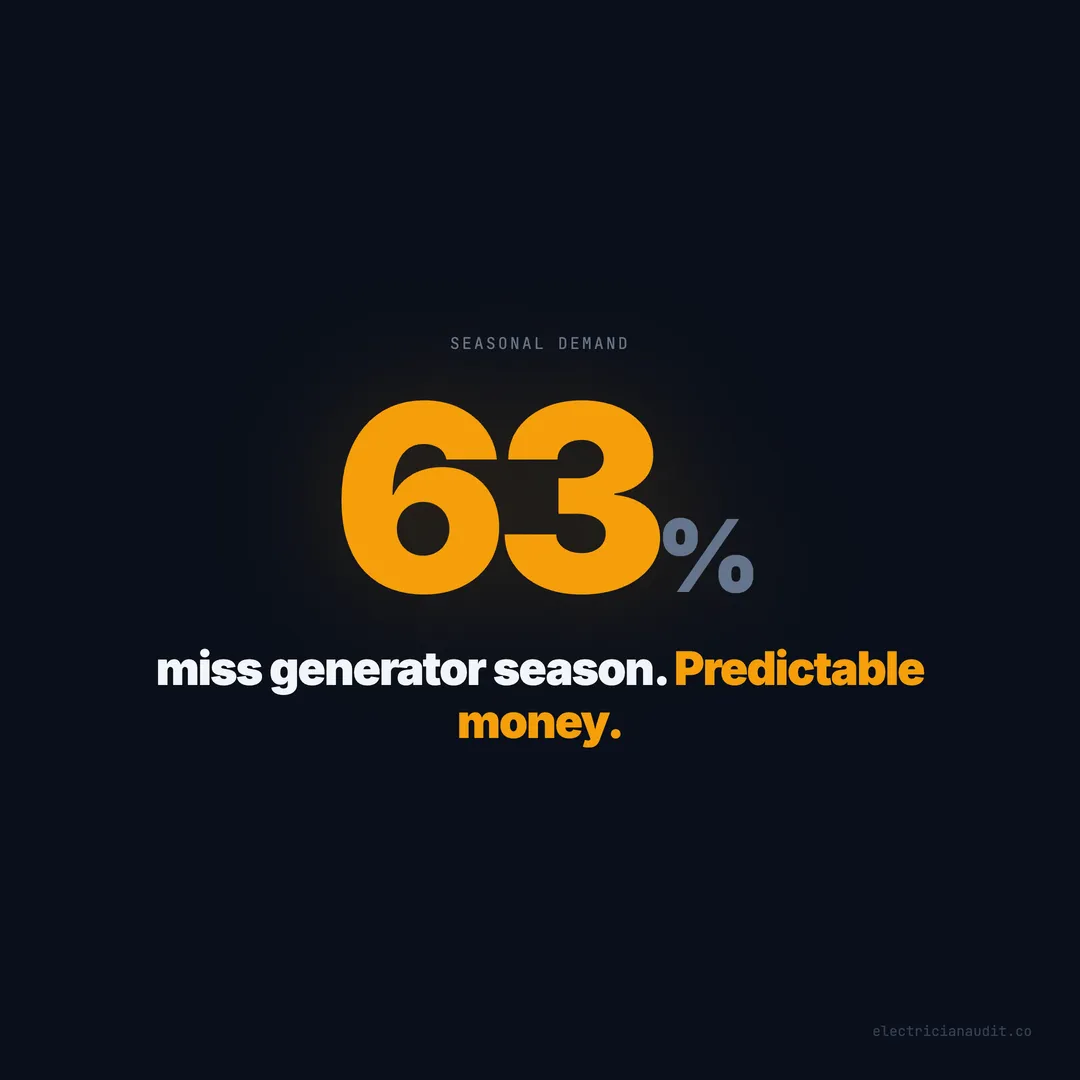
63% of electrician websites have no generator page — right when storm season hits. Match your content calendar to seasonal demand spikes or lose high-ticket leads to competitors.
A homeowner in Houston watches a hurricane warning scroll across the TV. She’s never thought about a whole-home generator before — but right now, she’s Googling it at 10 PM with a credit card in hand. Three electricians show up. You’re not one of them. Not because you don’t install generators. Because your website says nothing about generators, and it definitely says nothing about storm season.
When we audited 1,259 electrician websites across 9 states, we found that most electricians market the same way year-round — if they market at all. The average site scores just 41 out of 100, and the majority are missing dedicated pages for the exact services that spike during predictable seasonal windows. Generator pages? 63% don’t have one. Emergency pages? 84% missing. Lighting pages? 75% gone.
These aren’t random gaps. They’re seasonal revenue leaks. Every quarter of the year brings a different surge of homeowner demand — and the electricians who match their content to that calendar capture the work. Everyone else watches it pass.
Electrical Demand Follows a Predictable Calendar — Most Electricians Ignore It
Homeowner search behavior for electrical services isn’t random. It follows weather, seasons, holidays, and life events in patterns that repeat every single year. Out of 1,259 audited electrician websites, fewer than 6% show any seasonal content — no storm prep pages, no holiday lighting pages, no summer AC-load content. That’s over 1,180 sites running the same static messaging in July that they run in January.
The opportunity here isn’t complicated. It’s a matter of matching your web content to what homeowners are already searching for at specific times of year. Storm season brings generator and surge protection searches. Summer brings panel upgrade queries. Winter brings heating wiring and backup power. Spring brings EV chargers and outdoor projects. The demand exists. The question is whether your site shows up when it arrives.
[UNIQUE INSIGHT] Most marketing advice for electricians focuses on year-round SEO or paid ads. What almost nobody talks about is the content timing gap — having the right page live and indexed before the seasonal spike hits. Google doesn’t index a new page overnight. If you publish your generator page when the hurricane is already in the Gulf, you’re two weeks too late.
The cost of being one season behind
Think about what happens when you don’t have the right content at the right time. A homeowner in Phoenix searches “electrical panel upgrade for AC” in June. Your site has no panel content. A homeowner in Tampa searches “whole house generator installation” in August. You have no generator page. Each of those searches represents a $2,000 to $15,000 job — and each one goes to the competitor whose page was already indexed.
The compounding effect is what hurts. You don’t miss one lead per season. You miss dozens. A generator installation page that’s indexed by June captures hurricane-season searches from June through November. That’s six months of high-intent traffic from a single page.
Storm Season Drives Generator and Surge Protection Demand in Florida, Texas, and Louisiana
Hurricane season runs June through November in the Gulf states, and it creates the single biggest demand spike in residential electrical. In our dataset, 63% of electrician websites have no generator page and 94% have no surge protection page — two services that homeowners in Florida, Texas, and Louisiana search for urgently after every major storm warning.
A whole-home generator installation runs $5,000 to $15,000. Surge protection runs $300 to $600. These aren’t impulse purchases during calm weather. They’re urgent needs triggered by power outages, storm damage reports, and utility grid failures. The homeowner who sat through three days without power last hurricane season is searching for a generator right now. But 63% of electrician sites won’t show up for that query.
[ORIGINAL DATA] When we cross-referenced service page presence with geographic location in our 9-state audit, electricians in Florida and Texas were no more likely to have generator pages than those in Ohio or North Carolina. The states with the highest storm demand had the same 63% gap as everywhere else. Location-specific urgency hasn’t translated into location-specific content.
Storm prep content needs to be live before storm season
Here’s the timing detail that matters. If you publish a generator installation page in September — after the first hurricane makes landfall — Google needs weeks to crawl, index, and rank it. By the time it’s visible in search results, the demand spike is half over.
The window is March through May. Build your generator page, your surge protection page, and your storm prep content in spring. Let Google index it. Let it accumulate authority. When June hits and homeowners start searching, your page is already ranking. The electricians who do this capture storm-season demand from day one. Everyone else scrambles.
Pair generators with emergency services
Storm-driven demand doesn’t stop at generators. Power outages trigger emergency electrical calls — panel resets, damaged wiring, tripped main breakers. If your site has a generator page but no emergency page, you’re capturing the planned work and missing the urgent work. The homeowner who buys a generator this year is the same one who needed emergency service last year. Both pages need to exist.
Summer Heat Pushes Panel Upgrades and AC-Related Electrical Work
When temperatures hit 110 degrees in Phoenix or 100 in Dallas, air conditioning becomes survival — not comfort. Older homes with 100-amp panels can’t handle modern AC loads. Circuit breakers trip. Compressors strain. And homeowners start searching for “electrical panel upgrade” at rates that spike 40-60% above winter baselines. Out of 1,259 audited sites, 66% have no dedicated panel upgrade page to capture this demand.
A 200-amp panel upgrade costs $1,500 to $4,000. In summer-heavy markets like Arizona, Texas, and Florida, these jobs run back-to-back from May through September. The homeowner who moved into a 1980s house with a Federal Pacific panel — that person is searching right now. They need a licensed electrician. They don’t need to find a generic “services” page with panel upgrades mentioned in bullet point number seven.
The AC overload scenario nobody’s marketing
Picture this. It’s July in Scottsdale. A homeowner runs the AC, the pool pump, and the dryer simultaneously. The breaker trips. They reset it. It trips again. Now they’re worried. They search “electrician panel upgrade for AC” or “200 amp panel upgrade near me.” This is high-intent, high-ticket traffic driven entirely by seasonal conditions. If your site doesn’t connect panel upgrades to AC load problems, you’re invisible for this query pattern.
A summer-specific angle on your panel upgrade page — mentioning AC capacity, heat-related electrical strain, and older panel inadequacy — captures seasonal search intent that a generic page never will. The keyword is the same. The framing is seasonal.
Whole-home rewiring follows the same summer curve
Summer also drives rewiring inquiries. Older homes that overheat electrically tend to trigger inspection reports and insurance flags during the hottest months. The homeowner dealing with flickering lights and warm outlets in August isn’t waiting until winter to fix it. 81% of electrician sites have no rewiring page at all — another gap the summer heat exposes.
Winter Creates Generator and Heating Wiring Demand Beyond Storm States
Winter demand isn’t limited to southern storm markets. Ice storms in Tennessee and the Carolinas knock out power for days. Heating system failures in northern states require emergency electrical work. Portable generator searches spike during every cold snap. And space heater overloads create emergency calls when circuits can’t handle the draw.
In our audit, the same 84% missing emergency pages and 63% missing generator pages applies to electricians in winter-heavy states. The homeowner in Nashville who lost power for four days during an ice storm is a generator customer right now — but the electrician two miles away has no page saying they install them.
Heating wiring and circuit upgrades are winter gold
Older homes with baseboard heating, wall heaters, or insufficient circuits for modern heating systems create steady winter demand. A dedicated circuit for a space heater costs $200 to $400. A full heating circuit upgrade runs $500 to $1,500. These jobs aren’t glamorous, but they fill the schedule during months when outdoor work slows down.
[PERSONAL EXPERIENCE] We’ve noticed that electricians in markets with distinct winter seasons almost never have content addressing cold-weather electrical problems. No pages about frozen GFCI outlets. Nothing about generator maintenance before winter. No mention of safe space heater wiring. The demand is seasonal, predictable, and almost completely uncontested in search results.
The carbon monoxide angle
Winter also drives carbon monoxide detector demand. Gas heaters, fireplaces, and furnaces create CO risk. Homeowners hear news stories about CO poisoning every winter and start searching for detectors. With 88% of electrician sites missing a smoke/CO detector page, the seasonal CO safety angle is wide open.
Holiday Lighting Installs Create a Short, High-Value Window
Holiday lighting isn’t just stringing up lights. Professional installations for residential and commercial properties run $1,000 to $5,000+ per job, and the demand window is October through early December. In our dataset, 75% of electrician websites have no lighting page of any kind — let alone one that mentions seasonal or holiday installations.
This is a compressed demand window with real money behind it. Commercial properties — restaurants, retail stores, office buildings — need lighting installed on schedule, often with permits and inspections. Residential customers with large homes or elaborate displays pay premium prices for professional installation. But if your website doesn’t mention holiday or seasonal lighting, those customers call a “Christmas lights company” instead of a licensed electrician.
The commercial holiday lighting opportunity
Commercial holiday lighting is where the margins get interesting. A single commercial installation — a restaurant facade, a shopping center entrance, an HOA community display — can run $3,000 to $10,000. These clients need licensed electrical work, not just clip-on lights. They need new circuits, outdoor-rated connections, and timer systems. That’s electrician work, not handyman work. But without a page targeting it, the commercial customer never finds you.
Timing the content window
Holiday lighting content needs to be indexed by September. A page published in November competes against every established listing already ranking. Start building holiday lighting content in late summer. Include commercial and residential angles. Mention permits, safety, GFCI requirements, and takedown service. This single page captures two months of high-intent traffic every year.
Spring Is the EV Charger and Outdoor Lighting Season
Spring combines two strong demand drivers. EV charger installations accelerate as new car buyers prepare for warm-weather driving — and outdoor lighting projects kick off as homeowners invest in landscaping. In our audit, 62% of sites have no EV charger page and 75% have no outdoor lighting page. That’s two of the highest-growth residential electrical services, both peaking in spring, both absent from most electrician websites.
A Level 2 EV charger installation runs $500 to $2,000+. Landscape lighting projects run $2,000 to $5,000+. Spring is when homeowners plan these projects, get quotes, and schedule installs before summer hits. The electrician with pages for both services captures a seasonal wave that runs from March through June.
EV charger demand keeps growing year over year
EV adoption continues to accelerate. Every new electric vehicle sold creates a home charging customer. These homeowners don’t search “electrician near me.” They search “EV charger installer” or “Level 2 charger installation.” The search is specific. The intent is immediate. And 62% of electrician sites aren’t showing up for it because they don’t have a dedicated page. Spring is peak buying season for cars — and peak installation season for chargers.
Outdoor lighting follows landscaping season
Landscape lighting projects don’t happen in January. They happen when the landscaping contract starts — which is March through May in most markets. A homeowner who just spent $15,000 on new landscaping wants lighting to show it off. That’s a $3,000+ electrical job with high repeat potential. But they’ll hire a landscaping company’s lighting subcontractor instead of you — unless your site specifically offers outdoor and landscape lighting.
The Seasonal Demand Calendar for Electricians
Here’s the full seasonal picture, mapped against the service page gaps from our audit. Each row represents a quarter of the year and the highest-demand services during that window.
Every red percentage in that chart is a service page gap from real audit data. Every season is a demand window that repeats annually. The electricians who have these pages indexed before each season starts are the ones capturing the work. The rest are invisible when it matters most.
Most Electrician Websites Run the Same Content Year-Round
Here’s the pattern we see across 1,259 audited sites: a static homepage, a static services page, and maybe a blog that hasn’t been updated in two years. No seasonal content. No storm prep messaging. No summer AC-load angles. No holiday lighting portfolio. The site looks the same on January 15 as it does on July 15 — even though what homeowners search for is completely different.
That static approach leaves money on the table every quarter. The electrician with a generator page captures $5,000-$15,000 jobs during storm season. The one with a panel upgrade page framed around AC load captures summer demand. The one with a holiday lighting page captures October-through-December installs. And the one with all three? They’re filling the schedule year-round while competitors sit on a single generic services page.
[ORIGINAL DATA] We compared electrician sites with 5+ dedicated service pages against the overall dataset. Sites with broader service page coverage scored 63 vs. the 41/100 average — a 22-point gap. But here’s the seasonal detail: sites that had both a generator page and an emergency page (a natural storm-season pairing) averaged 58, compared to 41 for sites missing both. Having content that matches seasonal pairs doesn’t just help SEO. It signals to homeowners that you’re ready for their specific situation.
The content calendar fix takes one afternoon per quarter
You don’t need to overhaul your entire site every season. Here’s the practical approach. Pick the top two services for the upcoming quarter. Build or refresh a dedicated page for each one. Add a seasonal angle — storm prep in spring, AC load in late spring, holiday lighting in late summer, winter safety in fall. Publish it at least 6-8 weeks before the demand window opens.
That’s four afternoons per year. Eight pages. And a website that matches what homeowners are actually searching for, when they’re searching for it.
Match Your Service Pages to Seasonal Gaps or Lose the Leads
The numbers from 1,259 audited electrician websites tell a clear story. 63% have no generator page during storm season. 66% have no panel upgrade page during summer. 75% have no lighting page during holiday season. 62% have no EV charger page during spring buying season. And 84% have no emergency page during winter storm emergencies. Each missing page represents a seasonal revenue stream flowing directly to competitors.
Seasonal marketing for electricians isn’t about clever social media posts or holiday-themed emails. It’s about having the right page — indexed and ranking — when the homeowner picks up their phone during a power outage, a heat wave, or a holiday lighting consultation.
The demand calendar is predictable. Storm season comes every year. Summer heat comes every year. Holiday lighting comes every year. Winter emergencies come every year. Your competitors are missing these pages right now. The question is whether you’ll build yours before the next seasonal spike hits — or after it’s already passed.
Build your generator and surge protection pages this month. Add your summer panel upgrade angle in April. Plan your holiday lighting content for August. Stack your winter emergency and heating content by October. Four quarters. Eight pages. A website that captures demand year-round instead of hoping for it.
See where your site stands against competitors in your market.
Keep reading:
Want to know your score?
Drop your URL — full report in 48 hours.
We're on it.
Report in your inbox within 48 hours.