94% of Electricians Don't Market Surge Protection — And 4 Other Services They Ignore
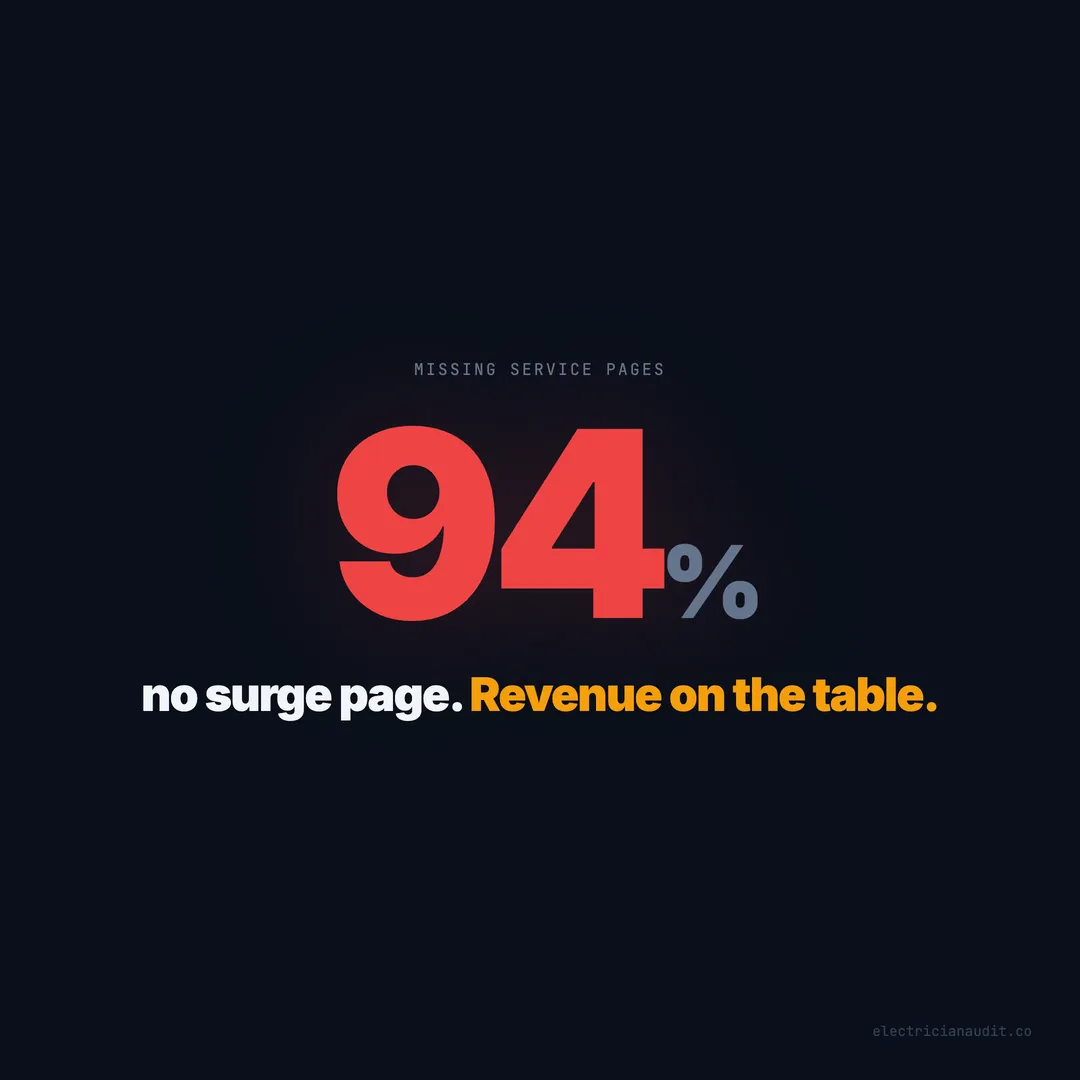
We audited 1,259 electrician websites. 94% have no surge protection page, 88% skip smoke detectors, and 93% ignore solar. These forgotten services drive repeat business.
A homeowner just had a new electrical panel installed. The electrician finishes, hands over the invoice, packs up the truck, and drives away. No mention of whole-home surge protection. No quote for smoke detector upgrades. No conversation about the ceiling fan the homeowner mentioned wanting in the living room.
That electrician left $500 to $2,000 in add-on revenue sitting on the kitchen counter. And their website? It never mentioned any of those services either — so the homeowner won’t think to call them back.
When we audited 1,259 electrician websites across nine states, we found a pattern hiding beneath the big-ticket gaps. Everyone talks about missing EV charger pages and panel upgrade pages. But the real blind spot is the tier of services that every homeowner eventually needs — surge protection, smoke detectors, ceiling fans, outdoor lighting, and solar — and almost nobody markets.
94% of Electrician Websites Have No Surge Protection Page
Out of 1,259 deep-audited sites, 1,182 have no dedicated surge protection page. That’s 94% — the single largest service page gap in our entire dataset. A service that pairs naturally with every panel job, every home purchase, and every appliance upgrade is invisible on nearly every electrician website.
Whole-home surge protectors cost homeowners $300 to $600 installed. That’s a 15-minute conversation and a 30-minute install tacked onto a panel upgrade or service call. The margin is excellent. The customer barely thinks twice about the price. And yet 94% of electricians aren’t even telling Google they offer it.
[ORIGINAL DATA] We cross-referenced surge protection page presence with overall site scores. The 6% of sites that do have a surge page average a score of 61 vs. the 41/100 overall average. That 20-point gap suggests these are electricians who treat their website as a lead tool, not a placeholder.
Every panel job is a surge protection upsell
Here’s the scenario nobody’s marketing. A homeowner gets a 200-amp panel upgrade. The electrician installs the new panel and leaves. Two weeks later, a lightning storm fries the homeowner’s $3,000 home theater system. They Google “surge protection electrician near me.” A different electrician shows up. That’s your customer, calling someone else — because your website never mentioned surge protection exists.
The connection is obvious to anyone in the trade. Old panels don’t have surge protection. New panels should. Every single panel upgrade is a natural entry point for a $300-$600 add-on. But if your website doesn’t have a page for it, that upsell conversation never starts online.
The search volume is real and growing
Smart home adoption keeps pushing demand. Homeowners with expensive electronics, home offices, and EV chargers are increasingly aware that a power surge can cost thousands. They’re searching for it. They’re finding the 6% of electricians who bothered to build a page. Everyone else doesn’t exist for that query.
88% Have No Smoke or CO Detector Page — The Easiest Repeat Service
Smoke and carbon monoxide detector installation is mandated by code in every state. Detectors expire. Batteries die. New construction needs them. Remodels trigger upgrades. It’s the definition of recurring demand — and 1,103 out of 1,259 electrician websites (88%) have no page for it.
Think about the math. A typical home needs 6-10 hardwired smoke detectors. At $50-$75 per unit installed, that’s a $300-$750 job per household. Not glamorous, but highly repeatable. Every detector has a 10-year lifespan. Every home needs them replaced eventually.
[PERSONAL EXPERIENCE] In reviewing hundreds of electrician sites, we’ve noticed something telling. The few sites that do mention smoke detector installation almost always bury it in a bullet point on a generic services page. Even among the 12% who reference it somewhere, dedicated pages with real content are rare. It’s treated as an afterthought — which is exactly why it’s such an open opportunity.
Code compliance creates built-in demand
Local fire codes require hardwired, interconnected smoke detectors in most residential settings. When homeowners sell their house, inspectors flag missing or expired detectors. When they remodel, permits require updated detection. This isn’t optional work — it’s mandated. And the homeowner who needs it done is searching for someone who specifically offers it.
A page titled “Smoke and CO Detector Installation” with 500 words about code requirements, detector types, and replacement timelines ranks for dozens of long-tail queries. “Hardwired smoke detector installation near me.” “Carbon monoxide detector electrician.” “Smoke detector replacement cost.” Each query represents a customer who needs a licensed electrician — and 88% of sites aren’t in the running.
The Forgotten Services Gap at a Glance
These aren’t niche offerings. They’re standard residential electrical work that homeowners search for every day. The gap between demand and visibility is massive across every one of them.
Compare this to the high-ticket service gaps we covered previously — EV chargers (62%), generators (63%), panel upgrades (66%). Those are bigger jobs per ticket. But the services above are the ones that drive repeat business, fill schedule gaps, and create relationships that lead to the big jobs later.
81% Have No Ceiling Fan Page — A Service Homeowners Actually Search For
Ceiling fan installation sounds boring. It’s not glamorous electrical work. But 1,014 out of 1,259 electrician sites (81%) have no dedicated page for it — and that’s a mistake, because homeowners search for it constantly.
“Ceiling fan installation near me” is one of the most-searched residential electrical queries outside of emergencies and panel work. Every bedroom, every living room, every covered patio is a potential job. The typical install runs $150 to $350 per fan. A home with four fans is a $600-$1,400 afternoon.
Is it going to make you rich? No. But here’s what it does: it gets you inside the house. A ceiling fan customer this spring is a panel upgrade customer next winter. A smoke detector replacement next year. A whole-home surge protector when they hear about the neighbor’s fried electronics. These small jobs are relationship starters.
The handyman competition problem
When electricians don’t market ceiling fan installation, homeowners default to handymen. That’s a licensed electrical connection going to an unlicensed installer — and a relationship your business never gets to build. Having a page that says “licensed electrician ceiling fan installation” with your license number and a clear price range pulls that work back where it belongs.
Why does this matter beyond the $200 job? Because every homeowner who hires you for a ceiling fan is now in your customer database. They’ve seen your truck. They’ve met your team. When the panel starts making noise at 2 AM, they’re calling you — not searching Google for an emergency electrician they’ve never met.
93% Have No Solar Page — Even If They Don’t Install Panels
Here’s where it gets interesting. 1,172 out of 1,259 electrician websites (93%) have no solar-related page. Most electricians will say, “We don’t install solar panels.” Fair enough. But you don’t need to install panels to capture solar-related electrical work.
Solar installations require electrical subpanel upgrades, meter socket replacements, and inverter connections. In many jurisdictions, the solar company installs the panels and a licensed electrician handles the electrical tie-in. That’s a $500 to $2,500 job that exists regardless of whether you touch a single panel on the roof.
[UNIQUE INSIGHT] There’s a missed positioning opportunity here that almost no electricians have caught. Instead of “solar installation,” the page targets “solar electrical connection” or “solar panel electrical hookup.” You’re not competing with solar companies. You’re capturing the homeowners who’ve already committed to solar and need the electrical side handled by a licensed pro. It’s a fundamentally different — and less competitive — search landscape.
The solar-adjacent keyword set is wide open
“Electrician for solar hookup.” “Solar inverter installation electrician.” “Electrical panel upgrade for solar.” “Solar meter base replacement.” These are real queries with real intent, and virtually no electricians are building content around them. The 7% who have any solar-related page are capturing traffic that 93% of competitors can’t see.
Solar adoption continues to accelerate. As more homeowners install panels, more of them need licensed electricians for the electrical integration work. A single page targeting solar-adjacent keywords positions you for a growing stream of $500-$2,500 jobs with zero competition from other electrician websites in most markets.
75% Have No Outdoor Lighting Page — Prime Territory for Recurring Revenue
Outdoor and landscape lighting hits a different revenue model entirely. 945 out of 1,259 electrician sites (75%) have no page for it. That leaves a quarter of the market visible for a service with strong seasonal demand and high repeat potential.
Landscape lighting projects range from $2,000 to $5,000+ for full installations. Holiday lighting services, security lighting upgrades, and pathway lighting add seasonal work that fills gaps between bigger jobs. And outdoor lighting customers tend to call back — they add zones, upgrade fixtures, and expand systems over time.
The search landscape for outdoor lighting is fragmented. Landscapers, lighting specialists, and electricians all compete for it. But when a homeowner wants electrical work done safely — running new circuits, installing GFCI-protected outdoor outlets, wiring low-voltage transformers — they want a licensed electrician. Having a page that makes that distinction wins the quality-conscious customer.
Seasonal demand creates predictable revenue
Spring and summer drive outdoor lighting searches. Fall brings holiday lighting requests. Security lighting demand runs year-round. Unlike emergency work or panel upgrades that arrive unpredictably, outdoor lighting follows patterns you can staff around. A dedicated page captures that demand cycle. Without one, it passes to the landscaper or the handyman.
These Services Compound — Each One Feeds the Others
Here’s the detail that makes these “small” services strategically important. They don’t exist in isolation. They create a web of cross-selling opportunities that the big-ticket services alone can’t match.
Consider a single homeowner over three years:
- Year 1: Ceiling fan installation ($250) — you’re in the house, they like your work
- Year 1: Smoke detector replacement ($400) — they mention expired detectors during the fan install
- Year 2: Whole-home surge protection ($500) — you recommend it during a follow-up service call
- Year 2: Outdoor lighting ($3,000) — they’re doing a backyard renovation
- Year 3: Panel upgrade ($3,500) — the old 100-amp panel can’t handle the new loads
That’s $7,650 from one household over three years. None of those jobs started with a panel upgrade search. They started with a ceiling fan. But without a ceiling fan page, that homeowner never found you in the first place.
[ORIGINAL DATA] When we looked at sites that have 5 or more dedicated service pages, they average a score of 63 vs. the overall 41/100. But more telling: sites with add-on service pages (surge, smoke detectors, fans, lighting) in addition to the big-ticket pages (panels, generators, EV chargers) scored 67 on average. The breadth of service pages correlates with higher quality scores — and by extension, better visibility across more search queries.
The “Generic Services Page” Trap Still Catches Most Electricians
Here’s what 94% of these sites have instead of dedicated pages: a single “Our Services” page with a bulleted list. Surge protection is one line item among 15 others. Smoke detectors get three words. Ceiling fans aren’t mentioned at all. Google can’t rank a bullet point.
Search engines match queries to pages. When someone types “whole home surge protection electrician,” Google wants a page about whole-home surge protection — not a page about everything you do with a passing reference to surge protection buried in paragraph nine. We’ve seen this pattern across every category we’ve audited. The sites that win specific queries are the ones with specific pages.
There’s a practical test. Search each of these five services plus your city name. “Surge protection electrician [city].” “Smoke detector installation [city].” “Ceiling fan installation [city].” “Solar electrical hookup [city].” “Outdoor lighting electrician [city].” Count how many times your site appears. If the answer is zero across all five, you’ve just mapped your invisible revenue.
What each service page needs
These pages don’t need to be novels. Each one needs roughly 500-800 words covering:
- What the service includes: specific work performed, not generic descriptions
- When homeowners need it: triggers like new construction, remodel, code updates, equipment age
- Price range: even a ballpark builds trust and filters leads
- Your license number: 56% of sites don’t show this anywhere
- Service area: mention specific cities or link to your service area pages
- Call to action: phone number, form, or booking link
Five pages. Five afternoons. Five new categories of search traffic you weren’t competing for yesterday.
The Add-On Revenue Most Electricians Walk Away From
Here’s the uncomfortable calculation. Take a mid-size electrical company running 200 service calls per year. If 10% of those jobs could’ve included a surge protection upsell at $400 average, that’s $8,000 in missed add-on revenue per year — from one service. Add smoke detector replacements, ceiling fan installs, and lighting projects, and the number climbs well past $30,000 annually.
But these add-ons don’t happen if the customer doesn’t know you offer them. And the customer won’t know you offer them if your website doesn’t say so. The service page isn’t just about ranking on Google. It’s about framing what you do before the truck ever rolls.
When your website has a surge protection page, the homeowner who books a panel upgrade has already seen that you offer surge protection. The conversation at the panel starts differently. “I saw on your website that you do whole-home surge protection — can you add that?” That’s a warm upsell initiated by the customer. That only happens when the page exists.
Five Pages, Five Revenue Streams, 94% of Your Competitors Aren’t There
The numbers across our audit of 1,259 electrician websites paint a consistent picture. 94% have no surge protection page. 93% have no solar page. 88% have no smoke detector page. 81% have no ceiling fan page. 75% have no outdoor lighting page. These are services every licensed electrician can perform, every homeowner eventually needs, and almost nobody is marketing online.
The electricians who do have these pages aren’t outliers with massive marketing budgets. They’re the same shops running two trucks and a part-time office manager. They just built pages for the work they already do. That’s the entire competitive advantage.
Each page you add is another net in the water. Another query you rank for. Another type of customer finding you instead of the handyman or the competitor two towns over. And unlike the big-ticket pages where you’re competing for $10,000 jobs, these add-on pages face almost no competition. The bar isn’t low — it’s underground.
Start with surge protection. It pairs with every panel job, every home sale, and every storm season. Then build out smoke detectors, ceiling fans, outdoor lighting, and solar. Five pages. Five new revenue streams. And a website that finally reflects the full scope of what you actually do.
See how your site compares against others in your market.
Keep reading:
Want to know your score?
Drop your URL — full report in 48 hours.
We're on it.
Report in your inbox within 48 hours.