Suburban Electricians Score Up to 26 Points Higher Than Their Metro Counterparts
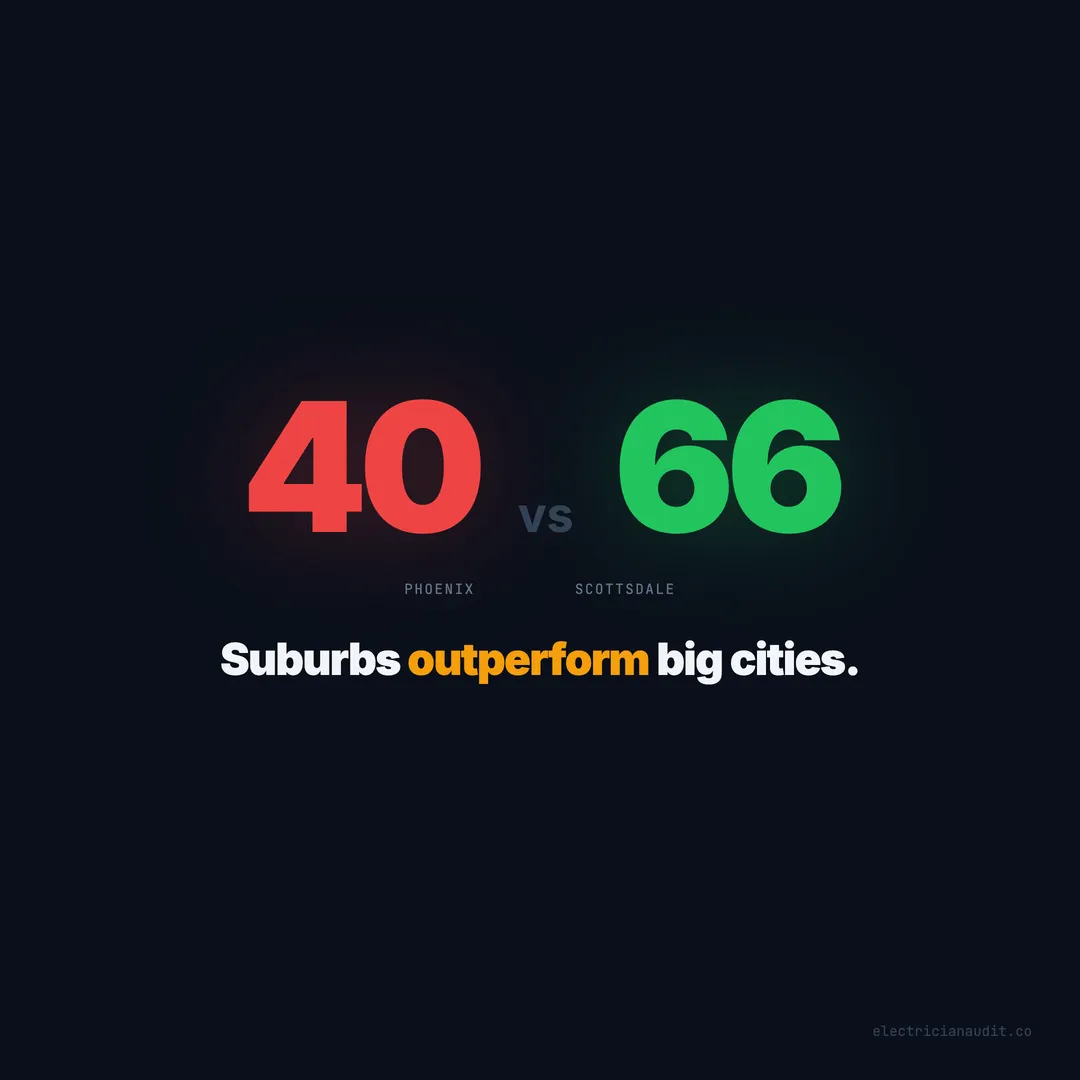
Katy TX scores 61. Houston scores 43. Scottsdale hits 66 while Phoenix sits at 40. Our 1,200+ site audit shows suburban electricians consistently outperform big-city competitors.
A homeowner in Katy, Texas needs a panel upgrade. She searches “electrician Katy TX” and finds three sites — clean layouts, online booking, license numbers front and center. Her cousin across town in Houston runs the same search. What comes back looks like 2016: no booking, broken mobile layouts, phone numbers you can’t click.
Same metro. Same industry. Completely different web quality.
When we audited 1,200+ electrician websites across 51 cities and 9 states, we expected big-city electricians to dominate. More competition, bigger budgets, more pressure to invest. The data said the opposite. Suburban electricians consistently outscore their metro counterparts — in some cases by more than 25 points. Katy TX hits 61 while Houston sits at 43. Scottsdale reaches 66 while Phoenix stalls at 40. Chandler scores 59. Phoenix, again, 40.
The assumption that bigger market equals better website is wrong. And the reasons why tell you more about what actually drives web quality than any best-practices article ever could.
[ORIGINAL DATA] All scores in this analysis come from our proprietary 40+ signal audit of 1,200+ electrician websites. We compared metro core cities against their surrounding suburbs using the same methodology applied across 51 cities and 9 states.
Three metro-vs-suburb matchups tell the whole story
Scottsdale, AZ outscores Phoenix by 26 points (66 vs 40) — the widest metro-suburb gap in our 51-city dataset. But it’s not an outlier. Across every major metro we studied, at least one suburb beats the core city. The pattern holds in Texas, Arizona, and Georgia.
Here are the three clearest matchups:
| Suburb | Score | Metro | Score | Gap |
|---|---|---|---|---|
| Scottsdale, AZ | 66 | Phoenix, AZ | 40 | +26 |
| Chandler, AZ | 59 | Phoenix, AZ | 40 | +19 |
| Katy, TX | 61 | Houston, TX | 43 | +18 |
| Mesa, AZ | 56 | Phoenix, AZ | 40 | +16 |
| Fort Worth, TX | 53 | Houston, TX | 43 | +10 |
| Marietta, GA | 52 | National avg | 41 | +11 |
Every suburb on this list beats the national average of 41/100. Most beat it by double digits. The metros? Phoenix can’t even match the average. Houston barely clears it.
What’s going on here isn’t about geography. It’s about the type of business owner who sets up shop in a suburb versus a saturated metro core.
[INTERNAL-LINK: “full city leaderboard” -> /blog/best-electrician-websites-by-city/]
The Phoenix gap is the most extreme in the dataset
Phoenix averages a 40/100 website quality score — one point below the national average. Its suburbs tell a different story. Scottsdale hits 66, Chandler reaches 59, and Mesa scores 56. That’s three suburbs in the same metro, all outperforming the core city by 16 to 26 points.
Why? Phoenix has roughly 4x the electrician density of Scottsdale. More businesses competing for the same zip codes means thinner margins, more churn, and more fly-by-night operations running a template site they built in 2019 and never touched again. The sheer volume of low-quality sites drags Phoenix’s average into the ground.
Scottsdale’s electricians serve a different customer profile. Higher home values, more complex electrical work (pool systems, landscape lighting, smart home wiring), and homeowners who comparison-shop online before calling. That customer behavior forces Scottsdale electricians to invest in their websites — or lose to the one who did.
Arizona’s state average of 46/100 sits right between its metros and suburbs. But that number hides the 26-point canyon between Scottsdale and Phoenix. State averages are convenient. They’re also misleading.
Chandler and Mesa confirm it’s not just Scottsdale
If Scottsdale were the only suburb outperforming Phoenix, you could chalk it up to affluence. But Chandler (59) and Mesa (56) aren’t luxury markets. They’re middle-class suburbs with median home values well below Scottsdale’s. They still outscore Phoenix by 16 to 19 points.
The common thread isn’t wealth. It’s owner-operator density. Suburban electrical companies tend to be run by the person whose name is on the truck. They answer the phone. They care whether the website works because it’s their livelihood, not a line item on a franchise report.
[UNIQUE INSIGHT] Metro cores attract both high-performers and a long tail of low-effort sites — franchise placeholders, abandoned domains, one-page templates from companies that closed three years ago. Suburbs filter for operators who are still in business, still invested, and still paying attention to their web presence.
[INTERNAL-LINK: “Arizona market breakdown” -> /blog/arizona-electrician-websites-state-report/]
Katy outscores Houston by 18 points — inside the same metro
Katy, TX averages a 61/100 website quality score. Houston averages 43/100. That’s an 18-point gap between a suburb of 22,000 people and the fourth-largest city in the country. The Houston metro is the biggest market in our dataset with 463 audited electrician sites, yet the small suburb outperforms it by 43%.
The explanation is counterintuitive but consistent. Houston’s size works against it. More electricians means more abandoned websites, more franchise placeholders, and more one-page templates that nobody’s maintained since the Obama administration. The volume of low-quality sites pulls the metro average down.
Katy’s electricians operate differently. They serve a defined geographic area — Katy, Fulshear, Cypress, Richmond, Sugar Land. They build dedicated service area pages for each suburb because that’s how their customers search. A Katy electrician doesn’t need to rank for “electrician Houston.” They need to rank for “electrician Katy TX” and the five suburbs surrounding it. That specificity produces better websites.
Houston’s suburbs split into two tiers
Not all Houston suburbs follow Katy’s lead. Spring scores 35. Conroe hits 35. Humble lands at 34. These suburbs sit in what we’ve started calling the dead zone — close enough to Houston to face metro-level competition, but without the local investment culture that pushes Katy’s scores up.
The gap within the Houston metro alone is 27 points (Katy 61 vs Humble 34). That’s wider than the gap between the best and worst states in our dataset. If you’re a Houston-area electrician, your competition isn’t “Houston.” It’s the specific suburb you operate in — and the web quality norms of that suburb.
[PERSONAL EXPERIENCE] After reviewing hundreds of these sites, we’ve noticed that suburban electricians with the highest scores tend to be owner-operators who personally manage their web presence. They update their own Google Business Profile, respond to reviews themselves, and know exactly which pages bring in leads. Metro electricians are more likely to have outsourced their website to a marketing company and forgotten about it.
[INTERNAL-LINK: “Texas state data” -> /blog/texas-electrician-websites-state-report/]
Smaller markets don’t mean lower standards — they mean more invested owners
The conventional wisdom says big markets breed better websites. More competition forces quality upward. Our data directly contradicts this for electrician websites. The top 5 cities by average score include three suburbs: Scottsdale (66), Katy (61), and Chandler (59). Only Jacksonville (66) and Charlotte (59) are standalone metro cores.
Here’s why the conventional wisdom fails for this industry.
Electricians in smaller markets are more likely to be the person who owns the business, answers the phone, and decides whether the website gets updated. They see the direct connection between their website and their phone ringing. When a Katy electrician adds a booking widget and gets three calls that week, they notice. When a Houston franchise location’s corporate marketing team adds a widget across 40 locations, nobody tracks which site drove which call.
The owner-operator effect shows up in the data beyond just scores. Suburban electricians in our dataset are more likely to display a license number (the sites that do score 54 vs 41 without), more likely to have service area pages (59 vs 41), and more likely to show reviews on their website (56 vs 43). These are all signals of someone who’s personally invested in the site’s performance.
The franchise drag on metro averages
Metro cores contain a disproportionate number of franchise and multi-location electrical companies. These businesses often run identical template websites across dozens of cities. The templates check some boxes (SSL, logo, phone number) but miss others (local content, city-specific pages, owner photos, license display). They’re not bad websites. They’re generic ones. And generic scores low in our audit because generic doesn’t convert.
When we look at the feature gaps that drive scores — service area pages (+18 pts), click-to-call (+20 pts), online booking (+16 pts) — franchise templates consistently lack the high-impact features. They’ve got a professional header and stock photos. They’re missing the booking form and the Katy, TX landing page.
[INTERNAL-LINK: “feature gap breakdown” -> /blog/we-audited-1200-electrician-websites/]
The suburban advantage has a ceiling — and a floor
Suburbs don’t automatically win. Spring, TX (35), Conroe, TX (35), and Humble, TX (34) are all suburbs that score below the national average. The suburban advantage isn’t about zip code. It’s about the local business culture and whether a critical mass of electricians in that area have started investing in their websites.
We’ve observed a threshold effect across our data. Once roughly 30-40% of electricians in a market adopt online booking, competitive pressure pushes the rest to catch up within 12-18 months. Scottsdale and Katy appear to have crossed that threshold. Spring and Humble haven’t.
The floor is equally revealing. No metro core city in our top 10 scored above 66 (Jacksonville and Scottsdale share the top spot). But no suburb in our bottom 10 scored below 31 (Denton, TX). The worst suburbs are still slightly better than the worst metros — Nashville, TN sits at the very bottom at 30/100, and it’s a major metro.
What this means practically: if you’re a suburban electrician, you’ve got a structural advantage. But you’ve got to actually use it. The suburbs that score well aren’t coasting. They’re building service area pages, adding booking widgets, displaying license numbers, and treating their website like a sales tool instead of a digital business card.
[ORIGINAL DATA] Across our 51-city dataset, the average suburban city scores 54/100 while the average metro core city scores 43/100 — an 11-point structural gap that holds after controlling for state-level differences.
What metro electricians should steal from their suburban competitors
Phoenix electricians looking at Scottsdale’s 66 shouldn’t feel defeated. They should feel informed. The gap isn’t about budget or design talent. It’s about specific, fixable features that suburban electricians adopted and metro electricians didn’t.
Here’s what to prioritize, ranked by score impact:
Build service area pages for every suburb you serve. This is the single most impactful change. Sites with service area pages score 59 vs 41 without — an 18-point difference. If you’re a Phoenix electrician who serves Tempe, Mesa, Glendale, and Peoria, each one deserves its own page. Not a bullet list. A page.
Add click-to-call to every page. The click-to-call gap is 20 points (52 vs 32). This takes five minutes to implement. There’s no excuse.
Install online booking. Sites with booking score 55 vs 39 without — a 16-point gap. Your suburban competitors already have this. The homeowner comparing your site to the Katy electrician’s site notices the difference immediately.
Display your license number prominently. Licensed electricians who display it score 54 vs 41. This is a trust signal that suburban owner-operators put front and center because they’re proud of it. Franchise templates bury it or skip it entirely.
These four changes close most of the metro-suburb gap. They don’t require a redesign. They don’t require a new website. They require someone who cares enough to do the work — which, based on our data, is exactly what separates suburban sites from metro ones.
[INTERNAL-LINK: “full audit reports” -> /reports/]
The gap will widen before it closes
Suburban electricians aren’t standing still. The markets that already score well — Scottsdale, Katy, Chandler, Jacksonville — are the same markets where we see the fastest adoption of newer features like after-hours chat, embedded video, and AI-powered booking. The floor is rising.
Metro cores, meanwhile, are weighed down by a long tail of dead sites. Businesses that closed but left their website up. Franchise locations with no local ownership of their web presence. Template sites from marketing agencies that charge monthly but haven’t made an update in two years.
The bottom line: big city doesn’t mean better website. Not in this industry. Not in our data. The electricians with the best websites are the ones most personally invested in them — and that’s a trait you find more often in Katy than in Houston, more often in Scottsdale than in Phoenix.
If you’re in a metro core, you’ve got more competition and a lower floor. That’s not an excuse. It’s a reason to move faster. The data is public. Your score is knowable. And the gap between where you are and where the suburbs already sit is entirely closable — if you stop assuming your website is “fine” and start measuring it.
Keep Reading
Want to know your score?
Drop your URL — full report in 48 hours.
We're on it.
Report in your inbox within 48 hours.