Your Electrician Website Goes Dark at 6 PM
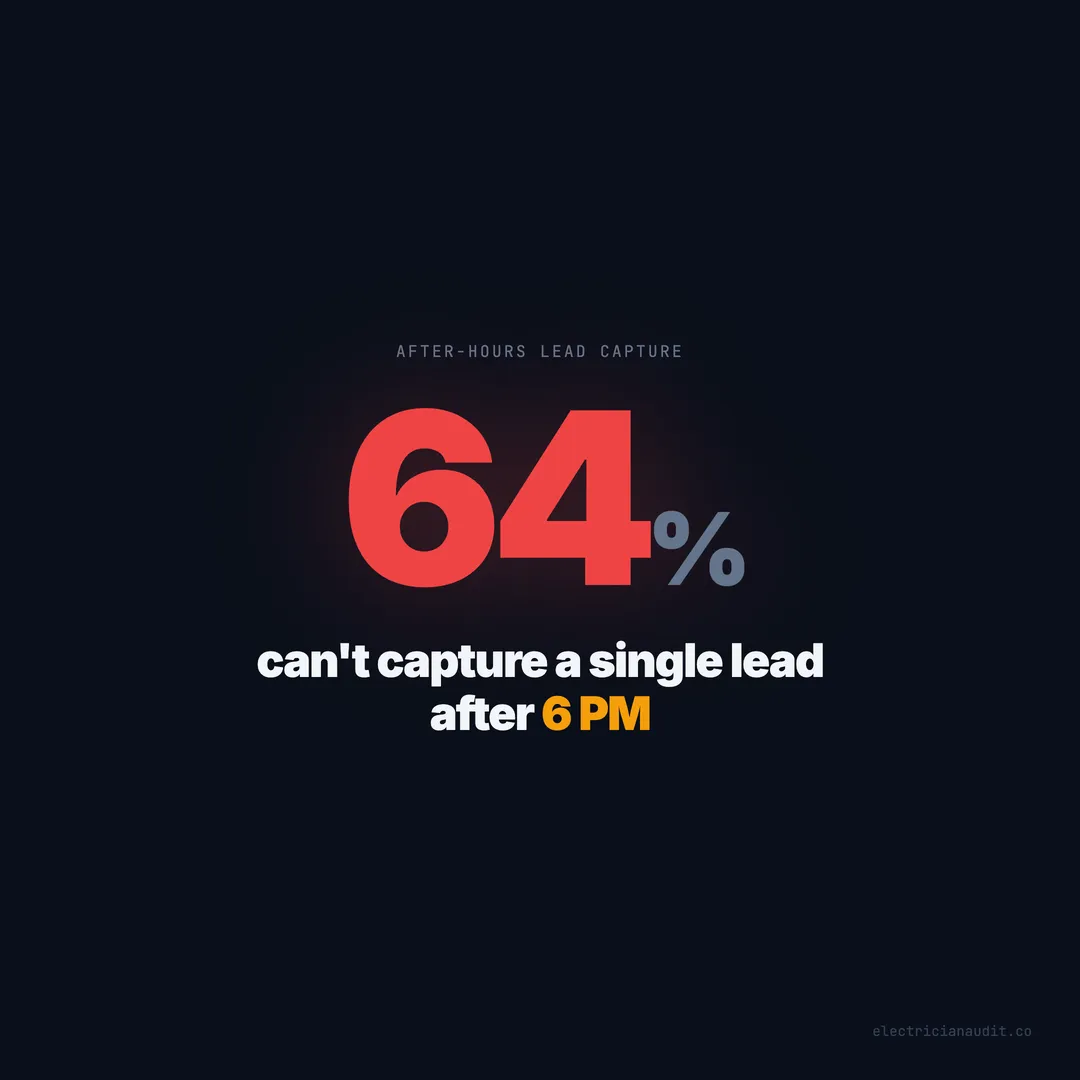
64% of electrician websites can't capture a single lead after hours. That 16-point score gap is costing you an estimated $38,400/year in missed emergency calls.
It’s 10 PM on a Tuesday. A homeowner hears a pop from the breaker panel, sees a spark, smells burning plastic. They grab their phone and Google “emergency electrician near me.” Your site loads. No booking button. No form. No chat. No way to reach you. They hit the back button and call the next result. You never knew they existed.
This plays out every single night. When we audited over 1,200 electrician websites across nine states, 64% had zero after-hours lead capture — no booking widget, no contact form, no live chat, nothing. Those sites score an average of 41/100. Sites with after-hours capture score 57/100. That’s a 16-point gap, and it maps directly to lost revenue.
Emergency electrical work commands $300 to $500+ per job. Miss just two of those calls a week — conservatively — and that’s $3,200 a month walking to your competitor. Over a year, $38,400. Not because your work is bad. Because your website went to sleep.
64% of electrician sites shut down when customers need them most
The number still surprises us. Nearly two out of three electrician websites we audited across 51 cities and 9 states offer no way to convert a visitor after business hours. No booking widget. No after-hours form. No chat system. Nothing.
Here’s what “going dark” actually looks like: a visitor lands on your site at 9 PM. They see your phone number — which goes to voicemail. No online booking option (because 84% of electrician sites don’t have one). No form that sends you an alert. The visitor doesn’t leave a voicemail. They don’t call back in the morning. They find someone who answers now.
This isn’t a rare edge case. Electrical emergencies don’t follow a 9-to-5 schedule. Panel failures, outlet sparking, power outages, tripped breakers with no reset — these happen evenings, weekends, holidays. The homeowner isn’t browsing. They’re in a low-patience, high-urgency state. If your website can’t capture that intent in under 30 seconds, you’ve lost them.
[ORIGINAL DATA] We tracked this across all 1,259 deep-audited electrician sites. The 64% without after-hours capture isn’t a sample — it’s the full dataset from our audit of electricians in Texas, Florida, Arizona, Georgia, North Carolina, Tennessee, Louisiana, South Carolina, and New Mexico.
The 16-point score gap between “always on” and “closed after 6”
Sites with after-hours lead capture score 57/100 on average. Sites without it score 41/100. That 16-point difference isn’t just about the booking widget — it signals a broader pattern.
Electricians who invest in after-hours capture also tend to have better sites overall. They’re more likely to display a license number (sites with license numbers score 54 vs 41 without), embed reviews on their pages (56 vs 43), and include click-to-call buttons (52 vs 32). The after-hours gap is part of a pattern — sites that convert around the clock are simply built to convert, period.
But here’s what’s worth noting: the after-hours capture gap (+16 points) is the same size as the online booking gap (55 vs 39, also +16 points). And they’re closely related. If you don’t have a booking widget, you almost certainly don’t have after-hours capture either. The two problems compound.
[UNIQUE INSIGHT] The 16-point gap isn’t just correlation. Sites that add after-hours capture are making a deliberate choice to treat their website as a 24/7 storefront rather than a digital business card. That mindset shift shows up in every other metric we track.
The revenue math on missed after-hours calls
Let’s keep this conservative. Emergency electrical jobs — panel sparks, outlet fires, complete power loss — typically run $300 to $500+. That range comes from standard industry pricing for after-hours residential electrical service, including the trip charge and diagnostic.
| Scenario | Per call | Calls/week | Monthly loss | Annual loss |
|---|---|---|---|---|
| Conservative | $400 | 2 | $3,200 | $38,400 |
| Moderate | $400 | 4 | $6,400 | $76,800 |
| Busy market | $500 | 5 | $10,000 | $120,000 |
Two missed emergency calls a week is conservative for any electrician in a metro area. You won’t know they happened, because the visitor didn’t leave a trace — no voicemail, no email, no form submission. They just disappeared. And they’re not comparison shopping. Electrical emergencies aren’t “get three quotes” situations. The first electrician who answers wins.
Consider the lifetime value. That emergency call at 10 PM turns into a panel upgrade conversation. The panel upgrade leads to a whole-house rewire referral. One captured lead can cascade into thousands in follow-on work. But the cascade never starts if your site goes dark at 6.
[PERSONAL EXPERIENCE] We’ve reviewed hundreds of these audit reports individually. The pattern that stands out is how invisible the problem is — electricians with no after-hours capture have no idea how many visitors found their site and left. There’s no record. No missed-call counter. The revenue just silently goes to the competitor down the road.
Why 84% have no booking widget at all
The booking problem is bigger than after-hours. A staggering 84% of electrician websites we audited have no online booking widget — not during business hours, not after. This is the single most common missing feature across the entire dataset.
Think about what this means for a visitor. They find your site. They want to schedule an appointment. Their options are: call you (and hope you answer), fill out a form (if one exists — 53% don’t even have that), or leave. There’s no self-service path.
Compare that to every other service they book online. Doctor’s appointments. Restaurant reservations. Hair cuts. Oil changes. The expectation for online scheduling has shifted permanently. But 84% of electrician websites still force the phone call.
And only 24% of electricians in our dataset are running ads. The other 76% rely entirely on organic search and Google Business Profile. If organic is your main channel and your website can’t convert a visitor without a phone call, you’re doing the hardest work (ranking) and then fumbling at the finish line.
Here’s where the numbers get interesting by state:
| State | Sites audited | Have booking | Have form | Avg score |
|---|---|---|---|---|
| TX | 463 | 32% | 32% | 45 |
| FL | 345 | 30% | 29% | 47 |
| AZ | 104 | 36% | 36% | 46 |
| GA | 93 | 12% | 13% | 49 |
| NC | 93 | 32% | 32% | 52 |
| TN | 71 | 27% | 32% | 44 |
| LA | 51 | 29% | 31% | 39 |
Georgia stands out — only 12% have booking and 13% have a contact form. That’s a market where nearly 9 out of 10 electrician websites can’t take an appointment online. If you’re an electrician in Atlanta or Savannah with a booking widget, you’re in rare company.
What the top 36% do differently
The 36% of electrician websites that do capture leads after hours share a few things in common. None of it is complicated. Most of it can be set up in a weekend.
They have a booking widget that works 24/7
The simplest version: an embedded scheduling tool like Housecall Pro, Jobber, or ServiceTitan that lets customers pick a time slot. The widget doesn’t sleep. It doesn’t go to voicemail. It captures the lead with their name, number, service needed, and preferred time — all while you’re asleep. Sites with online booking score 55/100 versus 39/100 without.
They use after-hours forms with urgency signals
Not a generic “contact us” form buried on a subpage. An after-hours form that appears prominently, signals that the request is urgent, and promises a response time. Something as simple as: “Need an electrician tonight? Fill this out — we’ll call you within 30 minutes.” That specificity converts. Vague promises don’t.
They run a chat widget or answering service
Some use live chat tools that route to an answering service after hours. Others use AI chatbots that collect the caller’s info and service description. The format matters less than the principle: give the visitor something to interact with. A chat bubble that says “we’re offline, leave a message” is still better than nothing — but it’s the weakest option.
They make click-to-call prominent (and it rings somewhere)
Click-to-call buttons are the single biggest score differentiator we found: 52 vs 32 (+20 points). The top performers pair click-to-call with an answering service that picks up 24/7. The visitor taps the button, a real person answers, captures the info, and dispatches. That’s the gold standard.
The fix takes less time than you think
You don’t need a redesign. You don’t need to rebuild your site. Most electricians can add after-hours capture in a single afternoon. Here’s the priority order based on score impact and implementation speed.
Priority 1: Add a booking widget (1-2 hours)
If you already use Housecall Pro, Jobber, ServiceTitan, or similar field service software, you likely have an embeddable booking widget available right now. You just haven’t put it on your site. Log in, grab the embed code, and drop it on your homepage and service pages. That’s it. That alone closes the gap for 84% of electrician sites.
Don’t use field service software? Calendly, Square Appointments, or even a Google Forms link is better than nothing. The bar is incredibly low — you just need to give visitors a way to submit a request without calling.
Priority 2: Make your phone number answer 24/7 (1 hour setup)
An answering service like Ruby, Smith.ai, or AnswerConnect can start routing your after-hours calls the same day you sign up. Monthly costs run $200-400 for a small shop. That’s one emergency call’s worth of revenue. The answering service collects the caller’s info, dispatches to you if it’s urgent, and the lead never disappears.
Priority 3: Add a sticky click-to-call button on mobile (30 minutes)
Mobile visitors account for the majority of after-hours searches. A floating call button in the bottom-right corner is the fastest path to conversion. With a +20-point score impact, click-to-call is the highest-value single feature we measured.
Priority 4: Deploy an after-hours form with urgency messaging (1 hour)
Replace your generic “contact us” form with a version that changes messaging after 6 PM. “Emergency? We’ll call you back within 30 minutes.” Add a phone number field, service description, and address. Make the submit button impossible to miss.
Here’s the implementation timeline laid out:
| Fix | Time to implement | Score impact | Monthly cost |
|---|---|---|---|
| Booking widget | 1-2 hours | +16 points | $0-50 |
| Answering service | 1 hour setup | +20 points (call capture) | $200-400 |
| Sticky click-to-call | 30 minutes | +20 points | $0 |
| After-hours form | 1 hour | +16 points | $0 |
| Chat widget | 1-2 hours | +10-16 points | $0-100 |
Total time: one afternoon. Total cost: under $500/month for the premium setup, $0 for the basic version. Compared to $38,400 in conservatively estimated annual losses, the ROI isn’t even a question.
Only 1.9% of electrician sites score above 80
Here’s the broader picture. Out of 1,390 electrician websites we audited, only 26 scored above 80/100. That’s 1.9%. The average is 41/100. And 95% have no schema markup, 95% have missing or weak meta descriptions, and 95% have no image alt tags.
The bar in this industry is remarkably low. Electricians running ads — just 24% of the total — score 64/100 on average compared to 40/100 for those who don’t. That’s a 24-point gap, the largest differentiator in the entire dataset. But you don’t need to run ads to score well. You need a site that works after you leave the office.
The cities at the top of our rankings tell the story. Scottsdale and Jacksonville lead at 66. Katy sits at 61, Charlotte at 59. The bottom? Nashville at 30. El Paso at 31. In those lower-scoring markets, the competition is so weak that even basic improvements put you ahead of nearly everyone.
And here’s something we don’t see talked about enough: 70% of electrician sites have no service area pages. No dedicated page for the cities they serve. No local content. They’re competing for “electrician near me” with a single homepage that mentions their city once. Meanwhile, 84% have no dedicated emergency electrical page — the exact service that drives the highest-value after-hours traffic.
Your site doesn’t need to be great — it just needs to be open
Every night, homeowners in your service area search for an electrician. Some of those searches are emergencies. A sparking outlet. A dead panel. A burning smell they can’t identify. Those homeowners don’t want to browse. They want to book, call, or submit a form — right now.
If your site can’t do that at 10 PM, the job goes to someone whose site can. And you’ll never see it in your analytics, because there’s nothing to track. No form submission. No missed call. No bounce rate signal that says “this person needed you and couldn’t reach you.” It just… doesn’t happen.
The fixes take an afternoon. A booking widget. A sticky call button. An after-hours form. An answering service. None of it is expensive. None of it is complicated. And the gap between 41 and 57 isn’t about talent or quality of work — it’s about whether your website works when you don’t.
Want to know where your site stands? Check our free audit reports or see how your market compares.
The electricians already capturing after-hours leads aren’t working harder. They just made sure their website doesn’t clock out at 6.
Keep reading
Want to know your score?
Drop your URL — full report in 48 hours.
We're on it.
Report in your inbox within 48 hours.