60% of Electrician Websites Trigger Chrome's 'Not Secure' Warning — Before the Homepage Loads
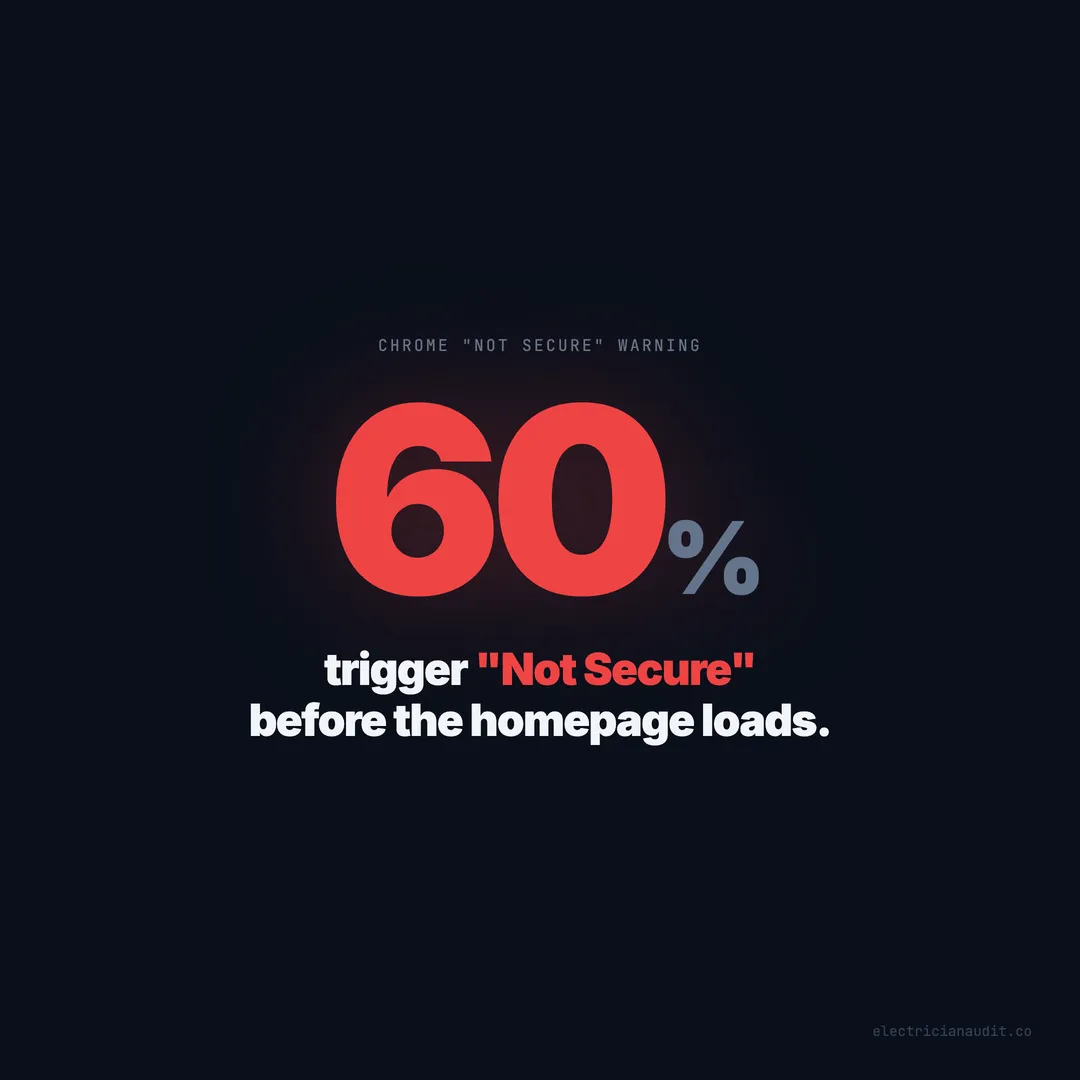
60% of electrician websites lack HTTPS. Chrome flags them 'Not Secure' before the homepage loads — a trust killer for a trade that enters homes to handle live wires.
A homeowner searches “electrician near me” on her phone. She taps your result. Before your logo loads, before she sees your phone number, before she reads a single word — Chrome puts “Not Secure” in the address bar. Right there, next to your URL, in plain text. She doesn’t know what HTTPS means. She doesn’t need to. The browser just told her your website isn’t safe. She hits the back button. She picks the next result. You never knew she existed.
This isn’t hypothetical. When we audited 1,200+ electrician websites across 9 states, 60% didn’t redirect HTTP to HTTPS. That means 60% of electrician websites trigger Chrome’s “Not Secure” warning the instant someone visits. For a business that asks homeowners to open their front door and let a stranger work on live electrical wiring — that warning is a deal-breaker before the deal even starts.
The general web has largely moved past this problem. Across all industries, only 5-15% of websites still lack HTTPS. Electricians are 4 to 10 times worse. And unlike a bad color scheme or a missing phone number, this failure hits before the visitor sees anything you’ve built.
Chrome’s “Not Secure” label appears before your content loads
Chrome has flagged HTTP sites as “Not Secure” since July 2018. That’s almost eight years. The warning appears in the address bar immediately — before images render, before fonts load, before the homepage displays. It’s the first thing a visitor processes.
In our 1,200-site audit, 60% of electrician websites lack HTTPS redirect (electricianaudit.co, 2026). That means the majority of electricians are greeting every visitor with a browser security warning. The visitor doesn’t need technical knowledge to react. She sees the word “Not Secure” next to a padlock icon with a line through it, and her gut says leave.
How does this actually work? When your site uses HTTP instead of HTTPS, data between the visitor’s browser and your server travels unencrypted. Chrome warns users because any information they enter — a phone number in your contact form, an email in your booking widget — could theoretically be intercepted. Most electrician sites don’t collect sensitive data, but Chrome doesn’t make exceptions. No HTTPS, no trust badge. Period.
What the visitor actually sees
The experience is fast and brutal. On desktop, Chrome shows a small “Not Secure” text left of the URL. On mobile, it’s even more visible because the address bar takes up proportionally more screen space. Since 63% of electrician website traffic comes from mobile devices (BrightLocal, 2025), the majority of your visitors see this warning in its most prominent form.
The visitor doesn’t analyze the warning. She doesn’t think about encryption protocols. She just feels uneasy. And when you’re asking her to let you into her home to touch her electrical panel, unease is the last emotion you want to trigger.
Electricians are 4-10x behind the general web on HTTPS
The internet largely solved this problem years ago. According to the W3Techs Web Technology Survey (2025), over 85% of websites globally use HTTPS. Google’s Transparency Report shows that over 95% of Chrome page loads use HTTPS across all platforms. The holdouts are a small, shrinking minority.
Except in the electrician industry. Our audit found 60% of electrician websites don’t redirect to HTTPS — a rate 4 to 10 times higher than the general web average. Why? It’s not cost. Most hosting providers include free SSL certificates through Let’s Encrypt. It’s not difficulty. Enabling HTTPS takes 30 minutes or less on most platforms.
The real reason is neglect. Many electrician websites were built years ago by a friend, a nephew, or a cheap freelancer, then never touched again. The original builder didn’t set up SSL, and nobody has logged into the hosting panel since. The site still works, so nobody notices the problem — except every single visitor.
That chart should bother you. The entire internet moved to HTTPS. Electricians — a trade built on trust — didn’t.
”Not Secure” hits harder for electricians than almost any other trade
Here’s something worth sitting with. A “Not Secure” warning on a recipe blog? Annoying but forgettable. A “Not Secure” warning on a website asking to send someone into your home to work on live 200-amp electrical panels? That’s a different calculation entirely.
Homeowners hiring an electrician are making a high-stakes trust decision. They’re letting a stranger into their house to handle systems that can start fires, cause electrocution, or destroy appliances. The decision is already stressful. According to a HomeAdvisor survey (2024), 86% of homeowners say trust is the most important factor when hiring a home service professional — ranking above price, speed, and reviews.
Now imagine that homeowner lands on your site and Chrome immediately tells her it’s not secure. She hasn’t seen your license number. She hasn’t read your reviews. She hasn’t even seen your name. The browser already undermined you.
The psychology of the first impression
Researchers at the Missouri University of Science and Technology found that visitors form a first impression of a website in less than 0.2 seconds (Missouri S&T, 2012). That’s faster than reading a single word. The “Not Secure” warning loads in that window — before your hero image, before your headline, before any trust signal you’ve placed on the page.
The warning doesn’t just compete with your content. It precedes it. Every positive signal you built — your license badge, your “Licensed & Insured” text, your five-star reviews — has to overcome a negative first impression that Chrome planted before the visitor even started evaluating you.
Can they overcome it? Some visitors will stay and look around. But why would you start at a disadvantage when the fix takes 30 minutes?
No HTTPS + no license + no reviews = the trust compound collapse
The “Not Secure” warning would be bad enough on its own. But for most electrician websites, it doesn’t arrive alone. It stacks on top of other missing trust signals, creating a compound failure that makes the site virtually unconvertible.
From our 1,200-site audit: 56% don’t display a license number anywhere on the site. 42% don’t mention the words “licensed” or “insured.” And 76% don’t embed a single review on their website. Layer the 60% HTTPS failure on top, and you get a picture of an industry-wide trust vacuum.
Here’s how it compounds. A visitor arrives and Chrome says “Not Secure.” She stays anyway — maybe she’s less tech-savvy, maybe she’s in a hurry. She looks for reassurance. No license number. No insurance mention. No reviews from real customers. No state contractor badge. Just the word “professional” used three times and a stock photo of a guy with a hard hat.
She leaves. Not because of any single missing element, but because nothing on the site gave her a reason to stay after the browser gave her a reason to go.
The score gap tells the story
In our data, sites with SSL, a contact form, and a clear CTA scored 55/100 on average. Sites without HTTPS and without these conversion basics scored 43/100 — a 12-point gap (electricianaudit.co, 2026). And that 12-point gap underestimates the real damage because it only measures what we can audit. It doesn’t measure the visitors who bounced before the page finished loading.
When we looked at sites missing their license number, the pattern was identical: sites that hide credentials score 13 points lower. Stack the HTTPS gap and the license gap together and you’re looking at a site that’s 25+ points behind competitors who fixed both.
Each missing trust signal doesn’t just subtract points. It removes a layer of reassurance that the next signal depends on. HTTPS is the foundation layer. Without it, nothing else you’ve built sits on solid ground.
Google has used HTTPS as a ranking signal since 2014
Trust isn’t the only casualty. Google confirmed HTTPS as a ranking signal back in August 2014 (Google Search Central Blog, 2014). That was over a decade ago. Google called it a “lightweight” signal at the time, but in the years since, the weight has grown as HTTPS became the universal standard.
According to a FirstPageSage analysis (2024), HTTPS is one of over 200 confirmed ranking factors in Google’s algorithm. It’s not the biggest factor — content relevance, backlinks, and user engagement still dominate. But here’s the thing: in local search, where electricians compete, the margins are razor-thin. You’re not competing against Amazon or Wikipedia. You’re competing against the five other electricians in your zip code. A small ranking signal can mean the difference between position 3 and position 8.
And it gets worse. Google’s John Mueller has stated that Google prefers HTTPS URLs when all other signals are equal (Google Search Central, 2020). If two electrician websites have similar content, similar backlinks, and similar reviews — but one has HTTPS and the other doesn’t — Google picks the HTTPS site. When 60% of your competitors don’t have HTTPS, fixing yours is a free ranking advantage over the majority.
The local pack impact
For electricians, the Google Local Pack (the three-result map section) drives a disproportionate share of calls. According to BrightLocal’s Local Consumer Review Survey (2024), 42% of local searchers click a result in the Local Pack. Google’s own documentation confirms that “prominence” — which includes web presence quality — influences Local Pack rankings.
A non-HTTPS site tells Google your web presence is outdated. That signal feeds into the prominence calculation alongside reviews, citations, and content quality. You’re not just losing trust with visitors. You’re losing prominence with the algorithm that decides whether visitors find you at all.
The 30-minute fix that 60% of electricians haven’t done
Here’s where the story should shift from frustrating to motivating. Enabling HTTPS on your electrician website is free with most hosting providers and takes less than 30 minutes. This isn’t a $5,000 redesign. It’s not a six-month SEO project. It’s a single setting in your hosting panel.
Step 1: Check if your host includes free SSL. Most do. GoDaddy, Bluehost, SiteGround, Hostinger, Wix, Squarespace, WordPress.com — all of them offer free SSL certificates through Let’s Encrypt or their own certificate authority. If you’re on any mainstream host, you already have access to HTTPS. You just haven’t turned it on.
Step 2: Enable the SSL certificate. Log into your hosting dashboard. Find the SSL or Security section. Enable the free SSL certificate for your domain. On most platforms, this is a single toggle. On cPanel-based hosts, it’s under “SSL/TLS Status” and usually auto-installs via AutoSSL.
Step 3: Force HTTPS redirect. This is the step most people miss. Having an SSL certificate isn’t enough — you need to redirect all HTTP traffic to HTTPS. On WordPress, a plugin like Really Simple SSL does this in one click. On Wix and Squarespace, it’s automatic once SSL is enabled. On custom-hosted sites, it’s a few lines in your .htaccess file.
Step 4: Fix mixed content. After enabling HTTPS, check for “mixed content” warnings — these happen when your page loads over HTTPS but some images, scripts, or stylesheets still use HTTP URLs. Your browser’s developer console will flag these. Update the URLs to HTTPS and you’re done.
Step 5: Verify in Google Search Console. Add the HTTPS version of your site to Google Search Console if it isn’t there already. Submit your sitemap. Google will begin indexing the secure version.
Total time: 15-30 minutes. Total cost: $0 on most hosts. Yet 60% of electrician websites haven’t done it.
What if your host charges for SSL?
Some budget hosts or older hosting plans charge $50-$100/year for an SSL certificate. If your host charges for something that’s free everywhere else, that’s a sign to switch hosts — not a reason to skip HTTPS. A basic hosting plan with free SSL runs $3-$10/month on mainstream providers. The cost of not having HTTPS — in lost trust, lost rankings, and lost calls — dwarfs any hosting fee.
Sites with SSL and conversion basics score 12 points higher
The HTTPS gap isn’t just about security labels. It correlates with broader website quality in a way that directly impacts whether your phone rings.
In our audit, electrician websites with SSL, a contact form, and a clear CTA scored 55/100 on average — compared to 43/100 for sites lacking these basics (electricianaudit.co, 2026). That 12-point gap tracks consistently across states and city markets.
Why does HTTPS correlate with forms and CTAs? Because all three require someone to care about the website. An electrician who sets up SSL is the same kind of operator who adds a contact form, writes a real homepage, and puts a phone number in the header. The three signals travel together because they’re all symptoms of the same underlying behavior: taking the website seriously.
The reverse is also true. A site without HTTPS almost always lacks other basics. It’s the canary in the coal mine. If Chrome says “Not Secure,” there’s a strong chance the site also has no click-to-call, no booking, no license number, and no reviews. The 60% of electrician sites without HTTPS are overwhelmingly the same sites scoring below 40 in our audit.
What 12 points means in dollars
A 12-point score difference maps to a measurable conversion gap. Sites scoring in the mid-50s convert visitors to leads at roughly 4-5%, while sites in the low 40s convert at 2-3% (industry benchmarks from Unbounce, 2024). On a site getting 400 monthly visitors, that’s the difference between 8-12 leads and 16-20 leads. At an average residential electrical job value of $300-$500, those extra 8 leads translate to $2,400-$4,000 per month.
And all of that starts with the 30-minute HTTPS fix.
Your competitors already have HTTPS — the 40% who fixed it are pulling ahead
We’ve been focusing on the 60% who lack HTTPS. But here’s the flip side: 40% of electrician websites already have SSL properly configured. That 40% isn’t a random slice. They’re disproportionately represented in the top-scoring tiers of our audit.
Among sites scoring above 60 in our audit, over 80% have HTTPS properly configured (electricianaudit.co, 2026). Among sites scoring below 40? Only about 25% do. HTTPS alone doesn’t get you a high score — but not having it almost guarantees a low one.
The window for HTTPS to be a competitive advantage is closing. Eventually, even the electrician industry will catch up. But right now, in March 2026, the majority of your local competitors still haven’t made the switch. Fixing your site today puts you in the minority that Chrome doesn’t warn visitors about.
And it stacks with every other fix. Add HTTPS, then display your license number. Add a click-to-call button. Embed your Google reviews. Each fix builds on the one before it. The electricians in the top 1.9% of our audit — the 26 sites that scored above 80 — have all of these. None of them trigger a “Not Secure” warning.
Want to see how your site compares? Check our free audit reports — they include HTTPS status, trust signals, conversion elements, and a full score breakdown across 40+ signals.
Chrome tells your customers not to trust you — unless you spend 30 minutes fixing it
Sixty percent. That’s how many electrician websites fail the most basic trust test on the internet. Not a hard test. Not an expensive test. A test that Chrome runs automatically on every visit and displays the result in the address bar before the homepage loads.
You’ve spent years building trust in your community. You earned your license. You carry insurance. You show up on time and do clean work. Your Google reviews prove it — the average electrician in our dataset has a 4.78-star rating. But none of that matters if Chrome tells the homeowner your website isn’t secure before she reads a single word you’ve written.
The fix is free. It takes 30 minutes. It removes a warning that’s actively costing you calls, undermining your search rankings, and compounding every other trust gap on your site.
The 40% of electricians who already have HTTPS aren’t better at electrical work than you. They just logged into their hosting panel and flipped a switch. The question is whether you’ll spend 30 minutes doing the same — or keep letting Chrome introduce you as “Not Secure” to every homeowner who finds you.
Your license says you’re qualified to handle 200-amp panels. Your website should at least be able to handle an SSL certificate.
Keep reading
Want to know your score?
Drop your URL — full report in 48 hours.
We're on it.
Report in your inbox within 48 hours.