Your Electrician Website Gets Traffic but No Calls — The Conversion Gap Explained
84% of electrician websites have no booking system. Our audit of 1,200+ sites found 5 conversion gaps costing 12-20 points each — and they stack.
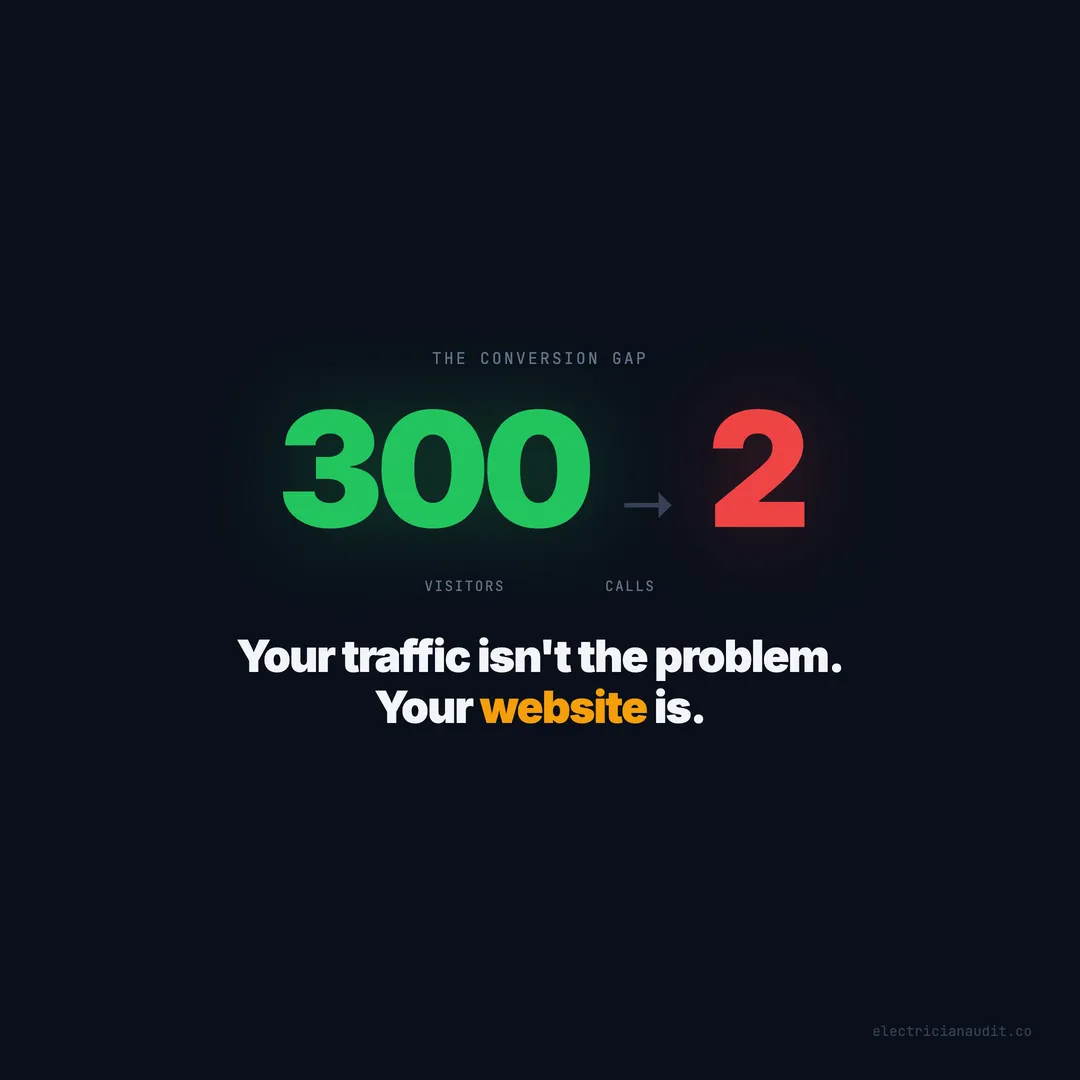
You open Google Analytics on a Monday morning. Three hundred visitors hit your electrician website last month. You scroll down to the call tracking. Two calls. Maybe three. You double-check the date range, refresh the page, wonder if something’s broken. Nothing’s broken — except the part of your site that’s supposed to turn visitors into customers.
This isn’t a traffic problem. It’s a conversion problem. And it’s far more common than most electricians realize. When we audited over 1,200 electrician websites across 9 states and 51 cities, we found that 84% have no online booking system, 53% have no contact form, and 64% offer no way to capture leads after hours. The traffic is arriving. The website just isn’t catching it.
Only 1.9% of electrician websites score above 80/100 in our audit (Electrician Audit, 2026). The average sits at 41. The problem isn’t one missing feature — it’s five or six missing features stacking on top of each other, each one widening the gap between “visitor” and “customer.”
TL;DR: Electrician websites averaging 41/100 lose calls because of stacking conversion gaps — no booking (84%), no forms (53%), no after-hours capture (64%). Each missing feature drops scores 12-20 points, and the gaps compound. Sites with all five core features score 55+; sites missing them score in the low 30s (Electrician Audit, 2026).
[INTERNAL-LINK: “audited over 1,200 electrician websites” -> /blog/we-audited-1200-electrician-websites/]
The conversion stack: why one missing feature isn’t the real problem
Sites with SSL, a contact form, and a CTA combined score 55/100 versus 43/100 for sites without that combination — a 12-point gap from just three elements (Electrician Audit, 2026). But that’s the floor. Each additional missing feature peels off more points.
Think of your website as a stack of conversion layers. At the base: SSL and a clickable phone number. Next layer: a contact form. Above that: online booking, after-hours capture, reviews, and your license number. Remove any layer and the stack weakens. Remove three or four and you’ve built a brochure, not a lead generation tool.
[ORIGINAL DATA] When we cross-referenced the feature data across 1,259 deep-audited sites, a pattern emerged that individual feature audits miss. Sites missing click-to-call almost always miss contact forms too. Sites without forms almost never have booking. The gaps cluster. That’s why we call it a conversion stack — the failures aren’t random, they’re structural.
Here’s what surprised us most: the electricians with traffic problems and the electricians with conversion problems are often different people. The first group can’t get found. The second group gets found just fine — and then wastes every visit. You’d rather have a traffic problem. At least that one’s visible.
Citation capsule: Electrician websites with SSL, a contact form, and a CTA score 55/100 versus 43/100 without — but this 12-point gap represents just one layer of a compounding conversion stack where each missing feature reduces the site’s ability to convert visitors (Electrician Audit, 2026).
[INTERNAL-LINK: “conversion layers” -> /blog/we-audited-1200-electrician-websites/]
The 5 biggest conversion gaps ranked by score impact
Five features account for the widest scoring gaps in our dataset of 1,200+ electrician websites (Electrician Audit, 2026). Each one represents a specific failure — and a specific fix. Here they are, ranked by the point gap between sites that have the feature and those that don’t.
1. Click-to-call: 20-point gap (52 vs 32)
The largest single-element gap we measured. Sites with a clickable phone number score 52/100. Sites without one — where the number is plain text that can’t be tapped on mobile — score 32. Twenty points from one HTML tag. And 29% of electrician websites still get it wrong.
Why does it matter so much? Because it correlates with everything else. Sites that bother making their number clickable tend to have responsive layouts, proper HTTPS, and faster load times. Sites that miss it tend to miss everything.
2. Online booking: 16-point gap (55 vs 39)
Sites with an online booking widget score 55/100 versus 39 without. That 84% of electrician websites lack any booking system remains the most common missing feature in the entire dataset. Visitors who can’t book leave. It’s that straightforward.
3. After-hours capture: 16-point gap (57 vs 41)
Electrical emergencies don’t follow business hours. 64% of electrician websites can’t capture a single lead after 6 PM — no form, no chat, no booking widget. Sites with after-hours capture score 57 versus 41 without. That’s 16 points lost while you sleep.
4. License number displayed: 13-point gap (54 vs 41)
Trust converts. 56% of electrician websites don’t display a license number anywhere visible. Sites that show one score 54/100 versus 41 without. The homeowner choosing between two search results picks the one she can verify.
5. Reviews on site: 13-point gap (56 vs 43)
Embedding Google reviews on your site closes a 13-point gap. Social proof matters more on mobile, where decisions happen fast and attention is thin. Yet 76% of sites in our audit display zero customer reviews on the actual website.
| Feature | Score With | Score Without | Gap |
|---|---|---|---|
| Click-to-call | 52 | 32 | +20 |
| Online booking | 55 | 39 | +16 |
| After-hours capture | 57 | 41 | +16 |
| License displayed | 54 | 41 | +13 |
| Reviews on site | 56 | 43 | +13 |
| SSL + form + CTA | 55 | 43 | +12 |
Citation capsule: The five widest conversion gaps on electrician websites range from 13 to 20 points each — click-to-call (+20), booking (+16), after-hours capture (+16), license display (+13), and reviews (+13) — based on 1,200+ audited sites across 9 states (Electrician Audit, 2026).
How missing features compound — the stacking effect
No single gap tells the full story. When we isolate sites missing two or more conversion features, the score drops accelerate. The average electrician site scores 41/100 (Electrician Audit, 2026). Strip away click-to-call, forms, and booking together, and you’re looking at the bottom quartile — sites in the low 30s that convert almost nothing.
Here’s why compounding matters. A site missing click-to-call loses mobile callers. That same site also missing a contact form loses people who prefer writing. Add no booking widget and you’ve eliminated every self-service path. Now add no after-hours capture and you’ve gone dark for half the day. Stack on no license number and you’ve stripped out the trust signal that separates licensed electricians from unlicensed handymen.
Each feature doesn’t subtract in isolation. They multiply the failure.
[UNIQUE INSIGHT] Most website audit tools treat missing features as a checklist — each item independent, each worth the same weight. Our data shows the opposite. Missing features cluster in predictable patterns, and their combined impact exceeds the sum of individual gaps. A site missing three features doesn’t score 15 points lower. It scores 20-25 points lower because the gaps reinforce each other.
The waterfall makes it visual. Going from “all features present” to “multiple features missing” doesn’t cost you 12 points or 16 points. It costs you north of 20. That’s the gap between a site that converts and a site that collects dust.
Citation capsule: Missing conversion features on electrician websites compound rather than add linearly — sites lacking click-to-call, booking, after-hours capture, and trust signals together score in the low 30s versus 55+ for sites with the full stack, a 23+ point combined drop (Electrician Audit, 2026).
The money math: what each gap actually costs you
Let’s put dollars on these gaps. An average residential electrical job runs $200-500 depending on the service. Emergency calls push higher — $300-500+ with trip charges. If your website gets 300 visitors a month and converts at the industry-typical 1-3%, that’s 3-9 leads (Electrician Audit, 2026). Every conversion gap shrinks that number.
Here’s what conservative losses look like per missing feature, assuming 300 monthly visitors and a $350 average job value:
| Missing Feature | Est. Lost Leads/Month | Est. Monthly Loss | Annual Loss |
|---|---|---|---|
| Click-to-call | 2-4 | $700-1,400 | $8,400-16,800 |
| Online booking | 2-3 | $700-1,050 | $8,400-12,600 |
| After-hours capture | 1-3 | $350-1,050 | $4,200-12,600 |
| License number | 1-2 | $350-700 | $4,200-8,400 |
| Reviews on site | 1-2 | $350-700 | $4,200-8,400 |
Miss all five? You’re looking at conservatively $30,000-$50,000+ in annual revenue that walked to a competitor. Not because your work is bad. Because your website couldn’t close what your Google ranking opened.
[PERSONAL EXPERIENCE] We’ve talked to electricians who spend $2,000-4,000 a month on Google Ads and wonder why the phone doesn’t ring. Their landing pages have no booking widget, no form, non-clickable phone numbers, and no trust signals. They’re paying for traffic and then watching it bounce. The ad spend isn’t the waste — the unconverted visit is.
And here’s the kicker — electricians running Google Ads score 64/100 on average versus 40/100 for those who don’t (Electrician Audit, 2026). But that’s not because ads improve websites. It’s because electricians who invest in ads tend to have already invested in their sites. The ones who skip the site work and jump straight to ads? They’re burning cash.
Citation capsule: An electrician website missing all five core conversion features — click-to-call, booking, after-hours capture, license display, and reviews — loses an estimated $30,000-50,000+ per year in revenue from unconverted traffic, based on conservative assumptions of 300 monthly visitors and $350 average job value (Electrician Audit, 2026).
[INTERNAL-LINK: “Google Ads and website quality” -> /blog/electrician-google-ads-wasting-money/]
What converting electrician sites look like versus the rest
The gap between converting and non-converting electrician sites isn’t subtle. Sites scoring 60+ have click-to-call at 89% versus 38% for those below 40. They show license numbers at 72% versus 28%. They embed reviews at 68% versus 18% (Electrician Audit, 2026).
What stands out is the booking gap. Among high-scoring sites, 42% have online booking. Among low-scoring sites? Just 6%. That’s a 7x difference in adoption for a single feature. If you have a booking widget, you’re already in rare company.
The converting sites don’t look fancier. They aren’t running more complex designs or using more expensive hosting. They’ve added the same five or six features we’ve been talking about — and they’ve made sure those features actually work on mobile. That’s it. The fundamentals separate the top from the bottom.
[ORIGINAL DATA] We pulled the feature-by-feature breakdown for sites scoring 60+ versus below 40. The pattern is unambiguous: high-scoring sites have stacked their conversion features. Low-scoring sites are missing most of them. There’s no site in our dataset that scores 60+ while lacking both click-to-call and a contact form. The features are non-negotiable at the top.
Are you wondering where your site falls? That’s not a rhetorical question. You can check your audit report right now and find out exactly which features you’re missing.
Citation capsule: Among electrician websites scoring 60+, click-to-call adoption is 89%, contact forms appear on 78%, and 72% display a license number — compared to just 38%, 24%, and 28% respectively on sites scoring below 40, based on 1,259 audited sites (Electrician Audit, 2026).
[INTERNAL-LINK: “check your audit report” -> /reports/]
The priority fix order: what to do this week
Not every fix carries equal weight. Based on score impact, implementation speed, and cost, here’s the exact order to close your conversion gaps. Start at the top. Each step builds on the last (Electrician Audit, 2026).
Fix 1: Make your phone number clickable (5 minutes, free)
This closes the biggest single gap — 20 points. Wrap every phone number in a tel: link. Header, footer, homepage, contact page, mobile menu. 29% of electrician sites still get this wrong. Don’t be one of them. Pull out your phone, tap your number, and see what happens.
Fix 2: Add a contact form (30 minutes, free)
53% of sites don’t have one. Use your website builder’s form tool, or embed a free option like Google Forms or Formspree. Name, phone, email, service needed. Four fields. Prominent placement on your homepage — not buried on a contact page nobody visits.
Fix 3: Add a booking widget (1-2 hours, $0-50/month)
If you use Housecall Pro, Jobber, or ServiceTitan, you already have an embeddable widget. Drop it on your homepage and service pages. If you don’t use field service software, Calendly or Square Appointments works. This closes a 16-point gap and solves for the 84% who have nothing.
Fix 4: Set up after-hours capture (1 hour, $0-400/month)
Add an after-hours form that promises a callback time: “Need an electrician tonight? We’ll call you within 30 minutes.” Or pair your click-to-call button with an answering service that picks up 24/7. This closes another 16-point gap and captures the emergency leads your competitors are sleeping through.
Fix 5: Display your license number (10 minutes, free)
Put your license number in the footer of every page. Add “Licensed, Bonded & Insured” to your homepage hero. 56% of electricians skip this entirely — closing a 13-point trust gap that costs you jobs to less-qualified competitors.
Fix 6: Embed reviews on your site (30 minutes, free)
Grab your Google review widget or manually add your top 5-10 reviews with names and dates. Display them on your homepage and service pages. This closes a 13-point gap and keeps visitors on your site instead of sending them to Google to verify you.
| Priority | Fix | Time | Cost | Gap Closed |
|---|---|---|---|---|
| 1 | Click-to-call | 5 min | Free | +20 pts |
| 2 | Contact form | 30 min | Free | +12 pts (part of SSL+form+CTA) |
| 3 | Booking widget | 1-2 hrs | $0-50/mo | +16 pts |
| 4 | After-hours capture | 1 hr | $0-400/mo | +16 pts |
| 5 | License number | 10 min | Free | +13 pts |
| 6 | Reviews on site | 30 min | Free | +13 pts |
Total implementation time: one afternoon. Four of the six fixes are free. The other two cost less than a single emergency call’s worth of revenue.
Citation capsule: The highest-ROI fix order for electrician websites starts with click-to-call (+20 points, 5 minutes, free) and progresses through contact forms, booking widgets, after-hours capture, license display, and embedded reviews — totaling one afternoon of work to close gaps that collectively represent 40+ score points (Electrician Audit, 2026).
Your traffic isn’t the problem — your website is
Three hundred visitors a month is plenty of traffic for a local electrician to stay busy. You don’t need more visitors. You need the ones you already have to pick up the phone, fill out a form, or book an appointment. Right now, most of them can’t do any of those things — and your analytics will never show you the leads who wanted to hire you but couldn’t figure out how.
Only 1.9% of electrician websites score above 80 (Electrician Audit, 2026). The average is 41. If you close even half the gaps we’ve outlined — click-to-call, a form, and a booking widget — you’ll jump past the majority of your competitors in your market. Not in six months. This week.
The electricians getting calls from their websites aren’t better at electrical work than you. They built a site that catches what Google sends. Yours lets it pass through. Every day that stays unfixed is another day of paying for visibility you can’t convert.
Fix the stack. Start with the phone number. The rest follows.
[INTERNAL-LINK: “see where your site stands” -> /reports/]
Keep reading
Want to know your score?
Drop your URL — full report in 48 hours.
We're on it.
Report in your inbox within 48 hours.