Florida Electrician Websites: 345 Audited, Average Score 47 — State Report
We audited 345 electrician websites across 14 Florida cities. Jacksonville leads at 66. Sarasota trails at 32. Full city-by-city data inside.
A homeowner in Sarasota searches “electrician near me” and lands on a site with no booking form, no license number, and no HTTPS. Thirty miles north in Tampa, the same search returns a site that books appointments at midnight. Same state, same industry, completely different experience. And the electrician in Sarasota? They don’t know they’re losing.
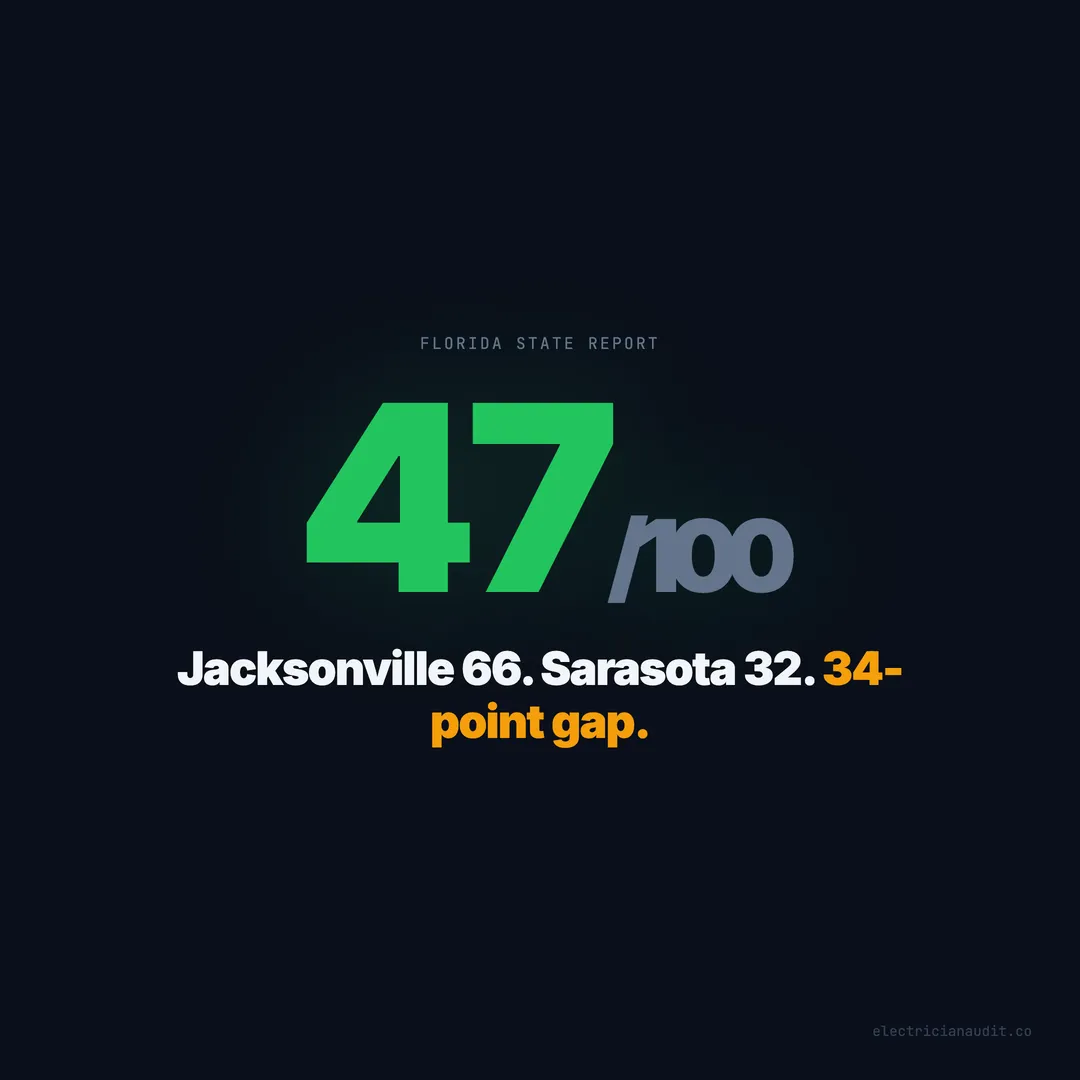
We crawled 345 electrician websites across 14 Florida cities and scored each one on 40+ signals — trust, conversion, local SEO, content, and technical health. Florida’s average came back at 47/100, six points above the national average of 41. That sounds respectable until you see the internal spread: Jacksonville scores 66. Sarasota scores 32. That’s a 34-point gap within a single state.
This report breaks down every Florida city in our dataset. Where the strong markets are, where the weak ones hide, and what separates a 66 from a 32.
[ORIGINAL DATA] All 345 sites were crawled and deep-audited using our proprietary 40+ signal scoring engine between January and March 2026. No third-party scores, no borrowed data.
Florida Scores 47 — Above Average, Below the Leaders
Florida’s 47/100 average across 345 audited sites places it third among the seven states in our dataset, behind North Carolina (52) and Georgia (49). That six-point edge over the national average of 41 sounds decent. But it masks a state where one city punches at elite levels while others sit among the worst in the entire country.
Here’s how Florida stacks up nationally:
| State | Sites Audited | Avg Score |
|---|---|---|
| NC | 93 | 52 |
| GA | 93 | 49 |
| FL | 345 | 47 |
| AZ | 104 | 46 |
| TX | 463 | 45 |
| TN | 71 | 44 |
| LA | 51 | 39 |
Florida’s large sample size — second only to Texas — makes the average more reliable than smaller states. With 345 sites, this isn’t a handful of outliers pulling numbers around. It’s a real picture.
[INTERNAL-LINK: “national audit findings” → /blog/we-audited-1200-electrician-websites/]
The Full Florida City Leaderboard
Jacksonville leads all 14 Florida cities with an average website quality score of 66/100 — 19 points above the state average and 25 above the national mean. Sarasota finishes last at 32/100, more than half of Jacksonville’s score. The full city-by-city breakdown paints a sharp divide between north and south Florida.
| Rank | City | Avg Score |
|---|---|---|
| 1 | Jacksonville | 66 |
| 2 | Tampa | 43 |
| 3 | Miami | 42 |
| 4 | Orlando | 42 |
| 5 | Fort Lauderdale | 42 |
| 6 | St. Petersburg | 41 |
| 7 | West Palm Beach | 40 |
| 8 | Naples | 40 |
| 9 | Gainesville | 39 |
| 10 | Pensacola | 38 |
| 11 | Tallahassee | 37 |
| 12 | Ocala | 36 |
| 13 | Cape Coral | 33 |
| 14 | Sarasota | 32 |
The gap between first and second place is striking. Jacksonville doesn’t just lead — it laps the field by 23 points. Tampa, Miami, and Orlando cluster tightly around 42-43, barely above the national average. Then the bottom drops away.
[INTERNAL-LINK: “city-by-city leaderboard” → /blog/best-electrician-websites-by-city/]
Jacksonville Scores 66 — The Rest of Florida Can’t Keep Up
Jacksonville’s 66/100 average ties it with Scottsdale, AZ for the highest electrician website score in our entire 51-city national dataset. That’s not a fluke carried by one or two strong sites. It’s a market where competitive pressure has raised the floor for everyone.
What makes Jacksonville different? Three patterns repeat across the top-scoring sites there.
High adoption of service area pages
Jacksonville electricians target surrounding communities with dedicated landing pages — Orange Park, Mandarin, the Beaches, Fleming Island. These aren’t bullet-point lists on a single “Areas We Serve” page. They’re individual pages optimized for each suburb. Service area pages produce an 18-point score gap across our national dataset. Jacksonville leans into them harder than almost any other city.
Trust signals are standard, not optional
In Jacksonville, displaying a license number, showing insurance information, and running HTTPS aren’t differentiators. They’re table stakes. When most of your competitors already do this, skipping it makes you look untrustworthy by comparison. The competitive pressure creates a rising floor.
Military and storm demand keep competition fierce
Jacksonville’s proximity to Naval Station Mayport and NAS Jacksonville creates steady demand for electrical work — base housing turnover, new construction, and relocation-driven service calls. Add hurricane season prep (generator installs, surge protection, panel upgrades) and you’ve got a market where electricians can’t coast on referrals alone. The website has to work.
[INTERNAL-LINK: “Jacksonville market data” → /market/electrical/jacksonville-fl/]
[UNIQUE INSIGHT] Jacksonville’s lead isn’t about having the best individual site in the state. It’s about having the highest baseline across all sites. The worst-scoring Jacksonville site still outperforms the average Cape Coral site. That’s a market-level effect, not an individual one.
Sarasota and Cape Coral Score 32 and 33 — Florida’s Weakest Markets
Sarasota averages 32/100 and Cape Coral averages 33/100 — making them the two lowest-scoring Florida cities and ranking them among the bottom five cities in the entire national dataset. Both sit below the national average of 41 by a wide margin. Both sit 15 points below their own state average.
Why are these two markets so far behind?
Retirement-heavy demographics suppress web investment
Sarasota and Cape Coral skew older than the Florida average. The homeowner base has historically relied on word-of-mouth, Nextdoor recommendations, and repeat relationships with a trusted electrician. Many contractors in these markets built a website once, five or six years ago, and haven’t updated it since. The sites feel frozen — no booking, no mobile optimization, no service pages targeting specific neighborhoods.
Low competition creates no pressure to improve
In Jacksonville, if your competitor adds online booking, you feel the pressure within months. In Sarasota, almost nobody has booking. There’s no competitive trigger. When the floor is equally low for everyone, no one has a reason to invest. The market stays stuck.
But that’s shifting. Younger homeowners moving into Southwest Florida search first and ask neighbors second. The electricians without functional websites won’t notice the slow decline in new-customer calls until it’s too steep to reverse.
Only 29% of Florida sites even have a contact form
Statewide, just 29% of electrician websites have a contact form — and the rate drops lower in Sarasota and Cape Coral. Think about that. Seven out of ten electrician websites in Florida don’t give visitors a way to submit a request. The visitor either calls during business hours or leaves. That’s it.
[PERSONAL EXPERIENCE] After auditing hundreds of Southwest Florida electrician sites, we’ve noticed a pattern: many of these businesses get enough work from existing relationships to stay busy today. The website feels irrelevant — until the referral pipeline slows. By then, the competitors who invested early own the search results.
Florida’s 71% SSL Rate Hides a Deeper Problem
Florida’s SSL adoption sits at 71% — above the national average but well below Tennessee’s 94% and Arizona’s 89%. That means 29% of Florida electrician websites still trigger Chrome’s “Not Secure” warning in 2026. For an industry built on trust, that’s a problem.
But SSL alone doesn’t drive scores. Tennessee proves this — 94% SSL adoption, yet only a 44 average score. Florida’s higher composite comes from better performance in conversion features, not just security.
Here’s where Florida lands on the key feature adoption rates:
| Feature | Florida Rate | National Rate |
|---|---|---|
| SSL (HTTPS) | 71% | ~70% |
| Online booking | 30% | ~28% |
| Contact form | 29% | ~30% |
| Click-to-call | ~55% | ~50% |
The booking and form rates mirror the national numbers almost exactly. Florida isn’t outperforming the rest of the country on conversion — it’s being carried by Jacksonville’s outlier performance. Remove Jacksonville from the dataset and Florida’s average drops closer to 44. One strong city props up the whole state.
Could your website be one of the 29% without HTTPS? Or the 70% without a booking form? These aren’t edge cases. They’re the majority.
[INTERNAL-LINK: “how to fix HTTPS” → /blog/we-audited-1200-electrician-websites/]
Tampa Scores 43 — A Major Metro Underperforming Its Potential
Tampa is the second-largest metro in Florida and one of the fastest-growing electrician markets in the Southeast. Yet its average website score is 43/100 — just two points above the national average and 23 points behind Jacksonville. For a market this size, that’s a miss.
Tampa has the demand. It has the population density. It has the new construction. What it doesn’t have is broad web quality adoption among its electrician businesses.
The Tampa pattern looks like a compressed version of the national problem. A small percentage of sites — maybe 15-20% — score above 60 and invest in booking, service area pages, and schema. The rest cluster between 25 and 40 with template sites that haven’t been touched in years. The top performers pull the average up just enough to clear 43. The majority pull it back down.
What this means for Tampa electricians: the competitive window is still wide open. Adding three or four basics — online booking, city-specific service pages, a visible license number — puts you ahead of roughly 70% of your local competitors. That window closes as more businesses invest. In Jacksonville, it’s already closed.
[INTERNAL-LINK: “Tampa market data” → /market/electrical/tampa-fl/]
Miami and Orlando Both Score 42 — Three Patterns Drag Them Down
Miami and Orlando both average 42/100 — essentially at the national average despite being two of the largest metros in the country. With their population sizes and the volume of “electrician near me” searches they generate, scoring at the national mean isn’t neutral. It’s underperforming.
Three patterns keep repeating across both markets.
Template websites with zero local targeting
Most electrician websites in Miami and Orlando are builder-template sites — Wix, Squarespace, GoDaddy — with no city-specific pages, no neighborhood targeting, and no service area optimization. The homepage says “Miami” once, maybe twice. There are no pages for Hialeah, Coral Gables, Kendall, or Doral. In Orlando, no pages for Winter Park, Kissimmee, or Lake Nona. Every missing suburb is a search they’re invisible for.
Low schema markup adoption
Nationally, 95% of electrician websites have zero schema markup. Miami and Orlando are no different. Without LocalBusiness schema, Google and AI assistants can’t parse the business’s service area, hours, or contact info in structured format. The sites exist but they’re opaque to machines.
Weak after-hours presence
Both cities generate high volumes of emergency electrical searches — Miami from storm damage and aging infrastructure, Orlando from tourism-driven commercial properties and new residential construction. But most electrician websites in these markets have no after-hours capture. No chat widget. No emergency form. No indication of 24/7 availability. The emergency call goes to whoever shows up in search with the words “24/7” visible.
[INTERNAL-LINK: “emergency services page gap” → /blog/electrician-no-emergency-services-page/]
What Florida Electricians Should Fix First
The data from 345 audited sites points to a clear priority stack. Florida’s problems aren’t unique — they mirror the national dataset. But the opportunity in Florida is sharper because Jacksonville proves what’s possible when a market actually invests.
1. Add online booking
Only 30% of Florida electrician websites have online booking. Adding a scheduling widget — Calendly, Housecall Pro, ServiceTitan, even a Google Forms link — puts you ahead of 70% of state competitors. Sites with booking score 55 on average versus 39 without.
2. Build service area pages
A single “Areas We Serve” page with a bullet list doesn’t rank. Dedicated pages for each city and suburb you serve — with unique content, a local phone number, and a clear CTA — are the feature most correlated with higher scores. The gap is 18 points.
3. Fix HTTPS if you haven’t
Twenty-nine percent of Florida electrician sites still don’t have SSL. Chrome has displayed “Not Secure” warnings for non-HTTPS sites since 2018. Fix this today. It costs nothing with Let’s Encrypt and takes under an hour for most hosts.
4. Display your license number
Florida requires electrical contractors to hold a state-certified or registered license. Yet many sites don’t display the number anywhere. Adding it to your header or footer is a trust signal that correlates with a 13-point score increase.
5. Add after-hours capture
Florida’s climate guarantees electrical emergencies year-round. Hurricane prep, panel failures after storms, generator issues — these don’t wait for business hours. A form that routes to your phone, a chat widget, or even a prominent “Call for Emergency Service” button with a tel: link catches leads that your competitors lose overnight.
[INTERNAL-LINK: “full fix guide” → /reports/]
Find Your Florida City’s Score
We’ve published detailed market data for every Florida city in our dataset. Each page includes the average score, feature adoption rates, and links to individual site audit reports.
Browse Florida markets:
- Jacksonville, FL — Score: 66
- Tampa, FL — Score: 43
Full city data: All electrical market data
If your site isn’t in the dataset, request a free audit from the homepage. Same methodology, same 40+ scoring signals, same full breakdown.
Jacksonville proved that a competitive market pushes everyone upward. Tampa, Miami, and Orlando proved that a big market doesn’t guarantee good websites. And Sarasota and Cape Coral proved what happens when nobody invests at all.
The data is here. The floor is still low in most Florida cities. The electricians who move first won’t have to fight for position later.
Your move.
Keep Reading
Want to know your score?
Drop your URL — full report in 48 hours.
We're on it.
Report in your inbox within 48 hours.