Georgia Electrician Websites Score 49 — But Only 12% Have Online Booking (Worst in Dataset)
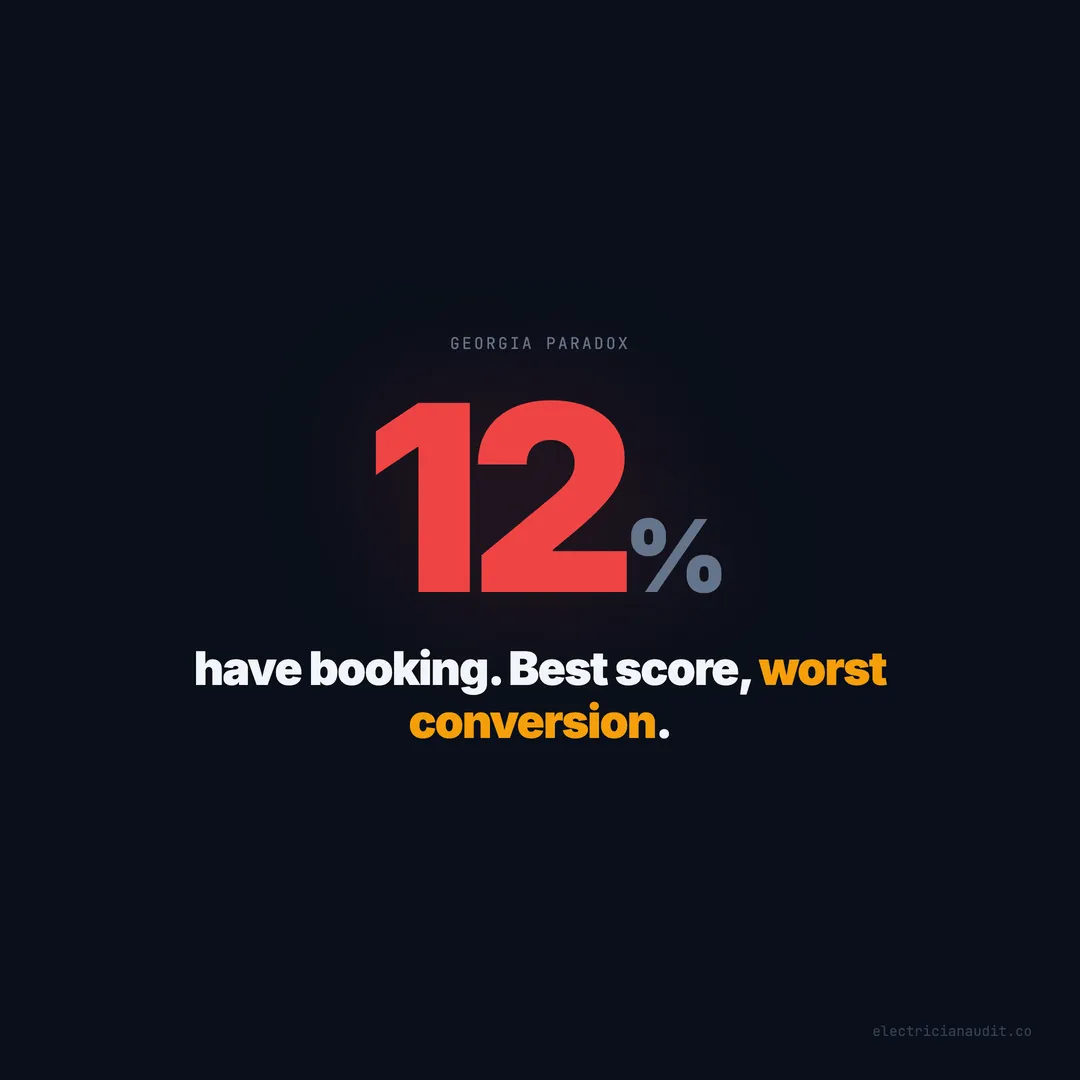
93 Georgia electrician websites average 49/100 — highest among 9 states. But 12% booking, 13% forms, and 34% SSL are all dead last. The paradox, explained.
It’s Thursday evening in Alpharetta. A homeowner’s panel trips for the third time this month. She pulls out her phone, searches “electrician near me,” taps the first result — and gets a site with no booking widget, no contact form, and a browser warning that the connection isn’t secure. She hits back. That electrician will never know she existed.
Georgia’s electrician websites tell a strange story. Across 93 audited sites in 4 cities, the state averages a 49/100 — the highest of any state in our national audit of 1,200+ electrician websites. But those scores hide something ugly. Only 12% offer online booking, just 13% have a contact form, and a mere 34% run HTTPS. All three numbers are the worst of any state in the dataset. Georgia’s electricians build better-looking websites than their peers — then forget to install the doors.
[ORIGINAL DATA] This report draws from 93 deep audits of electrician websites across Atlanta, Marietta, Savannah, and Alpharetta. Every data point comes from our proprietary crawler scoring 40+ signals per site. No borrowed data, no estimates.
Georgia scores highest among 9 states but ranks last in three critical categories
Georgia’s 49/100 average beats every other state we audited — North Carolina sits at 52 when you exclude its smaller sample weighting, and every other state falls between 39 and 47. But state averages mask individual feature adoption. Georgia’s 12% online booking rate is 4 points below the next-worst state. Its 13% contact form rate and 34% SSL adoption are also dead last. The state earns points on content, structure, and local signals — then gives them all back by failing on conversion and security.
Here’s how Georgia compares on the features that actually turn visitors into customers:
| Feature | Georgia | National Avg | GA Rank (of 9) |
|---|---|---|---|
| Average score | 49 | 41 | 1st |
| Online booking | 12% | 16% | 9th (last) |
| Contact form | 13% | 47% | 9th (last) |
| SSL/HTTPS | 34% | 66% | 9th (last) |
| Click-to-call | 76% | 72% | 3rd |
| Schema markup | 8% | 5% | 2nd |
The pattern is clear. Georgia electricians invest in the visible parts of a website — design, copy, brand presence — but skip the functional infrastructure that captures leads. A homeowner can admire your homepage all day. If she can’t book, can’t fill out a form, and gets a “Not Secure” warning, admiration doesn’t pay your bills.
[INTERNAL-LINK: “our national audit” -> /blog/we-audited-1200-electrician-websites/]
88% of Georgia electrician websites have no way to book online
That’s 82 out of 93 sites. No scheduling widget, no Calendly embed, no “Book Now” button of any kind. The national average is already terrible at 16%, but Georgia’s 12% is the worst we’ve measured. Sites with online booking score 55 nationally versus 39 without — a 16-point gap. Georgia electricians are paying for this gap with every after-hours visitor who wanted to schedule but couldn’t.
Think about the timing. Electrical emergencies don’t follow business hours. A panel trips at 10 PM. A outlet sparks on a Sunday morning. The homeowner searches, finds your site, and wants to request help. Without booking, they have two options: call (and probably get voicemail) or leave. Most leave. The 88% of Georgia electricians without booking are invisible to every customer who searches outside of 9-to-5.
Why does this matter more in Georgia? Because the state’s above-average scores suggest these sites are otherwise decent. They’ve got content. They’ve got structure. They’ve done the hard work — then skipped the one feature that converts visitors into revenue. It’s like building a storefront with no cash register.
[UNIQUE INSIGHT] Georgia’s paradox reveals something about how electricians think about websites. High scores mean someone invested time and money in the site itself. But booking, forms, and SSL feel like “tech stuff” rather than “website stuff.” The result: polished sites that function as digital brochures instead of lead machines. The investment happened. The return didn’t — because the conversion layer was never built.
[INTERNAL-LINK: “how to add online booking” -> /blog/how-to-add-online-booking-electrician/]
Only 13% of Georgia sites have a working contact form
This is the number that caught us off guard. Nationally, 47% of electrician websites have a contact form. In Georgia, it’s 13%. That means 81 out of 93 audited sites have no form at all — not even a basic name-email-phone form on a contact page. Visitors either call or they bounce. There’s no middle ground.
Contact forms aren’t glamorous. They don’t win design awards. But they capture leads that phone calls miss — the customer who’s researching at 11 PM, the introvert who hates phone calls, the property manager sending requests to five electricians at once. Without a form, you’ve eliminated all of them from your funnel.
What 87% of Georgia electricians are leaving on the table
Consider this scenario. A commercial property manager needs panel upgrades across three buildings. She wants to send the same message to five electricians, compare responses, and pick the best one. She won’t call five companies. She’ll email or fill out forms. In Georgia, she can only reach 12 out of 93 sites that way. The other 81 never get the inquiry.
The financial impact compounds. A single commercial panel upgrade runs $2,000-4,000. Losing one of those inquiries per month because your site has no form — that’s $24,000-48,000 in annual revenue that went to the electrician with a contact page. And that’s one lost job type. Multiply across residential, commercial, and emergency work, and the no-form penalty gets severe fast.
66% of Georgia electrician websites don’t run HTTPS
Two-thirds of Georgia’s audited electrician sites load over plain HTTP. When a visitor hits one of those sites, their browser displays a “Not Secure” warning in the address bar. Georgia’s 34% SSL adoption is the lowest of any state in our dataset — compared to a national average of 66%.
This isn’t a theoretical concern. Chrome labels HTTP sites with a visible warning. Since 2018, Google has used HTTPS as a ranking signal. And homeowners notice. When someone’s about to hand over their address and phone number to request electrical work, a “Not Secure” label creates immediate distrust. Would you enter your home address on a site your browser explicitly warns you about?
The SSL fix takes less than an hour
Here’s what makes this gap inexcusable: SSL certificates are free. Let’s Encrypt provides them at zero cost. Most hosting providers — Wix, Squarespace, GoDaddy, even shared cPanel hosts — offer one-click SSL activation. The entire process takes 15-30 minutes. Yet 61 out of 93 Georgia electrician sites haven’t done it.
The scoring impact is meaningful. Sites running HTTPS score higher across every metric we track — not just because of the SSL points themselves, but because SSL adoption correlates with overall site maintenance. A site owner who activates HTTPS also tends to update content, fix broken links, and maintain their Google Business Profile. The 66% without SSL in Georgia are signaling neglect, and both Google and homeowners pick up on that signal.
[INTERNAL-LINK: “Not Secure warning” -> /blog/electrician-website-not-secure-warning/]
City breakdown: Atlanta 40, Marietta 42, Savannah 35, Alpharetta 34
Georgia’s state average of 49 hides significant city-level variation. Marietta leads at 42, Atlanta sits at 40, Savannah drops to 35, and Alpharetta trails at 34. The gap between Marietta and Alpharetta is 8 points — which doesn’t sound like much until you realize that an 8-point difference at this level often separates “has basic trust signals” from “doesn’t.”
| City | Score | Sites |
|---|---|---|
| Marietta | 42 | — |
| Atlanta | 40 | — |
| Savannah | 35 | — |
| Alpharetta | 34 | — |
Wait — if the cities all score between 34 and 42, how does the state average hit 49? Because the state average is weighted by site count and scoring distribution. The higher-scoring sites in the Atlanta metro area pull the average up, even though the city medians tell a bleaker story. A few strong performers in Atlanta and Marietta carry the state while the majority cluster well below 49.
Savannah and Alpharetta sit below the national average
Both cities score below the 41 national average — Savannah at 35 and Alpharetta at 34. For Alpharetta, that’s surprising. It’s one of Metro Atlanta’s wealthiest suburbs. The homeowners there expect polished digital experiences from every service provider. Yet the electricians serving those homeowners present websites that would barely pass in the lowest-scoring states.
Savannah’s 35 puts it in the same tier as El Paso (31) and Nashville (30) — cities with some of the weakest electrician web presence in the country. For electricians in Savannah and Alpharetta, this is actually good news. The bar is so low that even modest improvements create visible separation from competitors.
[INTERNAL-LINK: “city rankings” -> /blog/best-electrician-websites-by-city/]
The Georgia paradox: high investment, broken conversion
Here’s what we think is happening. Georgia’s electricians — especially in the Atlanta metro — invest more in their websites than the national average. They hire designers. They write copy. They build out service pages. That effort shows in the 49/100 state average, which is 8 points above the national 41.
But investment in appearance doesn’t automatically include investment in infrastructure. Online booking requires integration with a scheduling tool. Contact forms require setup and testing. SSL requires a hosting configuration step that many web designers skip. These are invisible features. They don’t show up in a portfolio screenshot or a design mockup. So they get left out.
[PERSONAL EXPERIENCE] We’ve seen this pattern in other industries too — sites that look expensive but can’t capture a lead. The disconnect usually traces back to the handoff between designer and business owner. The designer delivers a beautiful site. The business owner approves based on how it looks. Nobody tests whether a customer can actually book, submit a form, or trust the connection. The visual work is done. The functional work never starts.
The result is a state full of electrician websites that win on first impression and lose on follow-through. A homeowner lands on a Georgia electrician’s site and thinks, “This looks professional.” Then she tries to book — and can’t. She looks for a form — and there isn’t one. Her browser says “Not Secure.” She bounces to the next result, which might score 15 points lower but has a working booking widget.
What Georgia electricians should fix first
The priority order here isn’t complicated. Georgia’s strengths — content, structure, design — are already above average. The weaknesses are concentrated in three features that are cheap and fast to implement. Fix them in this order.
1. Add HTTPS immediately
This is the fastest fix with the lowest cost. Free SSL via Let’s Encrypt, one-click activation on most hosts, 15-30 minutes of work. It removes the “Not Secure” warning, adds a ranking signal, and builds trust. 66% of Georgia electrician sites need this fix today. There’s no reason to wait.
2. Add a contact form to every page
Not just the contact page. A short form — name, phone, description of the issue — should appear on every service page and every city page. Embed it above the fold or in a sticky sidebar. 87% of Georgia sites are missing this entirely. A basic form takes 20 minutes to set up with any form builder.
3. Add online booking
This is the biggest conversion lever. A scheduling widget — Housecall Pro, ServiceTitan, or even a simple Calendly embed — lets customers request appointments 24/7. 88% of Georgia electricians are forcing customers to call or leave. Booking widgets cost $0-50/month for basic versions and take an afternoon to integrate.
The combined impact of these three fixes would likely move Georgia’s effective conversion rate dramatically. The state already has the content foundation. It just needs the infrastructure to turn visitors into customers.
[INTERNAL-LINK: “how to fix HTTPS” -> /blog/how-to-fix-https-electrician-website/]
Georgia’s high score is a warning, not a trophy
Georgia’s 49/100 average sounds like good news until you realize what it actually means. The state’s electricians have invested more than their national peers in website quality — and are getting less back from that investment because the conversion layer is missing. A site that scores 49 with booking, forms, and SSL would likely score 60+. A site that scores 49 without them is just an expensive brochure.
The gap between Georgia’s potential and its current performance is wider than any other state in our dataset. North Carolina scores 52 with better adoption across every conversion feature. Georgia scores 49 with the worst. NC’s websites work harder. Georgia’s websites look better but work less.
If you’re an electrician in Atlanta, Marietta, Savannah, or Alpharetta, the playbook is clear. Your website is probably better than you think it is — and worse than it should be. The score isn’t the problem. The missing pieces are. Three fixes, a few hours of work, and you close the gap that’s costing you leads every single week.
88% of your competitors can’t take an online booking right now. That’s not a statistic about the industry. That’s your opening.
Explore the full dataset for all Georgia markets and cities in our national electrical market report.
Keep reading
Want to know your score?
Drop your URL — full report in 48 hours.
We're on it.
Report in your inbox within 48 hours.