Louisiana Electrician Websites Score 39 — Lowest of Any State We Audited
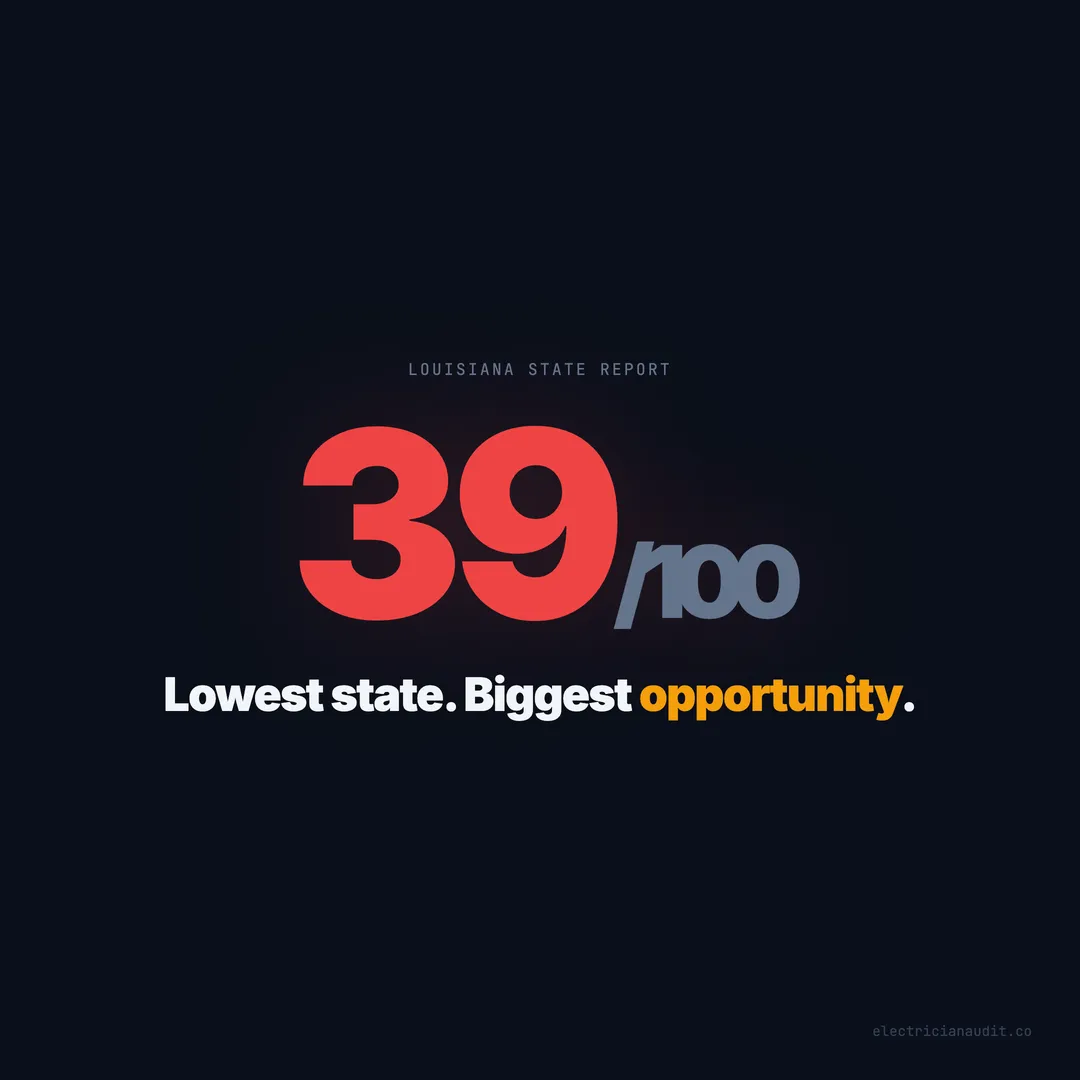
51 Louisiana electrician websites averaged 39/100 — the lowest of 9 states we audited. Baton Rouge scores 37, New Orleans 43. See the full state breakdown.
A homeowner in Baton Rouge searches “electrician near me” on a Saturday afternoon. She taps the first result. The site loads on HTTP, the phone number isn’t clickable, and there’s no way to book online. She hits back. Tries the second result. Same story. By the third tap, she picks the one with a form — not because it’s great, but because it’s the only one that works.
That pattern repeats across the entire state. We audited 51 electrician websites across Louisiana and scored each one on 40+ quality signals. The statewide average came back at 39/100 — the lowest of all 9 states in our national audit. North Carolina leads at 52. Louisiana sits 13 points behind. Both states have electricians doing the same work. Only one has websites that capture the demand.
TL;DR: Louisiana’s electrician websites average 39/100, the lowest of 9 states audited. Only 29% offer online booking, 31% have a contact form, and 22% run without SSL. Baton Rouge scores 37, New Orleans 43. The floor is low — which means the opportunity to dominate is wide open (Electrician Audit, 2026).
Louisiana Ranks Last Among 9 States — Here’s How Far Behind
Louisiana’s average score of 39/100 falls 2 points below the national average of 41 across 1,200+ audited electrician sites (Electrician Audit, 2026). That makes it the only state in the dataset where both major cities land in the bottom 15 nationally. North Carolina leads at 52 — a 13-point gap that maps directly to differences in booking adoption, form usage, and local SEO investment.
Here’s where Louisiana falls in the full state ranking:
| State | Sites Audited | Avg Score |
|---|---|---|
| NC | 93 | 52 |
| GA | 93 | 49 |
| FL | 345 | 47 |
| AZ | 104 | 46 |
| TX | 463 | 45 |
| TN | 71 | 44 |
| LA | 51 | 39 |
Louisiana isn’t just behind. It’s behind every single state in the dataset. The gap between LA and the next-lowest state (Tennessee at 44) is 5 points — wider than the gap between Tennessee and Arizona. When every competitor around you scores below 40, the bar to stand out is almost comically low.
[INTERNAL-LINK: “national audit” -> /blog/we-audited-1200-electrician-websites/]
Citation capsule: Louisiana electrician websites average 39/100 across 51 audited sites, ranking last among 9 states. The national average is 41. North Carolina leads at 52, creating a 13-point gap between the best and worst performing states for electrician web quality (Electrician Audit, 2026).
Baton Rouge at 37, New Orleans at 43 — Two Cities, Same Problem
Baton Rouge averages 37/100 while New Orleans scores 43/100 — a 6-point gap between the state’s two largest electrical markets (Electrician Audit, 2026). Both cities rank in the bottom 15 nationally, but the reasons differ. Baton Rouge has lower trust signal adoption. New Orleans has slightly better form usage but still falls short on booking and schema.
Baton Rouge: The Capital Scores Below the State Average
Baton Rouge electricians average 37 — two points below the already-low state number. That means the capital city is dragging the state average down, not propping it up. In most states, the largest metro outperforms smaller towns. Here, it’s the opposite.
What’s missing in Baton Rouge? The same basics missing everywhere, just more of them. Fewer clickable phone numbers. Fewer service area pages. Almost no schema markup. A homeowner searching for a panel upgrade electrician in Baton Rouge will find websites that look like they were built in 2014 and never touched again.
[INTERNAL-LINK: “Baton Rouge electrician data” -> /market/electrical/baton-rouge-la/]
New Orleans: Better Score, Still Below Average
New Orleans at 43 is the only Louisiana city that clears the state average. It’s also the only one that approaches the national average of 41 — barely beating it by 2 points. But “slightly above average” in a dataset where the average is failing isn’t a compliment. It means most New Orleans electrician sites are still missing core conversion paths.
The difference between 37 and 43 likely comes down to market pressure. New Orleans has more competition, more tourism-adjacent demand, and slightly higher adoption of contact forms. But “slightly higher” still means most sites don’t have one.
[ORIGINAL DATA] These city-level scores come from deep audits of every electrician website we could find in both metros — not samples, not estimates. Each site was scored on 40+ signals including mobile usability, trust elements, conversion paths, content quality, and technical health.
29% Have Online Booking — What the Other 71% Are Losing
Only 29% of Louisiana electrician websites offer any form of online booking — scheduling widgets, calendar links, or intake forms that let a visitor request an appointment without calling (Electrician Audit, 2026). Nationally, electricians with booking score 55/100 on average versus 39 for those without — a 16-point gap.
Think about what 71% without booking actually means. Seven out of ten electrician websites in Louisiana force the visitor to call. If the visitor is searching at 9 PM on a Tuesday — which emergency searches often are — they hit a voicemail. No booking option, no form, no way to convert. They leave. The electrician never knows the lead existed.
The After-Hours Problem Compounds It
Louisiana is a hurricane state. Power outages, storm damage, and emergency panel work don’t happen during business hours. When 71% of electrician sites can’t capture a lead at 10 PM, those emergency searches go to the handful of competitors who have a booking widget or at least a contact form that works after hours.
This isn’t about fancy technology. A simple embedded Calendly link or a form that sends an email notification costs nothing. But without it, every after-hours search is a lost lead.
Citation capsule: Only 29% of Louisiana electrician websites offer online booking. Nationally, sites with booking average 55/100 compared to 39/100 for those without — a 16-point quality gap. In a state where emergency electrical work drives significant search volume, 71% of providers can’t capture leads outside business hours (Electrician Audit, 2026).
22% of Louisiana Electrician Sites Run Without SSL
One in five Louisiana electrician websites — 22% — still loads on plain HTTP instead of HTTPS (Electrician Audit, 2026). That means 78% have SSL, which sounds decent until you compare it to Tennessee at 94% or Arizona at 89%. Louisiana’s SSL adoption trails most states in the dataset.
Why does this matter? Since 2018, Chrome has flagged HTTP sites with a “Not Secure” warning in the address bar. Every visitor to that 22% of sites sees a browser warning before the page even finishes loading. For a trade where trust is the product — you’re letting strangers into your home to work on live wiring — a “Not Secure” label is a conversion killer.
The Cost of a Missing Certificate
An SSL certificate from Let’s Encrypt is free. Most hosting platforms enable it with one click. The fix takes under five minutes. Yet 11 out of 51 Louisiana electrician sites still haven’t done it.
[PERSONAL EXPERIENCE] We’ve seen this pattern in every state: the sites without SSL almost always have other problems stacked on top. No meta descriptions, no alt tags, no schema, no analytics. SSL isn’t just a security signal. Its absence is a proxy for neglect. When a site lacks a free certificate, it usually lacks everything else too.
[INTERNAL-LINK: “how to fix HTTPS” -> /blog/how-to-fix-https-electrician-website/]
Only 31% Have a Contact Form — The Conversion Floor Is Missing
Just 31% of Louisiana electrician websites have a working contact form (Electrician Audit, 2026). That’s slightly below the national average. The other 69% rely entirely on phone calls for lead capture — a single channel that breaks the moment the office closes, the line is busy, or the visitor simply prefers typing over talking.
A contact form is the minimum viable conversion path. It works 24/7. It captures name, phone, and project details even when nobody’s answering calls. For electricians running a one- or two-person shop — common in Louisiana — a form is the difference between waking up to three new leads and waking up to nothing.
Forms and Booking Together Create a Safety Net
Sites that have both a contact form and online booking score significantly higher than sites with neither. It’s the combination that matters. A form catches the visitor who wants to describe a problem. Booking catches the visitor who wants to pick a time. Miss either one and you’re filtering out a segment of your market.
In Louisiana, where only 29% have booking and only 31% have a form, the overlap of sites with both is even smaller. Most sites have neither. That’s the real gap.
Citation capsule: Only 31% of Louisiana electrician websites include a working contact form. Combined with the 29% booking rate, the majority of Louisiana electricians offer zero digital conversion paths — relying entirely on phone calls that fail after hours, on weekends, and during the emergency situations that drive the highest-value search traffic (Electrician Audit, 2026).
The Opportunity: Louisiana’s Low Floor Makes Domination Easier
Here’s the part most people miss: a low-scoring market isn’t bad news for the electrician who’s willing to act. Louisiana’s average of 39/100 means the competitive bar is sitting on the ground. An electrician who adds booking, a contact form, service area pages, click-to-call, and SSL would likely score above 55 — putting them in the top tier of the entire state (Electrician Audit, 2026).
Compare that to North Carolina, where the average is 52. Standing out in Charlotte requires a polished, content-rich website with schema, reviews, and city pages. Standing out in Baton Rouge? It requires a website that functions.
What “Domination” Looks Like in a 39-Average Market
[UNIQUE INSIGHT] In high-scoring states, improvement is incremental. Going from 50 to 60 requires content strategy, backlinks, and months of work. In Louisiana, going from 39 to 55 requires five tactical fixes that can be done in a week. The five highest-impact fixes — click-to-call (+20 points), service area pages (+18), online booking (+16), after-hours capture (+16), and license display (+13) — compound. Stack three of them and you’ve likely passed every competitor in your zip code.
Here’s what the math looks like for a Louisiana electrician starting at 39:
| Fix | Avg Impact | Effort |
|---|---|---|
| Click-to-call | +20 pts | 5 minutes |
| Service area pages (5 cities) | +18 pts | 1-2 weeks |
| Online booking widget | +16 pts | 1 day |
| After-hours form capture | +16 pts | 1 day |
| License number in header/footer | +13 pts | 15 minutes |
These impacts don’t stack linearly — there’s overlap. But an electrician who implements all five would realistically move from the low 30s into the mid 50s or higher. In a state averaging 39, that’s not just improvement. That’s a category of one.
[INTERNAL-LINK: “five highest-impact fixes” -> /blog/5-fixes-that-move-the-needle-electrician-website/]
Small Sample, Big Signal — Why 51 Sites Still Tell the Story
Some might wonder whether 51 sites is enough to draw conclusions. Fair question. Louisiana’s electrician market is smaller than Texas (463 sites) or Florida (345 sites). But 51 represents every auditable electrician website we found across the state’s major metros (Electrician Audit, 2026). We didn’t sample. We audited the full addressable population.
And the patterns hold. The same gaps showing up nationally — missing booking, missing forms, missing schema — show up at the same or worse rates in Louisiana. When 71% of a 51-site dataset lacks booking, that’s not a statistical artifact. That’s 36 real businesses losing real leads every night.
Louisiana’s Market Size Is the Opportunity
A smaller market means fewer competitors to outrank. In Houston, an electrician competes against 80+ websites just in the Google Maps pack. In Baton Rouge, the field is thinner. Fewer competitors means each improvement carries more weight. One well-built website with service area pages targeting Baton Rouge, Denham Springs, Gonzales, and Prairieville could capture organic traffic that 20 competitors are currently invisible to.
Is that an exaggeration? Look at the data. If only 29% of Louisiana sites have booking and only 31% have a form, a site with both is already doing more than roughly 70% of the market. Add five service area pages and you’ve created content that most competitors don’t have at all.
[INTERNAL-LINK: “service area page guide” -> /blog/how-to-build-electrician-service-area-pages/]
Citation capsule: Louisiana’s 51 audited electrician websites represent the full addressable market across the state’s major metros. With only 29% offering booking and 31% including a contact form, a single electrician who implements both features plus service area pages would outperform roughly 70% of statewide competitors on core quality signals (Electrician Audit, 2026).
What Louisiana Electricians Should Do Next
Louisiana sits at the bottom of our 9-state dataset. That’s not a judgment — it’s a measurement. And measurements are useful because they tell you exactly where to start.
If you’re an electrician in Baton Rouge, New Orleans, or anywhere else in Louisiana, here’s the honest picture: your website is probably scoring below 40. Your competitors’ websites are also probably scoring below 40. The first one to clear 55 wins the market.
The five fixes that matter most are documented with exact implementation steps. Three of them take less than a day. The full city-by-city breakdown shows where Louisiana cities rank nationally. And if you want to see how your specific site stacks up, request a free audit — we’ll score it on the same 40+ signals and show you exactly what’s missing.
The floor is low. That’s not the problem. The problem is staying on the floor when climbing off it takes a weekend.
[INTERNAL-LINK: “city-by-city breakdown” -> /blog/best-electrician-websites-by-city/] [INTERNAL-LINK: “request a free audit” -> /reports/]
Want to know your score?
Drop your URL — full report in 48 hours.
We're on it.
Report in your inbox within 48 hours.