North Carolina Electrician Websites: Highest Average Score at 52 — State Report
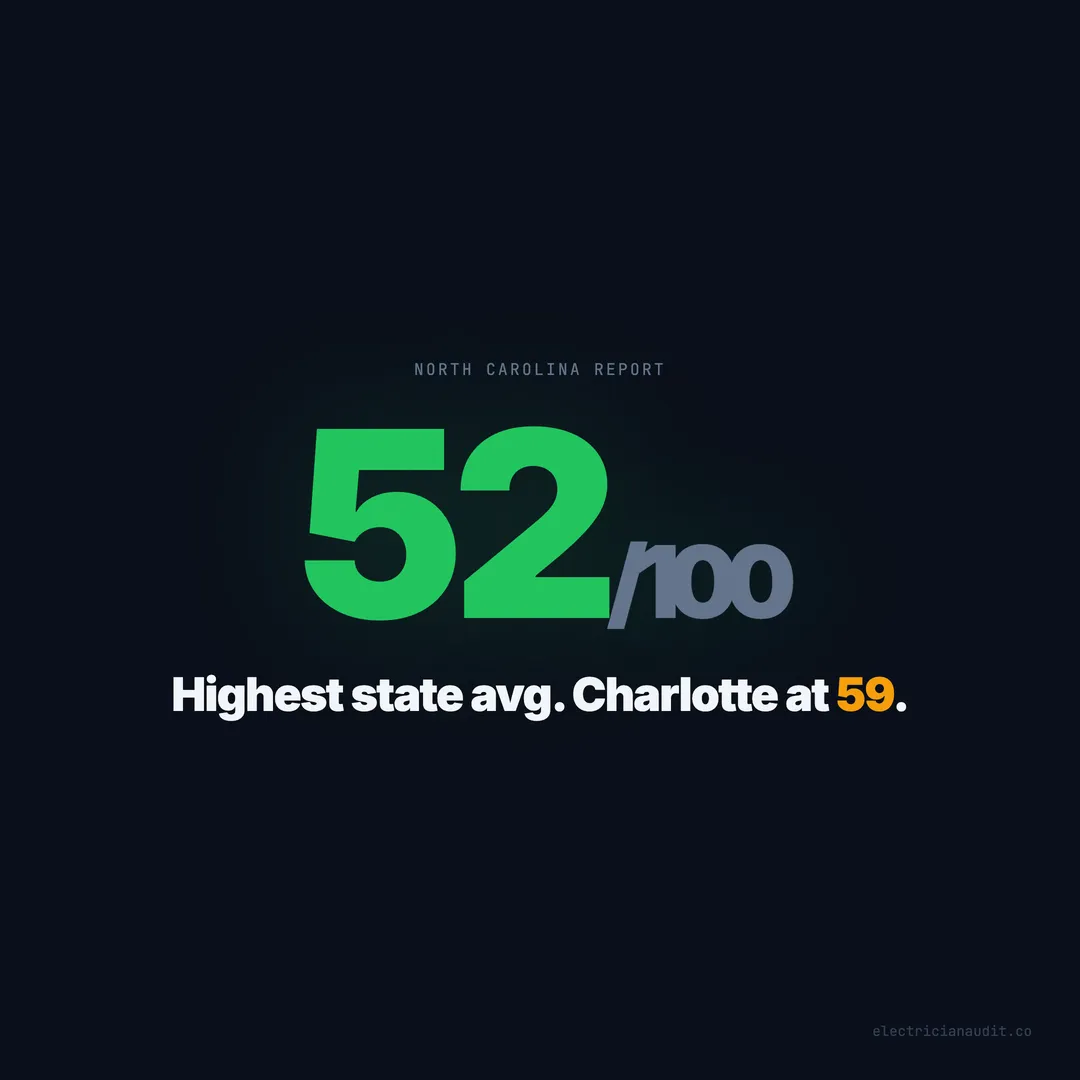
We audited 93 electrician websites across 5 NC cities. State average: 52/100 — the highest of all 9 states. Charlotte leads at 59. Wilmington trails at 37.
A homeowner in Raleigh searches “electrician near me” on a Thursday afternoon. Her panel is buzzing. She taps three results, scans each for about six seconds, and picks the one with a license number and a booking button. The other two — both scoring below 40 in our audit — never get the call. They’ll blame slow season instead.
We audited 93 electrician websites across 5 North Carolina cities and scored each one on 40+ signals covering trust, conversion, content, and technical health. The state average came back at 52 out of 100 — the highest of any state in our national 1,200-site dataset. That’s 11 points above the national average of 41. But before anyone celebrates, the numbers inside NC tell a messier story. Charlotte pulls a 59. Wilmington drags at 37. The spread within a single state is 22 points wide.
North Carolina isn’t uniformly strong. It has one dominant city, a couple of average ones, and two metros where electricians are losing leads to basic website failures every single day.
[ORIGINAL DATA] This report covers 93 deep audits across Charlotte, Raleigh, Durham, Greensboro, and Wilmington — all from our proprietary crawler scoring 40+ performance, trust, and conversion signals per site.
TL;DR: North Carolina’s 93 audited electrician websites average 52/100 — the highest state score in our 9-state dataset, per Electrician Audit (2026). Charlotte leads at 59. But 68% of NC sites still lack online booking, and Wilmington trails at 37. The gap inside the state is wider than the gap between NC and the national average.
[INTERNAL-LINK: “national audit” -> /blog/we-audited-1200-electrician-websites/]
North Carolina Leads All 9 States — But Not by Much
NC’s 52/100 average tops the 9-state leaderboard, 3 points above second-place Georgia (49) and 13 points above last-place Louisiana (39), based on our Electrician Audit dataset of 1,200+ sites. That lead is real but fragile. Remove Charlotte’s 59-point average from the calculation, and NC’s remaining four cities average roughly 39 — below the national floor.
Here’s how the full state leaderboard looks:
| State | Avg Score | Booking | Form | SSL |
|---|---|---|---|---|
| NC | 52 | 32% | 32% | 67% |
| GA | 49 | 12% | 13% | 34% |
| FL | 47 | 30% | 29% | 71% |
| AZ | 46 | 36% | 36% | 89% |
| TX | 45 | 32% | 32% | 78% |
| TN | 44 | 27% | 32% | 94% |
| LA | 39 | 29% | 31% | 78% |
NC doesn’t dominate the feature columns. Arizona has higher booking adoption at 36%. Tennessee has far better SSL at 94%. Florida has stronger form rates. NC’s lead comes from a more balanced profile — decent adoption across multiple categories instead of one standout metric propping up an otherwise weak base.
That balance matters. A site with HTTPS but no form still can’t capture a lead. A site with booking but no SSL still triggers a browser warning. NC electricians, on average, stack more of these features together than any other state. But “on average” hides a lot.
Citation capsule: North Carolina’s 93 audited electrician websites average 52/100, the highest state score in Electrician Audit’s 9-state, 1,200+ site dataset (2026). The state leads second-place Georgia by 3 points and exceeds the 41-point national average by 11.
Charlotte Scores 59 and Ranks 4th Nationally
Charlotte doesn’t just lead North Carolina — it ranks 4th out of 51 cities nationwide, trailing only Scottsdale (66), Jacksonville (66), and Katy (61) in our full city leaderboard. At 59, Charlotte scores 18 points above the national average of 41 and 7 points above its own state average.
What’s Charlotte doing differently? Three patterns stood out.
Higher feature stacking
Charlotte electricians don’t excel at one thing. They tend to have SSL plus a form plus a phone number that’s clickable — the basic trust-and-conversion stack. When we measured the impact of service area pages nationally, the 18-point score gap was driven largely by cities like Charlotte where multiple features appear together. A booking widget alone adds 16 points. Pair it with service area pages and the compound effect pushes sites into the high 50s and 60s.
Competitive metro pressure
Charlotte’s electrical market is dense. More competition means the baseline keeps rising. When three of your competitors show license numbers and booking buttons, you either match them or look less credible by comparison. We’ve seen this pattern in every top-10 city — competitive pressure creates a “feature floor” that lifts the entire market.
Proximity to strong markets
Charlotte sits near other strong-performing metros in the Southeast. Electricians here see what’s working in neighboring cities and adapt faster. That cross-pollination shows up in adoption rates that cluster above the state average across nearly every metric.
[INTERNAL-LINK: “Charlotte market data” -> /market/electrical/charlotte-nc/]
Citation capsule: Charlotte, NC averages a 59/100 electrician website quality score, ranking 4th of 51 cities nationally and 18 points above the national average of 41, per Electrician Audit’s 2026 dataset of 1,200+ audited sites.
The 22-Point Gap Inside NC: Charlotte vs Wilmington
Charlotte scores 59. Wilmington scores 37. That 22-point gap within a single state is wider than the 13-point gap between the best state (NC at 52) and the worst (Louisiana at 39). The distance between NC cities is more dramatic than the distance between entire states.
Here’s the full NC city breakdown:
| City | Score | vs National Avg (41) |
|---|---|---|
| Charlotte | 59 | +18 |
| Raleigh | 41 | 0 |
| Durham | 40 | -1 |
| Greensboro | 39 | -2 |
| Wilmington | 37 | -4 |
Only Charlotte clears the national average. Raleigh lands exactly on it. Durham, Greensboro, and Wilmington all fall below. That means 4 out of 5 NC cities perform at or below the national average — and the state only leads because Charlotte’s strong numbers pull the curve upward.
If you’re an electrician in Wilmington or Greensboro, the “best state” label means nothing for you. Your local competition is weaker than Nashville (30) by only a few points. The opportunity cost of a 37-scoring site in a market where homeowners have plenty of alternatives is real: missed calls, missed bookings, missed emergency jobs.
[UNIQUE INSIGHT] NC’s “best state” ranking is essentially a Charlotte story. Strip Charlotte out and the remaining four cities average 39/100 — below the national average and tied with Louisiana for last place. State-level rankings mask city-level reality.
Citation capsule: Within North Carolina, Charlotte (59) outscores Wilmington (37) by 22 points — a wider gap than exists between the best and worst entire states in Electrician Audit’s 2026 dataset. Four of NC’s five audited cities score at or below the 41-point national average.
68% of NC Electricians Have No Online Booking
NC’s booking rate sits at 32%, which means 68% of electrician websites in the state offer no way to schedule online. That 32% matches the national average for Texas but falls behind Arizona’s 36%, per our Electrician Audit dataset. For the top-scoring state, this is a weak spot hiding in plain sight.
Here’s what that costs in practice.
A homeowner’s breaker trips at 9 PM. She searches, finds your site, sees no way to book. She doesn’t call — it’s 9 PM and she assumes you’re closed. She goes to the next result, finds a booking form, fills it out in 90 seconds, and schedules a morning appointment. You lost that job not because your work is worse, but because your website goes dark after 6 PM.
The 32% booking rate also means NC has a 32% contact form rate. Those two numbers matching isn’t a coincidence. Sites with booking tend to also have forms, and sites without tend to have neither. It’s the full conversion infrastructure that’s missing, not just one widget.
Why this gap matters more in NC
In lower-scoring states, everyone’s missing booking. There’s no penalty for not having it because nobody else does either. But in NC — where Charlotte competitors are stacking booking plus forms plus click-to-call — an electrician in Raleigh or Durham without booking is competing against a higher standard. The feature floor is rising, and 68% of the state hasn’t caught up.
[PERSONAL EXPERIENCE] In our audits, we consistently see that adding an embedded booking tool (Calendly, Housecall Pro, or a simple form with date selection) correlates with a 16-point score improvement nationally. For NC electricians sitting at 40-41, that single addition could push them above the state average.
Citation capsule: 68% of North Carolina electrician websites lack online booking, matching a 32% adoption rate that trails Arizona’s 36%, according to Electrician Audit’s 2026 dataset of 93 NC sites. Sites with booking score 55 nationally versus 39 without — a 16-point gap.
NC’s 67% SSL Rate Falls Behind 5 Other States
North Carolina’s 67% SSL adoption rate means a third of electrician websites in the state still trigger Chrome’s “Not Secure” warning. That’s better than Georgia (34%) but worse than Tennessee (94%), Arizona (89%), Texas (78%), Florida (71%), and Louisiana (78%), per our Electrician Audit dataset.
For the top-scoring state, ranking 6th out of 7 on SSL is an odd look.
How does NC score highest overall while trailing on SSL? The same way it leads on score: Charlotte. Charlotte’s SSL adoption runs well above the state average, and the city’s strong performance across other categories masks the SSL weakness in Raleigh, Durham, Greensboro, and Wilmington.
The trust cost of no SSL
Every visitor to a non-HTTPS electrician site sees “Not Secure” next to the URL. In 2026, that warning is eight years old — Chrome started flagging it in 2018. Homeowners don’t understand SSL certificates. But they absolutely understand the words “Not Secure” next to a website where they’re about to enter their home address and phone number.
The remaining 33% of NC electricians without SSL aren’t just losing a minor SEO signal. They’re broadcasting untrustworthiness to every single visitor before the page even loads. For emergency electrical work — where trust is the entire buying decision — that first impression is fatal.
Would you hand your house keys to someone whose storefront has a “Not Secure” sign on the door? That’s what 33% of NC electricians are asking homeowners to do.
[INTERNAL-LINK: “how to fix SSL” -> /blog/how-to-fix-https-electrician-website/]
Citation capsule: North Carolina’s 67% SSL adoption rate ranks 6th of 7 states in Electrician Audit’s 2026 dataset, trailing Tennessee (94%), Arizona (89%), Texas (78%), Louisiana (78%), and Florida (71%). One-third of NC electrician websites still trigger Chrome’s “Not Secure” warning.
What NC Electricians Should Fix First
The data points to a clear priority stack for North Carolina electricians who want to climb from a 40-range score into the mid-50s and beyond. Based on our national feature-gap analysis, these are the highest-impact fixes ranked by the score improvement they correlate with.
Add service area pages
The 18-point score gap between sites with and without service area pages is the largest single-feature gap in our dataset. For Raleigh electricians who also serve Cary, Apex, Wake Forest, and Holly Springs, each missing city page is a search result you’ve forfeited. Build them. One page per city. Include your license number, a local phone number, and at least 300 words of unique content.
Install online booking
Sites with booking score 55 versus 39 without — a 16-point gap. This is especially high-impact in NC’s smaller cities where adoption is low. If you’re in Greensboro or Wilmington and you add booking, you’ve differentiated yourself from the majority of local competitors who still force visitors to call during business hours.
Fix SSL immediately
If you’re in the 33% without HTTPS, this is the cheapest and most urgent fix. Most hosting providers offer free SSL certificates through Let’s Encrypt. The fix takes less than an hour and removes the “Not Secure” label that’s silently killing your conversion rate.
Display your license number
NC requires electrical contractors to be licensed through the State Board of Examiners. Displaying that number on your site — footer, about page, homepage hero — adds a trust signal that correlates with a 13-point score improvement nationally. Yet over half of electricians nationally skip this. In a licensed trade, that’s an easy win.
Add a contact form
With only 32% of NC sites having a form, adding one puts you ahead of two-thirds of the state. Pair it with after-hours messaging (“We’ll respond within 1 business hour”) and you’ve built a lead capture system that works at 11 PM on a Sunday when the breaker box is sparking.
[INTERNAL-LINK: “full fix guide” -> /reports/]
[ORIGINAL DATA] The priority stack above is ranked by national score-gap data from 1,200+ audits. Service area pages (+18), booking (+16), click-to-call (+20), after-hours capture (+16), and license display (+13) are the five highest-impact features in the dataset.
Citation capsule: Adding service area pages correlates with an 18-point score increase, online booking with 16 points, and license display with 13 points across 1,200+ electrician website audits, per Electrician Audit (2026). NC’s low adoption rates on these features mean each fix carries outsized competitive impact.
North Carolina’s Lead Won’t Last Without the Fundamentals
NC sits at 52/100 — the top of 9 states but still a failing grade by any reasonable standard. That lead is built almost entirely on Charlotte’s 59-point performance. The other four cities average 39, which would place them at the bottom of the state leaderboard, not the top.
The numbers are clear. 68% of NC electricians have no booking. 33% have no SSL. 68% have no contact form. These aren’t edge cases — they’re the majority. And every missing feature is a homeowner who searched, visited, and left. That homeowner didn’t bookmark the page. She called the competitor whose site let her book at 10 PM.
NC’s electricians have an advantage they don’t realize: the state’s top ranking means Google already associates NC electrical sites with slightly better quality signals. That’s a foundation to build on, not rest on. The electricians in Raleigh, Durham, Greensboro, and Wilmington who fix the basics in the next six months will pull ahead of competitors who are still running 2015-era websites in 2026.
Charlotte showed what’s possible. The question is whether the rest of the state catches up — or lets the lead erode while states like Georgia and Arizona close the gap.
[INTERNAL-LINK: “see all city rankings” -> /blog/best-electrician-websites-by-city/]
Keep reading
Want to know your score?
Drop your URL — full report in 48 hours.
We're on it.
Report in your inbox within 48 hours.